
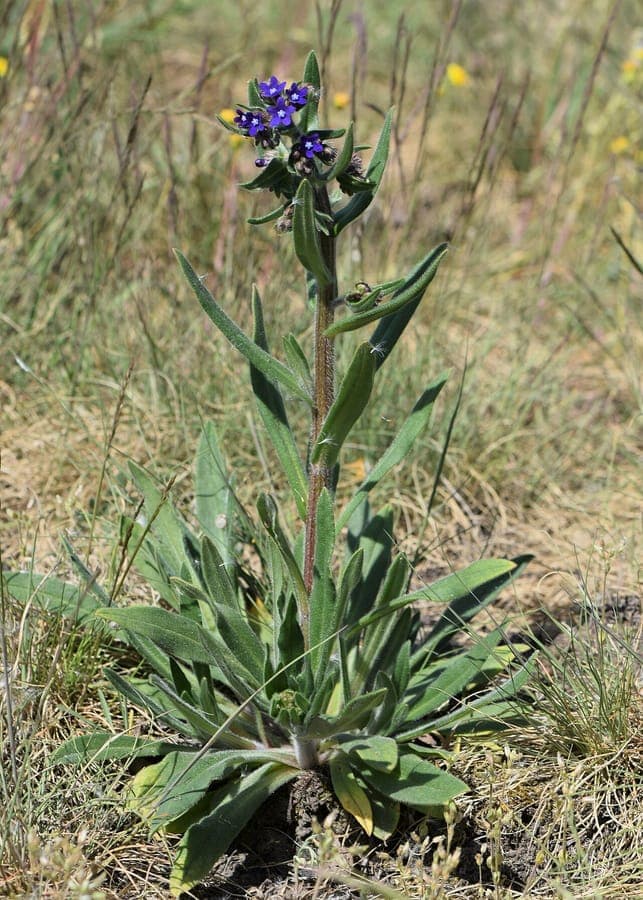
Krzysztof Ziarnek, Kenraiz / CC BY-SA 4.0, via Wikimedia Commons
Alkanet: complete guide
Anchusa officinalis
Want to see Alkanet: complete guide in your garden?
1 minute, no credit card
Overview
Alkanet (Anchusa officinalis) is a bold, biennial to short-lived perennial that brings deep blue spikes to the garden from early summer onwards. Don't let the coarse foliage fool you - this plant earns its place in any well-designed border. Native to regions across Central and Eastern Europe, including the Baltic States, Belarus, and Austria, it's adapted to tough conditions and thrives where other plants might struggle.
Reaching 60–100 cm in height, Alkanet blooms from June to August, producing clusters of trumpet-shaped flowers that are pure magnet for bees and bumblebees. While often dismissed as a weed, it's actually a valuable addition to wildlife gardens. On gardenworld.app, you can design a layout that highlights its vertical form and rich color, pairing it with softer textures for contrast.
Appearance & bloom cycle
The plant forms a rosette of rough, tongue-shaped leaves in its first year - hence the common name 'Alkanet' or 'Ox-tongue'. These leaves are dark green, up to 20 cm long, and covered in stiff hairs that make them unpleasant to touch. In the second year, tall, upright stems rise, crowned with vivid blue to violet-blue flowers.
Each bloom is about 1.5 cm long, funnel-shaped, and arranged in coiled clusters that unfurl as they mature. The flowering period lasts 6–8 weeks. Deadheading encourages a lighter rebloom in autumn. If you're planning a pollinator garden, use gardenworld.app to map out blooming times and ensure there's continuous forage from June through September.
Ideal location
Full sun is non-negotiable. Alkanet needs at least 6 hours of direct sunlight daily. It tolerates partial shade, but flowering diminishes and stems become leggy. It's ideal for dry slopes, gravel gardens, or low-maintenance borders.
Avoid damp, shady corners. This plant thrives on neglect - perfect for urban courtyards, walls, or between paving stones. Be aware: it self-seeds freely. If you want to keep it contained, remove spent flower heads before they set seed.
Soil requirements
Well-drained, sandy, or loamy soil is best. The pH should be neutral to slightly alkaline (6.0–7.5). Heavy clay soils are a no-go - they retain too much moisture and cause root rot. Avoid rich, heavily amended soils; Alkanet prefers lean conditions. Too much fertility leads to lush foliage but fewer flowers.
If your soil is poor, a light mix of compost can help young plants establish. But don't overdo it. This plant is adapted to low-nutrient environments and will perform better with less.
Free design
Want to see Alkanet: complete guide in your garden? Make a free design now.
Watering
Once established, Alkanet is drought-tolerant. Water young plants regularly during their first growing season, especially in dry spells. After that, it relies on natural rainfall.
Water at the base, not overhead - the hairy leaves trap moisture, increasing the risk of fungal diseases. Use drip irrigation or a watering can with a long spout. Avoid wetting the foliage, particularly in humid climates.
Pruning
Pruning isn't essential, but cutting back spent flower stems encourages a second, lighter flush of blooms. After flowering, trim stems to 15–20 cm above ground level. This also prevents unwanted self-seeding.
Remove any damaged or yellowing leaves, especially in spring. If growing as a biennial, leave the basal rosette intact in year one. Don't fertilize - it leads to weak growth and flopping stems.
Maintenance calendar
- January: No action needed. Check for heaved plants after frost.
- February: Dormant. No care required.
- March: Sow seeds outdoors, 5 mm deep, 30 cm apart. Or start indoors.
- April: Seedlings emerge. Thin to 30 cm spacing. Watch for slugs.
- May: Water if dry. Check for aphids on new growth.
- June: Flowers begin. No feeding. Monitor pollinator activity.
- July: Peak bloom. Stake if stems bend under rain.
- August: Flowers fade. Cut back flower spikes to prevent seeding.
- September: Possible late blooms. Stop watering.
- October: Leave seed heads for birds or collect for next year.
- November: Tidy up if desired. Leave some stems for overwintering insects.
- December: Dormant.
Winter hardiness
Alkanet is hardy in USDA zones 4–8. In zone 7 (most of the UK and US mid-Atlantic), it survives winter with no protection. The rosette often stays green through mild winters. Leave old foliage in place - it insulates the crown.
In harsh winters with repeated freeze-thaw cycles, a light mulch of dry leaves helps. Avoid thick coverings - they can trap moisture and rot the plant.
Companion plants
Pair Alkanet with other drought-tolerant perennials: Echinacea, Salvia, Stipa tenuissima, or Verbascum. For contrast, plant near silver-foliaged Artemisia or Lamb's ear. It also works well in cottage garden schemes with yarrow, poppies, or catmint.
Avoid moisture-loving plants like hostas or astilbes. On gardenworld.app, you can test combinations virtually, adjusting plant spacing and color schemes to create a cohesive design.
Closing
Alkanet isn't flashy, but it's dependable. It asks for little and gives back in color, structure, and wildlife value. It's not for pristine, formal gardens - but for those who appreciate rugged beauty, it's a gem.
You'll find Anchusa officinalis at garden centres like B&Q, Wilko, or local independents. Check the label - it's sometimes mislabeled as Anchusa azurea. If you're unsure about placement, use the garden planner on gardenworld.app to preview how it fits with your existing plants.
Want to see Alkanet: complete guide in your garden? Make a free design now.
Upload a photo, pick a style, and get a photorealistic design with plant list in under a minute.
No credit card required


Similar plants
Western waterleaf: complete guide
Hydrophyllum occidentale
Full growing guide for western waterleaf (Hydrophyllum occidentale): shade tolerance, soil needs, watering, winter hardiness and naturalistic garden use.
Limestone phacelia (Phacelia affinis): complete guide
Phacelia affinis
Full guide to Phacelia affinis, the limestone phacelia: sowing tips, purple-blue bee flowers, drought tolerance and uses in dry or wildlife gardens.
Pyrenean viper's bugloss: complete guide
Echium asperrimum
Echium asperrimum is a striking biennial from the western Mediterranean with rough bristly stems and vivid blue flowers. A magnet for bees and a bold border plant.