
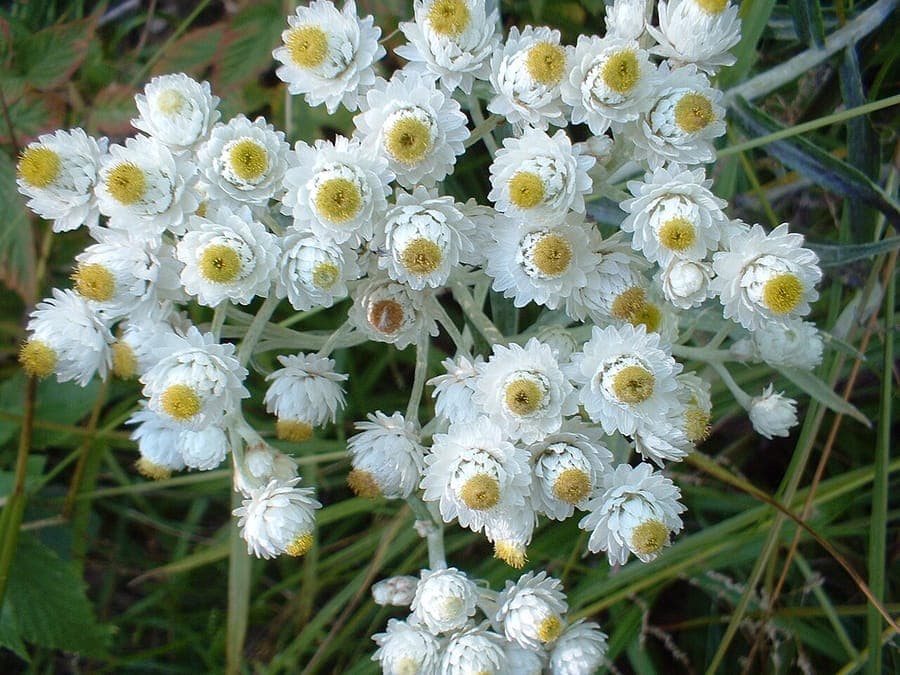
Pendragon39 / Public domain, via Wikimedia Commons
Pearly everlasting: complete guide
Anaphalis margaritacea
Want to see Pearly everlasting: complete guide in your garden?
1 minute, no credit card
Overview
Pearly everlasting (Anaphalis margaritacea) is a graceful, upright perennial that brings a soft, airy presence to sunny borders and naturalistic plantings. Native to regions across North America and parts of Asia - from Alaska and Alberta down through Arizona and into China - this hardy plant thrives in open, dry habitats. It belongs to the Asteraceae family and earns its 'everlasting' name from its papery, long-lasting flower heads that retain their shape and color even when dried. In the garden, it adds a silvery-white glow that pairs beautifully with warm-toned perennials.
On gardenworld.app, you can design a drought-tolerant border that highlights Pearly everlasting's resilience and visual softness.
Appearance & bloom cycle
This plant typically reaches 60–90 cm in height with a spread of about 45 cm. Stems are erect, often branching in the upper half, and covered in narrow, lance-shaped leaves. The foliage is light green above, but the undersides are densely covered in fine, woolly hairs, giving them a silvery-gray appearance. This texture adds depth and contrast in planting schemes.
Flowering occurs from July through September. The small, button-like flower heads consist of tiny yellow disc florets surrounded by overlapping white bracts. These bracts are dry and papery, resembling tiny pearls - hence the name. They attract butterflies, particularly painted ladies and skippers, but produce little scent. Once dried, the flowers are ideal for winter arrangements and craft projects.
Ideal location
Pearly everlasting needs full sun - aim for at least 8 hours of direct light daily (light factor 8/10). In shaded areas, it becomes leggy and prone to flopping. A front- or mid-border position in a well-drained, sunny spot works best. It's excellent for gravel gardens, rockeries, or dry slopes.
It tolerates coastal conditions well, including light salt spray, making it suitable for seaside gardens. Ensure good air circulation to prevent powdery mildew. On gardenworld.app, explore design ideas that pair it with Echinacea and ornamental grasses for a prairie-style look.
Soil requirements
This plant prefers lean, well-drained soils. The ideal pH range is 6.0 to 7.5 - slightly acidic to neutral. Heavy clay soils should be amended with coarse sand or grit to improve drainage. Avoid rich soils or excessive organic matter; too much fertility leads to floppy growth and fewer flowers.
It thrives in poor to moderately fertile ground, making it perfect for low-maintenance or xeriscaped gardens. Never plant in consistently wet or poorly drained areas - root rot is the main cause of failure.
Free design
Want to see Pearly everlasting: complete guide in your garden? Make a free design now.
Watering
Once established, Pearly everlasting is highly drought-tolerant. During the first growing season, water weekly during dry spells to help roots establish. Use deep, infrequent watering to encourage downward root growth.
After the first year, supplemental irrigation is rarely needed, even in hot, dry summers. Overwatering is more dangerous than underwatering. Avoid overhead watering to keep foliage dry and reduce disease risk.
Pruning
Pruning isn't essential, but it improves shape and flowering. In late spring (around May), pinch back the tips of new growth by about 15 cm. This promotes bushier growth and reduces the need for staking.
After flowering, cut stems back to 10–15 cm above ground in late fall or early winter. Leaving some stems intact provides winter interest and food for finches and other seed-eating birds.
Maintenance calendar
- January: No action needed. Check for pest overwintering in old stems.
- February: Remove any remaining old growth if it looks untidy.
- March: Prepare soil with added grit if drainage is poor.
- April: Divide mature clumps or plant new ones. Clear debris.
- May: Pinch back stems to encourage branching.
- June: Monitor for aphids. Water only during prolonged drought.
- July–September: Peak bloom. No feeding required.
- October: Begin cleanup or leave seed heads for winter.
- November–December: Dormant period. Minimal care needed.
Winter hardiness
Pearly everlasting is hardy in USDA zones 3–8. It reliably survives cold winters, dying back to the crown and re-emerging in spring. In zone 8 (including much of the UK and Pacific Northwest), it overwinters with no protection. Avoid mulching heavily - a light layer of gravel or small stones helps prevent crown rot while allowing airflow.
Companion plants
Pair with other sun-loving, drought-tolerant perennials such as Echinacea, Rudbeckia, Nepeta, and ornamental grasses like Panicum or Schizachyrium. The silver-white flowers contrast beautifully with purple salvias or dark coneflowers. Avoid overly aggressive spreaders like mint or goldenrod, which can outcompete it for space and moisture.
Young plants are often available in spring at garden centres like Wyevale, Dobbies, or local independents. Check that the root ball is firm and free of mold.
Closing
Pearly everlasting is a dependable, low-fuss perennial that adds structure and subtle beauty from midsummer into fall. Its drought tolerance, wildlife value, and long-lasting blooms make it a smart choice for sustainable gardens. Whether used as an accent, in drifts, or for dried arrangements, it rewards with years of reliable performance. With the right site and minimal care, it returns year after year - a quiet but essential player in the resilient garden.
Want to see Pearly everlasting: complete guide in your garden? Make a free design now.
Upload a photo, pick a style, and get a photorealistic design with plant list in under a minute.
No credit card required


Similar plants
Calendula stellata: complete guide
Calendula stellata
Complete guide to Calendula stellata, the star-flowered marigold from Sicily: location, soil, watering and companion planting tips.
Korean chrysanthemum: complete guide
Chrysanthemum x rubellum
Chrysanthemum x rubellum is a hardy autumn perennial with single pink to copper flowers from August to November. Care and combinations.
Helianthus divaricatus: complete guide
Helianthus divaricatus
Helianthus divaricatus is a North American woodland sunflower with yellow summer blooms, ideal for naturalistic borders and shady edges.