
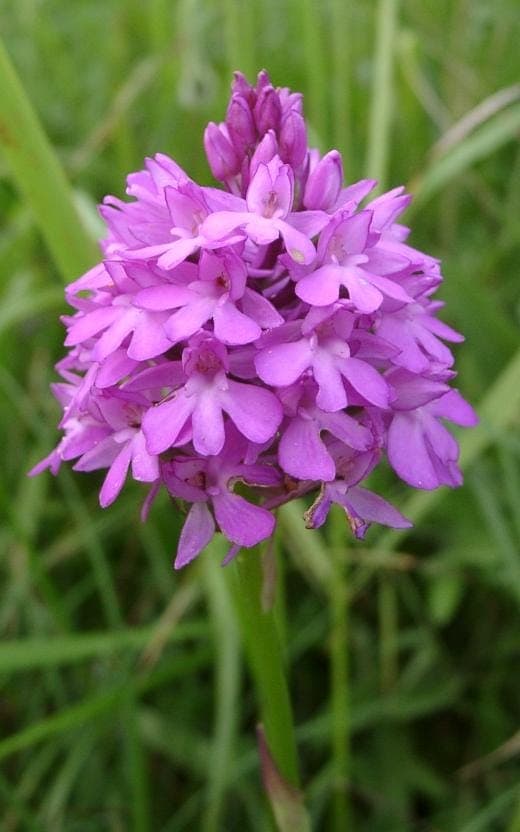
The original uploader was (Automated conversion) at English Wikipedia. / CC BY-SA 3.0, via Wikimedia Commons
Pyramid orchid: complete guide
Anacamptis pyramidalis
Want to see Pyramid orchid: complete guide in your garden?
1 minute, no credit card
Overview
Anacamptis pyramidalis, commonly known as the pyramid orchid, is a striking wild orchid native to southern and central Europe. Despite its delicate appearance, it's surprisingly tough once established, thriving in lean, alkaline soils under full sun. It's not commonly found in garden centres, but if you're drawn to naturalistic planting and low-fertility conditions, this could be your next challenge. The plant grows from a small tuber and blooms in early summer with a dense, pyramid-shaped cluster of purple flowers that stand out vividly against dry grasslands.
On gardenworld.app, you can design a drought-tolerant garden scheme that highlights pyramid orchids alongside other chalk-loving species. The platform helps visualise spacing, bloom overlap, and seasonal interest, making it easier to plan a long-lasting display.
Appearance & bloom cycle
The pyramid orchid gets its name from the tightly packed, conical inflorescence that forms at the top of a slender stem, typically 20–40 cm tall. Flowers are small, deep pink to purple, and densely arranged in a pyramid that starts forming in late spring. Each flower has a prominent labellum with fine stripes, attracting bees and small butterflies. The leaves are narrow, lance-shaped, and form a basal rosette, remaining green through the growing season.
Bloom time runs from May to July, peaking in June. In warmer microclimates or against south-facing walls, flowering may begin in late May. The plant dies back in late summer, retreating into its underground tuber until the following spring. It's a short-lived perennial, but can reseed gently in ideal conditions.
Ideal location
This orchid needs full sun – a solid 8 out of 10 on the light scale. That means at least 6 hours of direct sunlight daily. A south- or southeast-facing slope, rock garden, or chalky bank is ideal. It performs poorly in shade or dappled light, where it becomes leggy and fails to flower. It's hardy in USDA zones 7b to 9, so it's suitable for much of southern England and similar temperate regions. In colder areas, try planting near a warm wall or in a raised bed for better drainage and heat retention.
Soil requirements
The soil must be alkaline, with a pH between 8 and 9. If your garden has acidic soil, amend it with ground limestone or chalk grit. The key is drainage: mix in plenty of coarse sand or fine gravel to prevent waterlogging. Avoid compost, manure, or rich organic matter – these encourage rot and disrupt the mycorrhizal fungi the orchid depends on. A mix of 60% chalk rubble and 40% gritty sand works well in containers or poor ground.
Free design
Want to see Pyramid orchid: complete guide in your garden? Make a free design now.
Watering
Once established, pyramid orchid is drought-tolerant. Water only during prolonged dry spells in spring, especially if planted in containers. Overwatering is the main cause of failure – wet soil in summer leads to tuber rot. After planting in autumn or early spring, keep the soil lightly moist for the first few weeks to help root development. After that, let natural rainfall suffice.
Pruning
No pruning is required. Leave the flower stem intact after blooming to allow energy to return to the tuber. Cutting it too early weakens the plant. If you're collecting seed, wait until the capsule turns brown in late summer before removing the stem. Otherwise, let it decay naturally.
Maintenance calendar
- Jan: Check tubers are covered; protect from frost heave in containers
- Feb: Minimal care needed
- Mar: Watch for emerging shoots; guard against slugs
- Apr: Water lightly if spring is dry
- May: Start of flowering; avoid wetting flowers
- Jun: Peak bloom; observe pollinators
- Jul: Flowers fade; plant begins dormancy
- Aug: Allow stems to dry; collect seed if desired
- Sep: No action
- Oct: Ideal time for planting new tubers
- Nov: Let foliage die back naturally
- Dec: Dormant period; ensure good drainage
Winter hardiness
Hardy in USDA zones 7b–9. The tuber survives winter underground if the soil is well-drained. In wet or heavy clay soils, plant in raised beds or containers with extra grit. Avoid mulching with organic matter – use gravel or crushed oyster shell instead to keep the crown dry. Prolonged wet cold is more dangerous than frost.
Companion plants
Pair with other chalk-loving, drought-tolerant species: wild thyme (Thymus polytrichus), harebell (Campanula rotundifolia), kidney vetch (Anthyllis vulneraria), and sea holly (Eryngium maritimum). These create a low-maintenance, wildlife-friendly planting. Avoid vigorous perennials or moisture-loving plants like hostas or ferns. A rock garden or gravel bed works best.
Using gardenworld.app, you can map out companion plantings that match bloom times and soil needs. The app helps you avoid overcrowding and ensures your pyramid orchid has room to thrive without competition.
Closing
The pyramid orchid isn't for every garden – it demands specific conditions and patience. But if you have a sunny, chalky spot and want to support pollinators with something unusual, it's a rewarding choice. Buy tubers or plants from reputable nurseries, never wild-collected. In the UK, check specialist suppliers or look in garden centres during spring. Expect it to take a year or two to settle in. When it blooms, though, that vivid purple pyramid is unforgettable.
Want to see Pyramid orchid: complete guide in your garden? Make a free design now.
Upload a photo, pick a style, and get a photorealistic design with plant list in under a minute.
No credit card required


Similar plants
Ram's-head lady's slipper: complete guide
Cypripedium arietinum
Everything you need to know about growing Cypripedium arietinum, a rare woodland orchid for cool, moist garden settings. Soil, care and planting tips.
Sparrow's-egg lady's slipper: complete guide
Cypripedium passerinum
Everything about growing Cypripedium passerinum, a cold-hardy subarctic orchid suited to cool, moist, shaded garden spots. Soil, care and companion plants.
Algerian Butterfly-orchid: complete guide
Platanthera algeriensis
Everything about Platanthera algeriensis, the rare Mediterranean orchid with greenish flowers native to Algeria, Morocco, Corsica and Spain.