
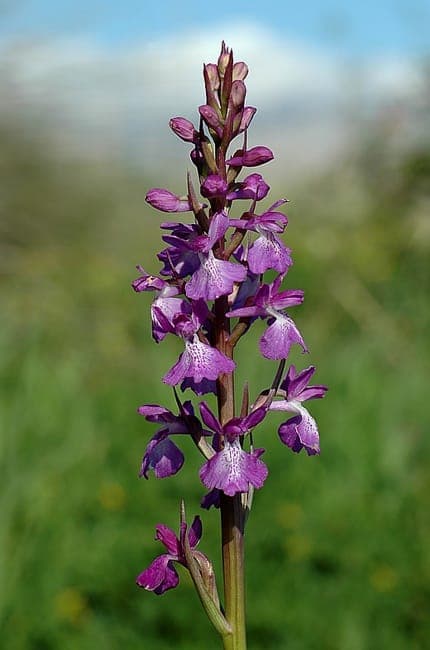
Mg-k / CC BY-SA 3.0, via Wikimedia Commons
Bog orchid: complete guide
Anacamptis palustris
Want to see Bog orchid: complete guide in your garden?
1 minute, no credit card
Overview
The bog orchid (Anacamptis palustris) is a delicate, native orchid species found in marshes, fens, and wet meadows across parts of Europe and Western Asia. It's not commonly seen in home gardens, but for those willing to match its needs, it offers a striking display of rich purple blooms. This perennial grows from a small tuber and thrives in consistently moist, open habitats. While not widely cultivated, it's a rewarding choice for wildlife gardens or naturalized wetland plantings. If you're designing a wet garden, gardenworld.app lets you generate a layout that integrates native species like this orchid seamlessly.
Appearance & bloom cycle
Bog orchid reaches a height of 20 to 50 cm, forming upright stems with narrow, lance-shaped leaves. The dense, cylindrical flower spike emerges in late spring, blooming from May through July. Each flower is a vivid purple with a slightly frilled lip, often clustering tightly along the upper third of the stem. The blooms have a subtle, sweet fragrance that attracts bees and moths. After flowering, seed capsules develop and split open in late summer, releasing fine dust-like seeds. No self-seeding occurs without the right mycorrhizal fungi, so propagation is best done through nursery-grown stock.
Ideal location
Full sun is essential - aim for a light exposure of 9 out of 10. The plant needs at least 6 to 8 hours of direct sunlight daily. Choose a spot with no overhead shade from trees or shrubs. Ideal locations include the shallow edges of ponds, seepage zones, or constructed rain gardens. Avoid north-facing slopes or heavily shaded lawns. South or southeast exposures work best, especially in cooler climates. If you're unsure whether your garden's microclimate suits bog orchids, try the garden planner on gardenworld.app - it evaluates sun exposure, moisture, and zone compatibility.
Soil requirements
Soil must be moist, well-aerated, and neutral to slightly alkaline, with a pH between 7.0 and 7.5. A loamy mix with added organic matter like leaf compost or well-rotted manure works well, but avoid rich fertilizers. This orchid evolved in low-nutrient soils, so over-amending harms root development. Include fine gravel or sand to prevent compaction. Do not use peat-heavy mixes; they dry out too fast and acidify the soil. A 20–30 cm planting bed over a gravel base ensures good drainage while retaining moisture.
Watering
Keep the soil consistently damp - never allow it to dry out completely. During dry spells in spring and early summer, water every 2–3 days. Use rainwater when possible, as tap water with high lime content can alter pH over time. Drip irrigation is ideal for steady moisture without waterlogging. Avoid overhead watering late in the day to reduce fungal risks. In containers, ensure pots have drainage holes and sit in shallow trays of water during hot months.
Free design
Want to see Bog orchid: complete guide in your garden? Make a free design now.
Pruning
No pruning is needed. After blooming, cut back only the spent flower stem, leaving the foliage intact until it yellows naturally in autumn. The leaves continue to feed the tuber for next year's growth. Never remove green leaves early. Discard dead material rather than composting it, as it may harbor pathogens. Do not divide tubers frequently - they need at least two growing seasons to re-establish.
Maintenance calendar
- Jan: Dormant. Check soil moisture; no action needed.
- Feb: Continue monitoring moisture. No fertilizing.
- Mar: New shoots may appear. Keep soil damp.
- Apr: Leaf growth accelerates. Protect from late frosts.
- May: Blooms begin. Watch for slugs and aphids.
- Jun: Peak flowering. Stake if stems bend.
- Jul: Flowers fade. Seed pods form.
- Aug: Pods ripen and open. Allow natural dispersal.
- Sep: Leaves begin to die back.
- Oct: Soil remains moist. Tuber stores energy.
- Nov: Foliage dies. Dormancy begins.
- Dec: Fully dormant. No watering or feeding.
Winter hardiness
Hardy in USDA zones 6 to 9. In zone 6, a light mulch of reed or straw helps prevent freeze-thaw cycles from heaving tubers. In containers, move to a cold frame or unheated greenhouse. The key is maintaining soil moisture - dry frost is more damaging than wet cold. Avoid covering with plastic; it traps moisture and encourages rot. Ground-planted tubers survive winter with no protection in zones 7–9.
Companion plants
Pair with other moisture-loving perennials: marsh marigold (Caltha palustris), Joe-Pye weed (Eutrochium maculatum), tussock sedge (Carex stricta), and blue flag iris (Iris versicolor). Avoid aggressive spreaders or heavy feeders like goldenrod or common tansy. A layered planting with varying heights - low sedges, mid-height spikes, and taller background plants - creates visual interest and mimics natural wetland ecosystems.
Closing
Bog orchid isn't for every garden, but if you've got a soggy corner begging for life, it's a gem. It demands attention to moisture and soil chemistry, but the payoff is a rare, elegant bloom few neighbors will have. Only purchase from ethical nurseries - never dig from the wild. In the UK and US, specialty garden centres increasingly stock native orchids, though availability varies. For design inspiration tailored to wetland conditions, head to gardenworld.app. Their tools help you create a garden that works with nature, not against it.
Want to see Bog orchid: complete guide in your garden? Make a free design now.
Upload a photo, pick a style, and get a photorealistic design with plant list in under a minute.
No credit card required


Similar plants
Ram's-head lady's slipper: complete guide
Cypripedium arietinum
Everything you need to know about growing Cypripedium arietinum, a rare woodland orchid for cool, moist garden settings. Soil, care and planting tips.
Sparrow's-egg lady's slipper: complete guide
Cypripedium passerinum
Everything about growing Cypripedium passerinum, a cold-hardy subarctic orchid suited to cool, moist, shaded garden spots. Soil, care and companion plants.
Algerian Butterfly-orchid: complete guide
Platanthera algeriensis
Everything about Platanthera algeriensis, the rare Mediterranean orchid with greenish flowers native to Algeria, Morocco, Corsica and Spain.