
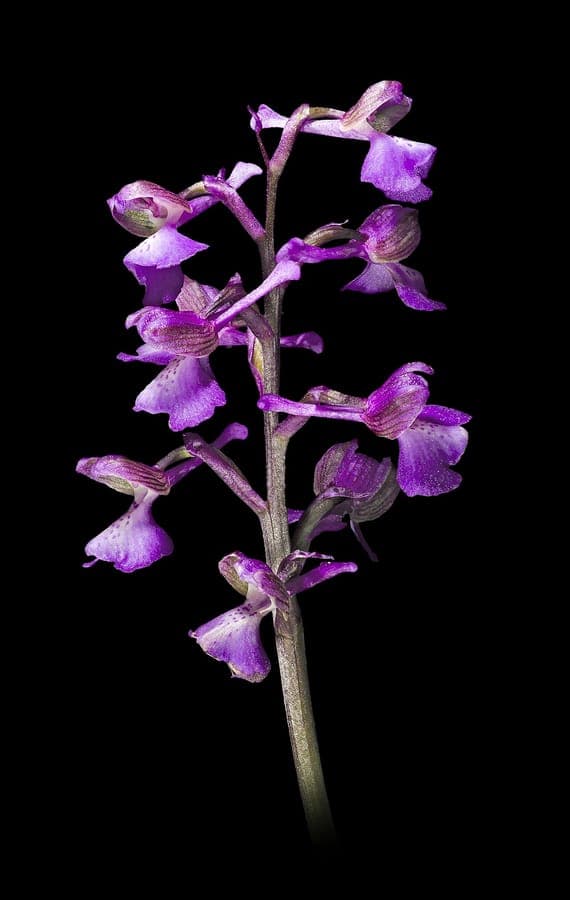
Didier Desouens / CC BY-SA 4.0, via Wikimedia Commons
Green-winged meadow orchid: complete guide
Anacamptis morio
Want to see Green-winged meadow orchid: complete guide in your garden?
1 minute, no credit card
Overview
Anacamptis morio, commonly known as the green-winged meadow orchid, is a delicate and striking wild orchid native to grasslands across southern and central Europe. Standing between 15 and 40 cm tall, it blooms in late spring with vibrant purple flowers that rise above lance-shaped, mottled leaves. Once common in meadows, it's now rare due to habitat loss - but can still thrive in well-planned gardens that mimic its natural conditions.
This orchid isn't suited for pots or rich borders. It wants open, sunny ground with low fertility and minimal competition. If you're designing a wildflower area, gardenworld.app offers custom garden layouts that integrate Anacamptis morio with compatible species and optimal spacing.
Appearance & bloom cycle
The green-winged meadow orchid blooms from April through June, depending on local climate and elevation. In warmer zones (like USDA 8), flowering starts in mid-April; in cooler areas (zone 6), it may not peak until late May. The flower spike carries 10 to 30 individual blooms, each with a deeply lobed, helmet-shaped lip in rich purple, often with darker veining. The side petals curve forward, giving the flower a hooded, almost whimsical look - hence the nickname 'merryman' or 'gagman' in some regions.
Leaves are narrow, dark green, and marked with irregular purple blotches, forming a rosette at the base. These appear in early spring and remain until after flowering. The plant dies back completely by late summer, surviving as a tuber underground.
Ideal location
Choose a spot with full sun to light shade - aim for at least a 7 on the light scale. South-facing slopes, dry meadows, or rocky banks work best. Avoid shaded areas under trees or near dense shrubs. This orchid needs open access to sunlight and air circulation to prevent fungal issues.
It's crucial to avoid overly fertile or moist soils during summer dormancy. The site should drain quickly and not collect standing water. Use gardenworld.app to simulate microclimates in your yard, helping you pick the driest, sunniest patch for long-term success.
Soil requirements
Anacamptis morio thrives in alkaline soils with a pH of 7.0 to 7.5. It prefers calcareous, well-drained substrates - think chalky loam, sandy gravel, or limestone rubble. Avoid adding compost, manure, or peat, as these increase organic matter and fertility, encouraging competitive grasses that will overwhelm the orchid.
When planting, strip away the top 10–15 cm of soil and replace it with a lean mix of garden soil, sharp sand, and crushed limestone. Plant tubers 5–7 cm deep, pointed end up, and space them 10–15 cm apart.
Free design
Want to see Green-winged meadow orchid: complete guide in your garden? Make a free design now.
Watering
Once established, this orchid needs almost no watering. Rely on natural rainfall during its spring growth phase. Only irrigate during prolonged droughts in April or May, and then sparingly - never soak the soil. During summer dormancy (July–September), keep the area completely dry. Excess moisture at this stage causes tuber rot.
Always use rainwater if possible. Tap water, especially in hard water areas, can raise pH beyond optimal levels over time.
Pruning
No pruning is required. Leave the flower spikes intact until they dry out in early summer. This allows seeds to mature and disperse naturally if conditions allow. If you're managing a formal meadow, cut back dead foliage in July, after seed drop. Avoid mowing the area before mid-July to protect seed development.
Maintenance calendar
- January: Check for frost heave; ensure tubers remain covered
- February: Monitor soil moisture; avoid waterlogging
- March: Look for emerging shoots; keep competing vegetation low
- April: Growth accelerates; protect from foot traffic
- May: Peak bloom; attract bees, hoverflies, and butterflies
- June: Flowering ends; reduce watering
- July: Cut back dead stems if desired; mow meadow only after seed set
- August: Dormancy begins; no water or feed
- September: Maintain dry conditions; avoid mulching
- October: Plant new tubers if needed; prepare site
- November: Keep area clear of leaf litter
- December: Protect from wet; ensure good drainage
Winter hardiness
Hardy in USDA zones 6–9, Anacamptis morio survives winter well in most of the UK, northern Europe, and the northern US. In colder zones, a light topdressing of grit or sand helps shed excess moisture. Never use organic mulch - it holds water and promotes rot.
Companion plants
Pair with low-nutrient grasses like Sheep's Fescue (Festuca ovina) or Crested Hair-grass (Koeleria macrantha). Good wildflower companions include Cowslip (Primula veris), Common Knapweed (Centaurea nigra), and Wild Thyme (Thymus serpyllum). Avoid aggressive spreaders like Creeping Buttercup or Bramble.
Closing
The green-winged meadow orchid is not a plant for impatient gardeners. It demands specific conditions and patience - but when it blooms, it's a jewel in the spring meadow. Always source tubers or seed from reputable nurseries, never from the wild. In the UK and US, look for ethical suppliers at garden centres or online conservation-focused growers. With thoughtful planning, this orchid can become a self-sustaining part of your garden. For inspiration, use gardenworld.app to visualise how it fits into a larger native planting scheme.
Want to see Green-winged meadow orchid: complete guide in your garden? Make a free design now.
Upload a photo, pick a style, and get a photorealistic design with plant list in under a minute.
No credit card required


Similar plants
Ram's-head lady's slipper: complete guide
Cypripedium arietinum
Everything you need to know about growing Cypripedium arietinum, a rare woodland orchid for cool, moist garden settings. Soil, care and planting tips.
Sparrow's-egg lady's slipper: complete guide
Cypripedium passerinum
Everything about growing Cypripedium passerinum, a cold-hardy subarctic orchid suited to cool, moist, shaded garden spots. Soil, care and companion plants.
Algerian Butterfly-orchid: complete guide
Platanthera algeriensis
Everything about Platanthera algeriensis, the rare Mediterranean orchid with greenish flowers native to Algeria, Morocco, Corsica and Spain.