
Unknown authorUnknown author / Public domain, via Wikimedia Commons
Common fiddleneck: complete guide
Amsinckia menziesii
Want to see Common fiddleneck: complete guide in your garden?
1 minute, no credit card
Overview
Amsinckia menziesii, commonly known as common fiddleneck, is an annual forb in the Boraginaceae family. Native to western North America - including California, Arizona, and British Columbia - it's now found in disturbed soils across temperate zones. In the garden, it's a rugged, low-maintenance plant that fits perfectly in naturalistic designs, wildflower meadows, or along gravel paths. It's not a showy bedding plant, but it brings a wild charm that few cultivated flowers can match.
One thing experienced gardeners appreciate: this plant doesn't need coddling. It thrives where others struggle - in lean soils, full sun, and dry conditions. If you're designing a low-input garden, Amsinckia deserves a spot. On gardenworld.app, you can create a custom planting plan that integrates fiddleneck with other drought-tolerant species for year-round texture.
Appearance & bloom cycle
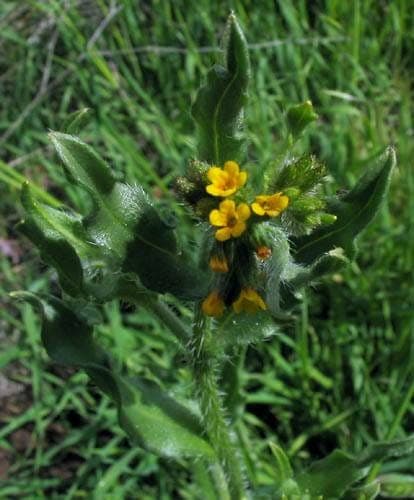
Common fiddleneck grows upright, reaching 30–60 cm in height. The stems are hairy, branching, and slightly sticky to the touch. Leaves are lance-shaped, rough, and arranged alternately along the stem. The most striking feature is the coiled inflorescence that unfurls as it blooms - resembling a fiddlehead, hence the name.
Flowering begins in late spring (May) and extends into mid-summer (July, sometimes August). The small, tubular flowers are bright yellow to orange-yellow, about 1 cm wide, opening from the base of the coil upward. Each flower lasts a day, but continuous blooming gives the plant a long display.
Bees, especially mason bees and small bumblebees, frequently visit the flowers. While not highly toxic, the plant's bristly hairs can irritate sensitive skin, so wear gloves when handling.
Ideal location
Full sun is non-negotiable. Amsinckia needs at least 6–8 hours of direct sunlight daily. It performs best in open, unshaded areas - rocky slopes, dry borders, or poor soil patches. Avoid shaded corners, under trees, or north-facing walls.
That said, it's a pioneer species, meaning it colonizes bare ground fast. Use that to your advantage in rehabilitating compacted or disturbed soil. Pair it with other sun-lovers like Eriophyllum lanatum or Nemophila menziesii for a California-native look. If you're unsure where to place it, gardenworld.app's garden planner helps visualise sun exposure and plant compatibility on your property.
Soil requirements
This plant thrives in well-drained, sandy, or gravelly soils. It tolerates poor fertility and prefers low to moderate organic content. Rich, heavily amended soils encourage lush foliage but reduce flowering.
Ideal pH ranges from 6.0 to 7.8. Avoid heavy clay or waterlogged sites. If your soil retains water, consider raised beds or berms with added sand or grit to improve drainage. Amsinckia doesn't need fertiliser - in fact, skip it altogether.
Free design
Want to see Common fiddleneck: complete guide in your garden? Make a free design now.
Watering
Once established, common fiddleneck is drought-tolerant. Young seedlings need light, regular watering for the first 2–3 weeks after germination, especially in dry springs. After that, natural rainfall is usually sufficient.
During extended droughts (3+ weeks without rain), a deep soak every 10–14 days helps prevent premature dieback. Avoid frequent shallow watering - it promotes weak roots. This plant is suited to xeriscaping and works well in water-wise gardens.
Pruning
Pruning isn't necessary. As an annual, it completes its life cycle in one season. Deadheading won't prolong bloom significantly, but removing spent flower stalks can keep the area tidy.
If you want self-seeding, leave 1–2 healthy plants uncut until seeds fully ripen (late July to mid-August). The nutlets drop easily, so collect them or let them scatter naturally. Birds rarely eat them, so don't count on wildlife dispersal.
Maintenance calendar
- March–April: Sow seeds directly outdoors after last frost. Use open ground with minimal competition.
- May–July: Active growth and bloom. Minimal care. Watch for aggressive weeds early on.
- August: Bloom fades. Monitor seed development.
- September: Seeds mature. Allow self-seeding or collect for next year.
- October–February: Plant dies back. Clear debris if desired, but not required.
Winter hardiness
As an annual, Amsinckia doesn't survive winter as a plant. However, seeds can overwinter in soil, especially in well-drained, sunny spots. Seed viability lasts 2–3 years. In USDA zones 7–10, it often reappears reliably.
In colder zones (below 7), natural reseeding is less predictable. For consistent returns, collect and resow seeds in spring. Avoid mulching heavily over potential germination zones.
Companion plants
Pair Amsinckia with:
- Calochortus vestae (Wand lily)
- Clarkia amoena (Farewell-to-spring)
- Grindelia stricta (Ditch gumplant)
- Lasthenia californica (California goldfields)
These combinations mimic native plant communities and support pollinators. Place taller companions behind fiddleneck, and use shorter species like Phacelia in front.
Closing
Common fiddleneck isn't for every garden - it's a little rough around the edges. But if you value resilience, low input, and ecological function, it's a winner. It asks for almost nothing and gives weeks of colour and habitat. Use it to fill gaps, stabilise bare soil, or add texture to a dry border. Buy seeds from reputable garden centres that specialise in native species. With the right design, even a wild plant like Amsinckia can feel intentional. Try mapping your layout on gardenworld.app to see how it fits into your long-term vision.
Want to see Common fiddleneck: complete guide in your garden? Make a free design now.
Upload a photo, pick a style, and get a photorealistic design with plant list in under a minute.
No credit card required


Similar plants
Western waterleaf: complete guide
Hydrophyllum occidentale
Full growing guide for western waterleaf (Hydrophyllum occidentale): shade tolerance, soil needs, watering, winter hardiness and naturalistic garden use.
Limestone phacelia (Phacelia affinis): complete guide
Phacelia affinis
Full guide to Phacelia affinis, the limestone phacelia: sowing tips, purple-blue bee flowers, drought tolerance and uses in dry or wildlife gardens.
Pyrenean viper's bugloss: complete guide
Echium asperrimum
Echium asperrimum is a striking biennial from the western Mediterranean with rough bristly stems and vivid blue flowers. A magnet for bees and a bold border plant.