
Thayne Tuason / CC BY 4.0, via Wikimedia Commons
Bugloss fiddleneck: complete guide
Amsinckia lycopsoides
Want to see Bugloss fiddleneck: complete guide in your garden?
1 minute, no credit card
Overview
Amsinckia lycopsoides, known in English as bugloss fiddleneck, scarce fiddleneck, or tarweed fiddleneck, is a bristly annual herb in the family Boraginaceae. Native to western Canada and the western United States, its natural range stretches from British Columbia and Washington State south through Oregon and California into Idaho, Montana, Wyoming, Utah, and as far east and south as Texas and the Great Plains states. Beyond its native range, the species has been recorded as introduced in France, Great Britain, Greece, Czechoslovakia, and even Tasmania and Korea - evidence of a remarkably wide ecological tolerance.
The genus Amsinckia was named for Wilhelm Amsinck, a Hamburg merchant and plant patron of the early nineteenth century. The specific epithet lycopsoides means resembling Lycopsis, an older genus of borage-family plants, and refers to the resemblance of the leaves and rough-haired stems. The species was first formally described by Lindley ex Lehmann in 1831. Recognised synonyms include Amsinckia idahoensis M.E.Jones, Amsinckia setosissima Suksd., Benthamia lycopsoides (Lindl. ex Lehm.) Druce, and several others.
For the garden enthusiast, Amsinckia lycopsoides is an excellent choice for naturalised wildflower plantings, gravel gardens, and dry, sunny borders where lower-fertility conditions encourage the plant's most floriferous, compact habit. Its bright yellow flowers and bristly, characterful stems give it a rugged, unmanicured charm that suits contemporary ecological gardening and wildlife-friendly planting. The species is a useful nectar source for bees, hoverflies, and small butterflies.
If you want to see how wildflowers like this can be incorporated into a complete garden design, explore the layout tools at gardenworld.app for personalised planting plans.
Appearance & bloom cycle
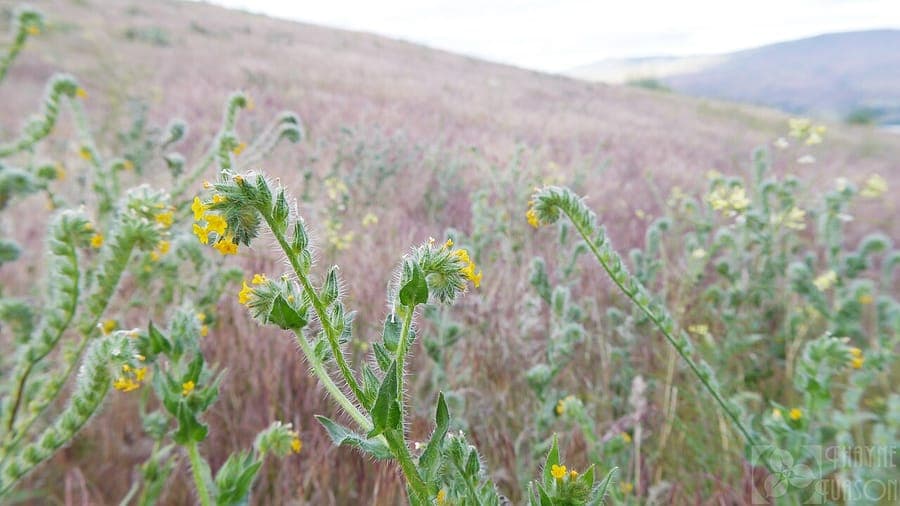
Amsinckia lycopsoides is an erect annual herb growing to between 20 and 70 cm in height, depending on soil fertility and moisture availability. Stems are stout and densely covered with stiff, bristly hairs - a hallmark character of the Boraginaceae family. Leaves are lance-shaped to elliptic, similarly rough-haired, with a coarse texture. Foliage colour is a fresh, bright green in the seedling and early vegetative stage, becoming slightly greyish-green as the plant matures.
The flowers are the plant's defining ornamental feature. Individually small - just 5 to 8 mm across - they are bright yellow and tubular-funnel shaped, borne in the tightly coiled, scorpioid cymes (cincinni) characteristic of the borage family. As the cyme uncoils with each successive flower opening, it resembles the scroll of a fiddle neck, giving the plant its popular English name. In its native range, flowering occurs from April through June; in European gardens, depending on the sowing time, flowering extends from April to August.
Fruits are small, rough, brownish nutlets that cling to clothing, fur, and feathers with ease, facilitating the plant's natural dispersal. Each plant produces copious seed, making the species reliably self-seeding once established in appropriate conditions. The foliage is predominantly single-stemmed, though branching is more frequent in plants growing on richer soils.
The flower colour is consistently a clean, warm yellow - no cultivar variation has been commercially developed, as the species is grown from wild-type seed. pH tolerance ranges from 5.8 to 8.2, a wide span that accommodates both slightly acid and alkaline soils.
Ideal location
Amsinckia lycopsoides is a plant of open, unshaded habitats. It scores a light value of 8 out of 9 in standard ecological indices, indicating a requirement for full sun or near-full sun conditions. In its native range it colonises dry grasslands, disturbed ground, field margins, talus slopes, and roadsides - invariably open, bright, and often disturbed sites.
For garden use, choose a fully sunny position with at least six hours of direct sun daily. South-facing borders, sunny paths, open gravel beds, and sunny wildflower meadow areas are ideal. The species tolerates very little shade; when light is insufficient the plant becomes etiolated (drawn and floppy) and flowers poorly.
The species performs particularly well in gravel gardens and drought-tolerant, low-fertility borders, where the lean, dry conditions encourage the characteristically compact, floriferous habit. In over-rich, moist garden soil the plant tends to produce excessive leafy growth at the expense of flowers. Remarkably, Amsinckia lycopsoides can self-seed and flower successfully in pavement cracks, gravel paths, and low walls where a modicum of soil and sun is available.
Soil requirements
Amsinckia lycopsoides is broadly soil-tolerant but performs best on light to medium-textured, free-draining soils. The optimal pH range is 5.8 to 8.2 - one of the widest tolerances among annual wildflowers - accommodating both slightly acid and moderately alkaline soils. On neutral to slightly alkaline soils (pH 6.5 to 7.5) growth is generally most even.
High soil fertility is neither required nor beneficial. On lean sandy soils, gravel substrates, and similarly low-fertility growing media, bugloss fiddleneck grows most compactly and flowers most freely. On overly rich, humus-heavy soils the plant becomes rank and lush, but less floriferous. This is an annual that genuinely prefers adversity to luxury.
Minimal soil preparation is needed: simply loosen the top 10 cm and remove persistent perennial weeds. No compost or fertiliser additions are necessary for most garden soils. On very compacted clay, working in 20 percent by volume of coarse grit or sand helps create the open drainage the plant needs.
Free design
Want to see Bugloss fiddleneck: complete guide in your garden? Make a free design now.
Watering
Amsinckia lycopsoides is drought-tolerant once established, consistent with its origins in the semi-arid western United States. The atmospheric humidity index for the species is low (value 4 in ecological scoring), confirming that excessive ambient moisture is undesirable. Under normal conditions in north-western Europe, established plants require no supplemental watering beyond natural rainfall in most summers.
During germination and in the early seedling stage - when the root system is still shallow - keep the surface of the soil from drying out completely. Water lightly once a week when no rain falls. Once the plant has established a deeper root system, watering can be reduced to once a fortnight during sustained dry spells.
Waterlogged conditions, particularly on compacted soil, cause root rot and rapid plant decline. The governing principle in cultivation is: err on the side of dryness. On sandy or gravelly soils the plant withstands two to three weeks without rain without damage, especially once it has reached a reasonable size.
Pruning
As an annual, Amsinckia lycopsoides requires virtually no management beyond the basic decisions about self-seeding. The plant completes one growth cycle from germination to seed set and then dies. Ongoing pruning is not a meaningful concept for this species.
The key management decision is when and whether to allow self-seeding. Leave plants standing until the nutlets are fully ripe and brown if you want the species to naturalise and return the following year without resowing. Remove plants before seed dispersal if you wish to prevent spreading or if the plant's location needs to be managed carefully.
Removing spent flower cymes before seed maturation will reduce the plant's opportunity to self-sow, which is appropriate in a more formal or controlled planting but counterproductive in a naturalised wildflower setting. In wild gardens and ecological borders, minimal intervention is always the preferred approach.
Maintenance calendar
January – February: No outdoor action needed. Optionally start seed in a cold greenhouse for early transplanting after frost.
March: Sow direct in the final position as soon as the soil is workable. Lightly loosen the surface, sow thinly in rows 20 to 25 cm apart, or broadcast for a naturalistic effect. Cover lightly with 3 mm of soil.
April – May: Germination and early growth. Remove competing weeds that might swamp the seedlings. Water lightly in prolonged dry spells.
May – July: Peak flowering. Enjoy the bright yellow blooms and the pollinator activity they attract. Check whether self-seeding is at an acceptable level.
August: Seed ripening. Decide whether to allow self-seeding or to clear the planting.
September – October: Remove spent plants if desired, or leave them as rough mulch over the area.
November – December: Seed lies dormant in the soil, awaiting spring germination triggers.
Winter hardiness
As an annual, the mature plant of Amsinckia lycopsoides has no overwintering requirement - it completes its life cycle and dies after setting seed. The plant's winter persistence is entirely as dormant seed in the soil. These seeds tolerate light to moderate frost without difficulty and survive normal European winters reliably.
In USDA zones 5 to 9, which encompasses the vast majority of European gardening climates, the species can maintain itself through self-seeding year after year once the initial seed stock is in place. Seeds require no special stratification treatment and germinate spontaneously in spring when soil temperatures consistently exceed 8 to 10 °C.
In unusually harsh winters with sustained temperatures below -15 °C, seeds lying very close to the surface may be lost, but seeds that have been incorporated slightly deeper into the soil generally survive. As a precaution, retain a small quantity of harvested seed in a cool, dry location as a backup for spring resowing.
Companion plants
Bugloss fiddleneck suits naturalised wildflower settings and ecological borders. Suitable companions include:
- Papaver rhoeas (common poppy): the classic red of field poppies against the yellow fiddleneck creates a vibrant wildflower combination on dry, sunny ground. Sow both simultaneously for a massed effect.
- Centaurea cyanus (cornflower): the blue of cornflower against the yellow of amsinckia is the archetypal cornfield palette. Sow in mixed drifts at approximately 20 cm spacing.
- Linaria vulgaris (common toadflax): similar habitat preferences and a warm yellow flower colour that echoes the amsinckia tone.
- Silene gallica (small-flowered catchfly): another arable field pioneer that coexists happily with amsinckia on lean, dry soils.
- Phacelia tanacetifolia (phacelia): a fellow Boraginaceae member with similar habitat preferences and exceptional pollinator value.
Avoid combining with tall, vigorous perennials that rapidly claim space and shade out the lower-growing amsinckia. Keep companions compact, or allocate the amsinckia its own zone in the border.
Conclusion
Amsinckia lycopsoides is an underrated gem of the wild flora of western North America that proves surprisingly well-suited to European gardens, particularly in open, sunny, lower-fertility conditions. The cheerful yellow flowers, characterful bristly stems, and genuine ecological value as a pollinator nectar source make it a rewarding addition to any naturalistic planting scheme.
Curious to see how a year-round blooming wildflower garden actually looks? Visit gardenworld.app for inspiration and a personalised planting plan that brings together plants perfectly matched to your location, style, and the wildlife you want to attract.
Want to see Bugloss fiddleneck: complete guide in your garden? Make a free design now.
Upload a photo, pick a style, and get a photorealistic design with plant list in under a minute.
10,000+ gardens designed already
No credit card required


Similar plants
Western waterleaf: complete guide
Hydrophyllum occidentale
Full growing guide for western waterleaf (Hydrophyllum occidentale): shade tolerance, soil needs, watering, winter hardiness and naturalistic garden use.
Limestone phacelia (Phacelia affinis): complete guide
Phacelia affinis
Full guide to Phacelia affinis, the limestone phacelia: sowing tips, purple-blue bee flowers, drought tolerance and uses in dry or wildlife gardens.
Pyrenean viper's bugloss: complete guide
Echium asperrimum
Echium asperrimum is a striking biennial from the western Mediterranean with rough bristly stems and vivid blue flowers. A magnet for bees and a bold border plant.