
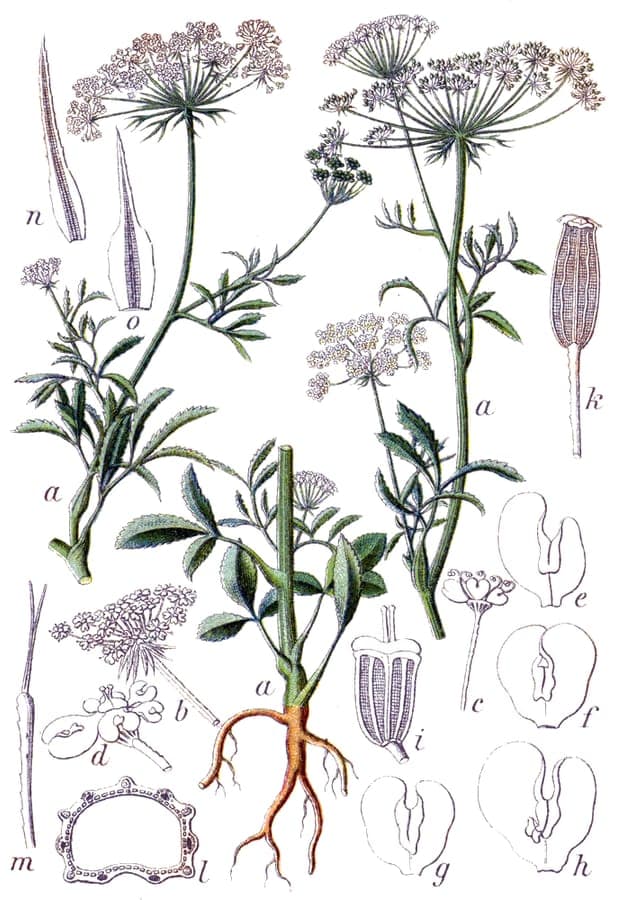
Johann Georg Sturm (Painter: Jacob Sturm) / Public domain, via Wikimedia Commons
Bishop's-weed: complete guide
Ammi majus
Want to see Bishop's-weed: complete guide in your garden?
1 minute, no credit card
Overview
Ammi majus, commonly known as Bishop's-weed, is an annual that brings an elegant, almost ethereal quality to summer gardens. Belonging to the Apiaceae family, it shares traits with parsley, dill, and fennel-most notably its umbrella-like flower clusters. Native to the Mediterranean basin, it thrives in warm, well-drained spots and has become a staple in cottage-style and cutting gardens across temperate zones. Reaching 80–120 cm in height, it works best in the middle or back of a border, where its airy presence can weave through other plants without dominating.
One of the reasons gardeners love Bishop's-weed is its ability to soften hard edges and add movement. It doesn't scream for attention, but it holds the garden together. If you're designing a new border, gardenworld.app lets you visualise how Ammi majus fits into your layout, pairing it with complementary textures and colours.
Appearance & bloom cycle
From July through September, Ammi majus produces large, flat-topped umbels of tiny white flowers, each measuring 6–8 cm across. The bloom peak hits in August, when the plant is at its fullest. The foliage is finely divided, feathery, and mid- to dark green, resembling fennel or dill. This fine texture contrasts beautifully with bolder-leaved plants.
Germination to flowering takes about 12–14 weeks. Direct sowing is possible from late May onwards, once soil temperatures reach 15°C. For earlier blooms, start seeds indoors in April and transplant after hardening off. The taproot doesn't like disturbance, so use biodegradable pots if starting inside.
Ideal location
Ammi majus needs a 7 out of 10 on the light scale-meaning at least 6 hours of direct sun daily. Full sun is ideal, especially in cooler climates. South- or southwest-facing borders work best. It can tolerate partial shade, but stems become weak and flop under their own weight.
Air circulation is crucial. In humid summers, poor airflow can lead to mildew or rot. Avoid planting in dense clumps or sheltered corners with stagnant air. If you're unsure about microclimates in your garden, gardenworld.app helps map sun exposure and airflow to find the perfect spot.
Soil requirements
This plant prefers well-drained, slightly alkaline soil with a pH between 7.5 and 8.0. It tolerates poor soils but struggles in heavy clay or waterlogged conditions. If you're gardening on clay, amend the planting area with grit and compost to improve drainage. Sandy soils are ideal, especially when enriched with a modest amount of organic matter.
Avoid high-nitrogen fertilisers. Too much nitrogen encourages leafy growth at the expense of flowers. A light mulch of gravel or sand helps suppress weeds and reduces moisture around the base.
Free design
Want to see Bishop's-weed: complete guide in your garden? Make a free design now.
Watering
Water consistently during establishment-first 3–4 weeks after sowing or transplanting. Once established, Ammi majus is drought-tolerant. Deep, infrequent watering encourages strong root development. Water at the base in the morning to prevent wet foliage, which can invite disease.
During prolonged dry spells, give a thorough soak every 7–10 days. Overwatering leads to floppy stems and root rot.
Pruning
Pruning isn't necessary, but deadheading spent blooms prevents self-seeding if you want to control spread. For cut flowers, harvest when outer florets are open but before the centre fully expands. Cut stems early in the morning, place in water immediately, and recut at an angle. Vase life is 7–10 days.
If you want naturalised patches, leave a few stems to set seed. The seeds drop easily and may germinate the following spring, especially in warm, open soil.
Maintenance calendar
- March–April: Start seeds indoors in trays (use deep pots for taproot)
- May: Sow directly outdoors after frost risk passes
- June: Thin seedlings to 30 cm apart, keep area weed-free
- July–September: Bloom period, harvest cut flowers, deadhead as needed
- October: Remove dead stems or leave for self-seeding
Winter hardiness
Ammi majus is not winter-hardy. It's an annual, rated for USDA zones 2–11 as a seasonal plant. It won't survive freezing temperatures, but seeds may overwinter in mild climates (zones 8+). Self-seeded plants often emerge in spring, though success varies with soil and moisture.
Companion plants
Pair Bishop's-weed with plants that share its sun and water needs. Excellent companions include Echinacea, Verbena bonariensis, Salvia patens, and taller Sedum varieties. The white umbels highlight deep purples and reds, making it ideal beside dark-leaved foliage like Foeniculum vulgare 'Purpureum' or Heuchera.
Avoid overcrowding with aggressive spreaders like mint or goldenrod. Also, don't plant near heavy feeders that require moist soil-Ammi majus prefers it drier.
In cutting gardens, it's a top-tier filler flower, adding volume and texture. Its Apiaceae kinship attracts beneficial insects-lacewings, hoverflies, and parasitic wasps-making it a functional addition to eco-friendly plots.
Closing
Bishop's-weed isn't flashy, but it's indispensable. It adds light, movement, and structure without demanding attention. With minimal care and the right conditions, it delivers weeks of bloom and excellent cut material. For layout ideas and planting combos, check gardenworld.app, where you can design a border that maximises its airy potential. Seeds are widely available at garden centres-look for reliable suppliers and sow early for best results.
Want to see Bishop's-weed: complete guide in your garden? Make a free design now.
Upload a photo, pick a style, and get a photorealistic design with plant list in under a minute.
No credit card required


Similar plants
Whorled carrot: complete guide
Daucus involucratus
Daucus involucratus is a Mediterranean umbellifer with white flower heads framed by lacy bracts. Growing this gravel garden gem.
Daucus muricatus: complete guide
Daucus muricatus
Daucus muricatus, the spiny wild carrot, grows wild on Mediterranean coasts. Discover sowing, June-July bloom, and wildflower meadow use.
Daucus pumilus: complete guide
Daucus pumilus
Daucus pumilus is a dwarf wild carrot relative with white lacy umbels, thriving on dunes and coastal rock in poor, fast-draining soil.