
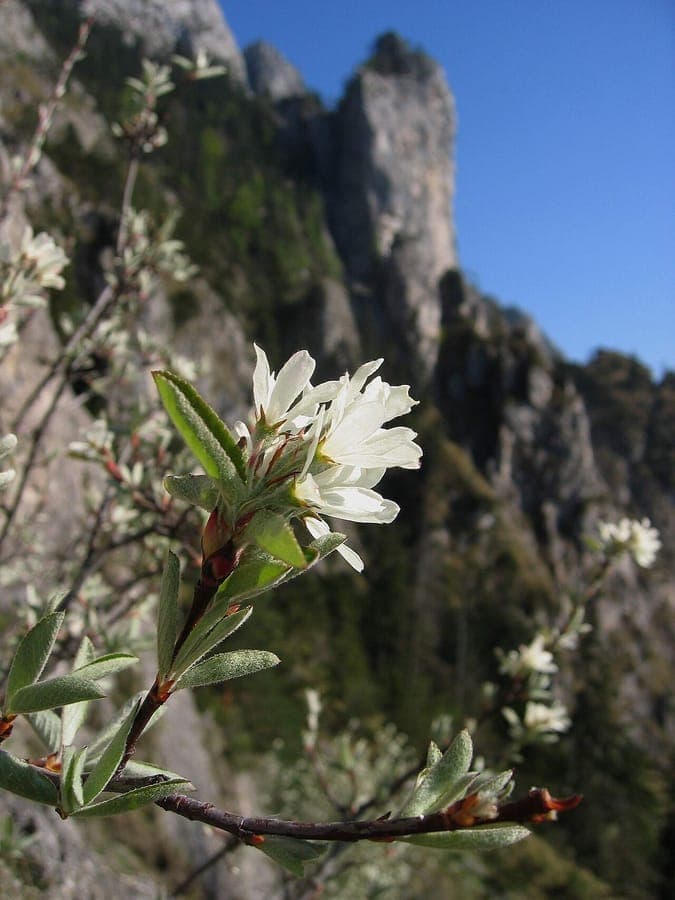
User:Tigerente / CC BY-SA 3.0, via Wikimedia Commons
Serviceberry: complete guide
Amelanchier ovalis
Want to see Serviceberry: complete guide in your garden?
1 minute, no credit card
Overview
Amelanchier ovalis, commonly known as serviceberry, is a graceful deciduous shrub or small tree native to central and southern Europe. Belonging to the Rosaceae family, it's a resilient and ornamental plant that offers year-round interest. From fragrant spring blossoms to edible berries and vibrant autumn foliage, this species adds both beauty and ecological value to gardens. It's ideal for naturalistic designs, mixed borders, and wildlife-friendly spaces.
On gardenworld.app, you can design a garden layout that integrates serviceberry perfectly, ensuring proper spacing and seasonal visibility in your outdoor space.
Appearance & bloom cycle
Amelanchier ovalis typically grows 3 to 6 meters tall with a spread of 2 to 4 meters. It has an upright, open habit with multiple slender trunks and smooth grey bark that develops subtle lenticels with age. The leaves are oval to elliptic, 3–6 cm long, and emerge in spring with a soft bronze tint and fine downy coating, turning glossy green by summer.
The flowering period runs from late March to early May, depending on local climate. Clusters of white, star-shaped flowers (2.5–3 cm across) appear before or alongside the new leaves. Each flower has five petals and numerous stamens, attracting bees and early pollinators. After flowering, small round berries develop, ripening from red to deep purple or nearly black by late June. The berries are about 8–10 mm wide, sweet with a hint of almond, and edible for people and birds alike.
In autumn, the foliage turns brilliant shades of yellow, orange, and crimson, often lasting several weeks. This long-lasting colour display makes it a standout in seasonal garden designs.
Ideal location
Serviceberry thrives in full sun to partial shade. For maximum flowering and fruiting, plant in full sun (at least 6 hours of direct light daily). In partial shade, it still grows well but may produce fewer flowers and berries.
Plant as a specimen tree in a lawn, in mixed shrub borders, or as an understory tree in light woodland settings. Allow at least 2.5 meters of clearance from other plants or structures for healthy air circulation. When planning your layout, use gardenworld.app to visualise how the tree will cast shade and fill space over time.
Soil requirements
Amelanchier ovalis prefers fertile, well-drained soil but adapts to a range of conditions. Loam or sandy loam with a slightly acidic to neutral pH (5.5–7.0) is ideal. Heavy clay soils can work if amended with compost and coarse sand to improve drainage.
At planting, mix in a bucket of compost or well-rotted manure into the planting hole. Avoid high-nitrogen fertilisers, which can encourage weak growth and reduce winter hardiness.
Free design
Want to see Serviceberry: complete guide in your garden? Make a free design now.
Watering
Water regularly during the first growing season, especially during dry spells. Provide 10–15 litres per week per plant. Once established, serviceberry is moderately drought-tolerant but performs best with consistent moisture in summer.
Apply a 5 cm layer of organic mulch (such as wood chips or leaf mould) around the base to retain moisture and suppress weeds. Keep mulch a few inches away from the trunk to prevent rot.
Pruning
Pruning is rarely needed, but you can shape the plant or remove old, damaged, or crossing stems. The best time is late winter (February) or early spring before bud break. Use clean, sharp tools to avoid disease transmission.
Avoid pruning in autumn or early winter, as this can remove flower buds for the next season. If you prefer a tree form over a multi-stemmed shrub, select one or two central leaders and remove lower suckers annually.
Maintenance calendar
- January: Inspect for storm damage. No pruning required.
- February: Light shaping or removal of old stems.
- March: Watch for swelling buds. No fertiliser needed.
- April: Flowers open. Water during dry periods.
- May: Bloom ends. Fruit begins to form.
- June: Harvest ripe berries (from late June). Leave some for birds.
- July: Check for aphids or mildew. Top up mulch if needed.
- August: Water only in prolonged drought.
- September: Foliage starts turning. No pruning.
- October: Leaf drop. Leave fallen leaves as natural mulch.
- November: Final check for lingering berries and bird activity.
- December: Monitor for snow damage on branches.
Winter hardiness
Serviceberry is hardy in USDA zones 4 to 7, tolerating temperatures down to -25°C. In zone 8, it may struggle in hot summers unless planted in a sheltered, partially shaded spot. Young plants benefit from a thick mulch layer around the root zone in their first winter to protect against freeze-thaw cycles.
Companion plants
Pair serviceberry with native perennials like Geranium sylvaticum, Digitalis purpurea, or Anemone nemorosa for a natural look. Underplant with spring bulbs such as Crocus tommasinianus or Narcissus 'Tête-à-tête' for early colour.
Shrubs like Cornus alba or Viburnum opulus complement its form and seasonal interest. For woodland gardens, combine with oaks or beeches, where serviceberry acts as a mid-layer accent.
Closing
Amelanchier ovalis is a low-maintenance, high-reward plant that brings beauty and biodiversity to any garden. Its spring flowers, edible fruit, and fiery autumn foliage make it a year-round performer. With minimal care and good initial planting, it will thrive for decades.
You can find healthy specimens at local garden centres or reputable suppliers. When planning your design, use gardenworld.app to create a custom layout that accounts for growth rate, canopy spread, and seasonal changes.
Want to see Serviceberry: complete guide in your garden? Make a free design now.
Upload a photo, pick a style, and get a photorealistic design with plant list in under a minute.
No credit card required


Similar plants
Siberian crab apple: complete guide
Malus x robusta
Complete guide to the Siberian crab apple (Malus x robusta): location, soil, pruning, winter hardiness and the best companion plants for your garden.
Chinese flowering crabapple (Malus x spectabilis): complete guide
Malus x spectabilis
Meet the Chinese flowering crabapple (Malus x spectabilis): a classic spring bloomer with carmine buds and pink blossom.
Potentilla crassinervia: complete guide
Potentilla crassinervia
Potentilla crassinervia, the Corsican cinquefoil, grows wild on Corsica and Sardinia's peaks. Discover how to grow this hardy alpine rock garden gem.