
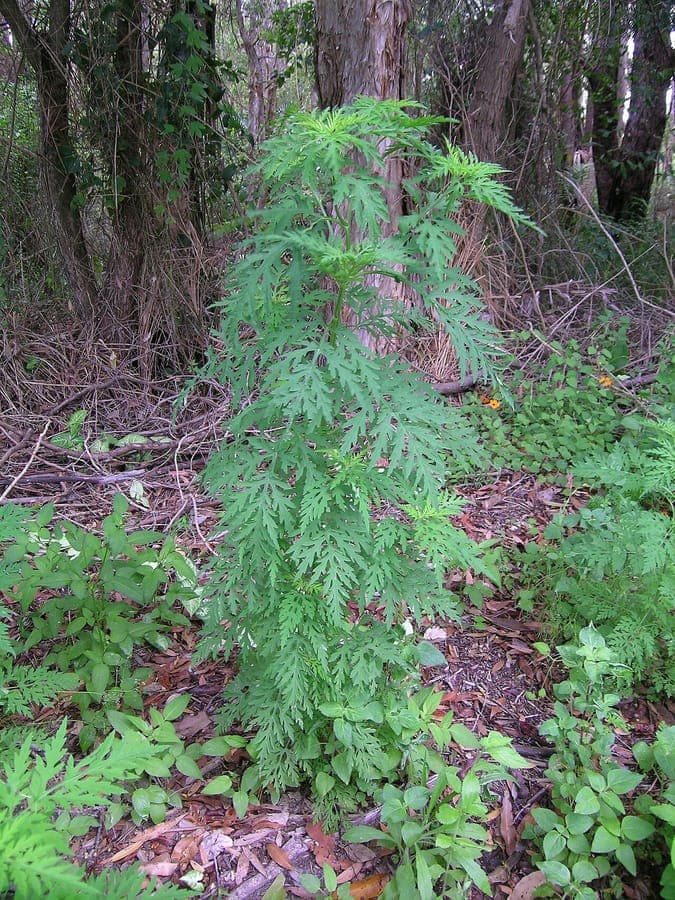
Harry Rose from South West Rocks, Australia / CC BY 2.0, via Wikimedia Commons
Roman-wormwood: complete guide
Ambrosia artemisiifolia
Want to see Roman-wormwood: complete guide in your garden?
1 minute, no credit card
Overview
Ambrosia artemisiifolia, commonly known as Roman-wormwood, is an annual plant in the Asteraceae family, native to regions across North America including Alabama, Alaska, Alberta, and Arizona. While it may not look imposing, this plant has gained notoriety for producing one of the most potent allergenic pollens in temperate climates. In many parts of Europe, it's now classified as an invasive species, often found on wastelands, roadsides, and in neglected garden corners.
Roman-wormwood spreads aggressively through its seed bank, which can remain viable in soil for up to 40 years. Each plant can produce tens of thousands of seeds, making it a persistent challenge for gardeners. If you're designing a low-allergy garden, avoiding this plant is essential. On gardenworld.app, you can create a digital garden plan that flags allergenic species and suggests alternatives.
Appearance & bloom cycle
Roman-wormwood has deeply lobed, gray-green leaves that resemble those of true wormwood (Artemisia), hence the name. Plants typically grow 30 to 120 cm tall, with upright, branching stems covered in fine hairs. The foliage has a slightly silvery sheen and emits a faintly bitter aroma when crushed.
Flowering occurs from late summer into autumn, usually from August to October. The flowers are wind-pollinated and lack showy petals. Male flowers cluster at the top of the stem in spike-like formations, while female flowers sit lower down, often hidden in leaf axils. This discreet flowering strategy allows for massive pollen release, peaking in early September - a nightmare for hay fever sufferers.
Ideal location
This plant thrives in full sun but can tolerate partial shade. It's most commonly found in disturbed soils - think vacant lots, construction sites, gravel paths, and over-cultivated garden beds. It's a pioneer species, meaning it's one of the first to colonize bare ground.
In a managed garden, the best defense is ground cover. Dense planting with perennials or mulching heavily in vulnerable areas reduces the chances of seed germination. Use gardenworld.app to map out high-risk zones in your garden and simulate planting schemes that suppress weeds like Roman-wormwood.
Soil requirements
Roman-wormwood is not picky about soil. It grows in sandy, loamy, and clay soils, with a pH range from 5.5 to 8.0. It tolerates compacted, nutrient-poor soils better than most garden plants. However, it struggles in consistently wet conditions - standing water inhibits seed germination.
The plant prefers well-drained sites. In gardens with rich organic matter, competition from other plants usually keeps Roman-wormwood at bay. But if the soil is bare and exposed, even a small seed bank can explode into a full infestation.
Free design
Want to see Roman-wormwood: complete guide in your garden? Make a free design now.
Watering
This is a drought-tolerant species that requires no supplemental watering. In fact, overwatering can encourage other weeds while doing nothing to stop Ambrosia. Natural rainfall is more than sufficient for its growth.
During dry spells, established plants will survive with ease. Young seedlings may die off in prolonged drought, so dry conditions in early summer can actually help suppress outbreaks. Avoid irrigating unused areas of the garden, especially those with exposed soil.
Pruning
Pruning isn't relevant in the traditional sense - this is an annual, not a shrub. The goal is elimination, not shaping. To prevent pollen and seed spread, remove plants before they flower, ideally in July.
Pull or cut them at ground level, making sure to remove the entire root. Hand-pulling is effective for small infestations. For larger areas, mowing before flowering can reduce seed set, but repeated cuts are needed. Always wear a mask and gloves, especially if you're allergy-prone.
Maintenance calendar
- January–March: Dormant season. Review last year's infestation areas.
- April: Watch for early seedlings, especially in sunny, bare spots.
- May–June: Monitor weekly. Hand-pull young plants.
- July: Critical month - remove all plants before flowering.
- August–October: Peak pollen season. Avoid disturbing plants to prevent pollen release.
- November–December: Clear plant debris. Consider soil solarization or mulching to suppress seeds.
Winter hardiness
As an annual, Roman-wormwood dies with the first hard frost. However, its seeds survive winter easily, remaining dormant in the soil until spring. Seeds can withstand temperatures as low as -20°C and germinate when soil temperatures exceed 10°C.
This plant is hardy in USDA zones 3 to 10, meaning it can establish almost anywhere in temperate regions. No winter protection is needed - the real challenge is managing the seed bank over multiple seasons.
Companion plants
Due to its allergenic nature, Roman-wormwood has no place in a garden. Instead, consider non-invasive alternatives with similar foliage, such as Artemisia ludoviciana 'Silver King' or 'Powis Castle'. These provide the same silvery texture without the health risks.
Good companion plants are those that establish quickly and form a dense canopy. Sedum, nepeta, and echinacea are excellent choices. Ground covers like thyme or ajuga also help by shading the soil and preventing seedling emergence.
Closing
Roman-wormwood is not a plant to welcome into your garden. While it may appear harmless, its impact on air quality and human health is significant. Proactive management - early removal, soil coverage, and smart planting - is the best strategy.
Garden centres often sell tools and barriers for weed control, but knowledge is your strongest weapon. Visit trusted retailers like OBI, Hornbach, Truffaut, or local garden centres for supplies. And don't forget to use gardenworld.app to design a resilient, low-allergy garden that works with your local climate and soil.
Want to see Roman-wormwood: complete guide in your garden? Make a free design now.
Upload a photo, pick a style, and get a photorealistic design with plant list in under a minute.
No credit card required


Similar plants
Calendula stellata: complete guide
Calendula stellata
Complete guide to Calendula stellata, the star-flowered marigold from Sicily: location, soil, watering and companion planting tips.
Korean chrysanthemum: complete guide
Chrysanthemum x rubellum
Chrysanthemum x rubellum is a hardy autumn perennial with single pink to copper flowers from August to November. Care and combinations.
Helianthus divaricatus: complete guide
Helianthus divaricatus
Helianthus divaricatus is a North American woodland sunflower with yellow summer blooms, ideal for naturalistic borders and shady edges.