
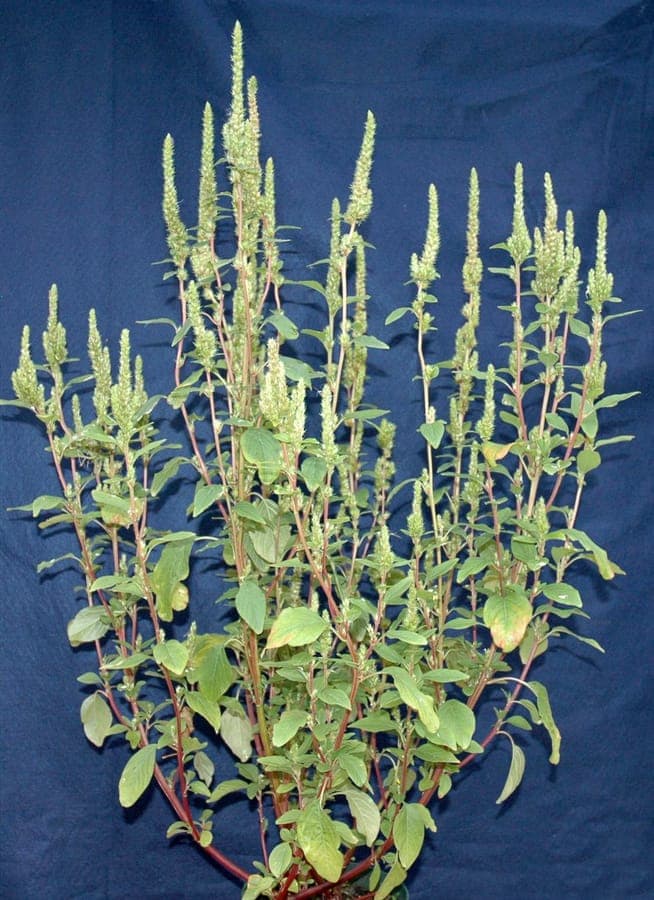
Bruce Ackley, The Ohio State University, Bugwood.org / CC BY 3.0 us, via Wikimedia Commons
Powell's amaranth: complete guide
Amaranthus powellii
Want to see Powell's amaranth: complete guide in your garden?
1 minute, no credit card
Overview
Powell's amaranth (Amaranthus powellii) is a distinctive annual plant native to southwestern North America and Mexico. This species is also known as green amaranth, Powell's pigweed, and Powell's smooth amaranth. The plant is prized for its long, green flower spikes that appear from July to October, offering a decorative accent to any garden.
This highly versatile plant fits beautifully in borders, mixed beds, and wilder garden corners. Powell's amaranth attracts butterflies and beneficial insects while providing food for birds through its seeds.
Appearance and Bloom
Powell's amaranth grows as an upright, herbaceous plant, reaching heights of 30 to 60 cm depending on growing conditions. The foliage is greenish with subtle texture.
The flowers emerge as slender, drooping spikes in vibrant green. While not eye-catching for color alone, these characteristic flower plumes are highly decorative for their elegant form. Flowering runs from July to October, giving your garden a refined appearance.
Following bloom, countless tiny seeds develop that birds eagerly consume.
Ideal Location
Powell's amaranth thrives best in full sun. The plant requires at least 6 hours of direct sunlight daily for optimal growth. In shadier spots, the plant remains more compact, which can be advantageous in smaller gardens.
Protection from strong winds is important, as slender stems can bend or break.
Soil
The plant grows well in virtually all soil types but prefers well-draining conditions. Moderately fertile soil is ideal. Overly nutrient-rich soil causes excessive vegetation at the expense of flowering.
Ensure soil moisture remains moderate; waterlogging and poorly drained conditions are poorly tolerated.
Watering
Powell's amaranth requires regular water, especially during dry spells. In the first weeks after planting, consistent moisture is essential.
Once established, the plant tolerates drought better. Water at the plant's base during the day, never overhead, to prevent fungal issues.
During extended dry periods (more than 2 weeks without rain), supplemental watering becomes necessary.
Free design
Want to see Powell's amaranth: complete guide in your garden? Make a free design now.
Pruning and Maintenance
Powell's amaranth requires minimal upkeep. Pruning is unnecessary, though you may stake plants with plant supports if they risk toppling in storms.
Do not immediately remove faded flower spikes, as they provide decorative value for extended periods. Leave some spikes standing so they can feed birds in autumn.
The plant sets seed readily, ensuring plentiful free new plants the following season.
Maintenance Calendar
May to June: Plant after last frost. Water regularly during dry spells. July to August: Flowering begins. Continue watering in dry weeks. Optional bi-weekly liquid fertilizer applications. September to October: Full bloom. Minimal watering suffices unless extreme drought occurs. November: Plant senescence. Leave some plants standing for bird food and next-year self-seeding. December to April: Winter dormancy. Prepare for the coming season.
Winter Hardiness
Powell's amaranth is an annual and cannot tolerate frost. The plant dies at the first autumn or winter frost.
Leave some seed heads on plants for natural self-seeding next season. Mark the location so volunteer seedlings aren't removed.
Suitable Combinations
Powell's amaranth pairs well with other annuals such as zinnias, cosmos, and maize. For a wild, luxuriant look, combine with culinary herbs like basil, oregano, and lavatera.
In borders, Powell's amaranth fits beautifully between perennials such as coneflowers, rudbeckia, and sage. The green spikes contrast nicely with purple and red blooms.
In Conclusion
Powell's amaranth is an easy, straightforward plant delivering significant ornamental value with minimal effort. Ideal for beginning gardeners seeking impressive decorative results. Grow your own plants from seed for even greater savings.
Available at most garden centers during season. Seedlings typically cost 2-4 euros per plant. Seed packets are even more economical at around 1-2 euros and produce dozens of plants.
Visit gardenworld.app for additional integration tips for your garden.
Want to see Powell's amaranth: complete guide in your garden? Make a free design now.
Upload a photo, pick a style, and get a photorealistic design with plant list in under a minute.
No credit card required


Similar plants
Bassia laniflora (woolly summer-cypress): complete guide
Bassia laniflora
Full guide to Bassia laniflora: origin, appearance, ideal location, soil, watering and care for this drought-tolerant annual.
Suaeda spicata: complete guide
Suaeda spicata
Everything about Suaeda spicata (spiked seablite): a rare salt-tolerant coastal succulent from the western Mediterranean and Macaronesia.
California amaranth: complete guide
Amaranthus californicus
Full guide to California amaranth (Amaranthus californicus): growing tips, ideal location, soil needs, watering, and garden design ideas.