
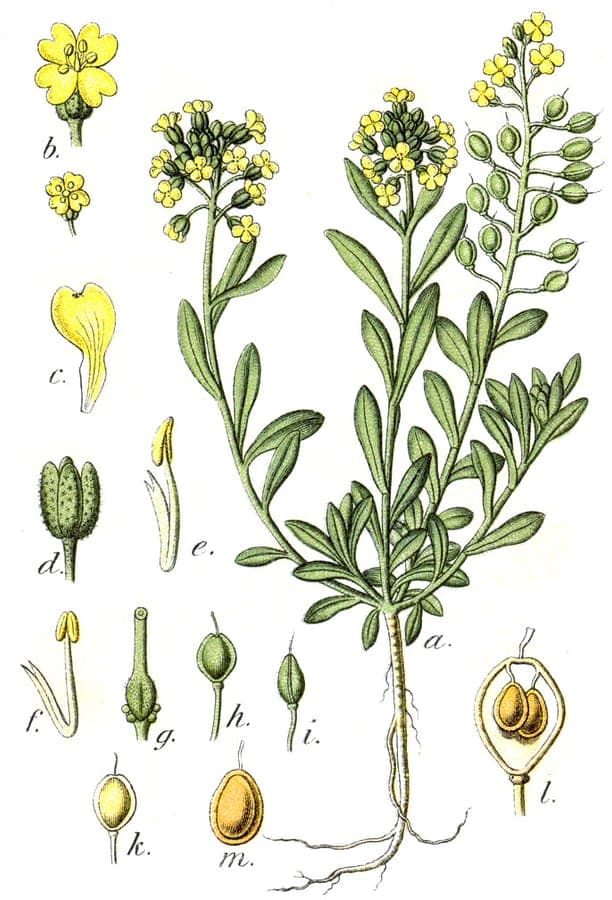
Johann Georg Sturm (Painter: Jacob Sturm) / Public domain, via Wikimedia Commons
Mountain alison: complete guide
Alyssum montanum
Want to see Mountain alison: complete guide in your garden?
1 minute, no credit card
Overview
Mountain alison (Alyssum montanum) is a tough, low-growing perennial that thrives where other plants struggle. Native to rocky slopes and alpine regions across Central and Southern Europe, it's perfectly adapted to dry, sunny conditions. Reaching just 10–15 cm in height, it forms a dense mat of dark green, leathery leaves and bursts into golden-yellow blooms each spring. It's a brilliant choice for rock gardens, walls, and drought-prone areas in the garden.
On gardenworld.app, you can design a layout that highlights mountain alison's strengths-pairing it with gravel paths or stone crevices for maximum visual impact. The platform also helps track microclimates in your yard, so you'll know exactly where this sun-lover will perform best.
Appearance & bloom cycle
The foliage is evergreen, with small, narrow, grey-green leaves that stay fresh year-round. From May to July, clusters of tiny, four-petaled yellow flowers cover the plant in waves. Each bloom lasts about 10–14 days, and deadheading encourages a second flush in late summer. The flowers have a faint honey-like scent, just strong enough to attract beneficial insects like hoverflies and small bees.
After blooming, seed pods form and split open in late summer, scattering seeds nearby. While it self-seeds lightly, it's not invasive and stays well-behaved in mixed borders.
Ideal location
Plant mountain alison in full sun-rate it a 9/10 for light needs. It thrives in USDA zones 4 to 8, handling winter lows down to -34°C. South- or west-facing slopes, dry stone walls, and raised beds with excellent drainage are ideal. Avoid shaded or damp areas: the plant will stretch, flop, and rot in poor light or wet soil.
In urban gardens, ensure good air circulation to prevent powdery mildew, especially during humid summers. Space plants 20–25 cm apart to allow airflow while still forming a cohesive ground cover.
Soil requirements
This alison prefers lean, well-drained soil. Sandy, gravelly, or limestone-based substrates work best. It tolerates poor fertility and actually blooms better in low-nutrient conditions. Rich, heavy clay soils should be amended with coarse sand, perlite, or crushed rock to improve drainage.
For container planting, mix two parts potting soil with one part grit or pumice. Always use pots with drainage holes. On gardenworld.app, use the soil prep guide to customise your mix based on local conditions and container size.
Free design
Want to see Mountain alison: complete guide in your garden? Make a free design now.
Watering
Once established, mountain alison is highly drought-tolerant. Water weekly during the first six weeks after planting, then reduce to only during prolonged dry spells. Overwatering is the most common cause of failure-soggy soil leads to crown rot. When you do water, soak deeply but infrequently to encourage deep root development.
Use rainwater when possible, especially in areas with hard tap water, which can raise soil pH over time.
Pruning
After the main bloom in early summer, shear back the plant by about 3–5 cm using hand shears or a small hedge trimmer. This keeps the plant compact, prevents legginess, and may trigger a second flowering. Remove any dead or damaged stems in early spring before new growth starts.
Avoid heavy pruning in late autumn-leave the old growth to protect the crown during winter.
Maintenance calendar
- Jan: Check for winter damage; remove any mushy stems
- Feb: No action needed
- Mar: Lightly rake around plants to remove debris
- Apr: Watch for new growth; control weeds early
- May: Flowers begin; avoid fertilising
- Jun: Peak bloom; shear back after flowering
- Jul: Second bloom possible; inspect for aphids
- Aug: Seeds ripen; collect if desired
- Sep: Reduce watering; stop feeding
- Oct: Clear fallen leaves; check for pests
- Nov: Leave plant intact for winter protection
- Dec: Minimal care; protect container plants from freeze-thaw cycles
Winter hardiness
Hardy in USDA zones 4–8, mountain alison handles cold winters with ease. The foliage may bronze in severe cold but rebounds quickly in spring. In containers, move pots to a sheltered spot or wrap with burlap to prevent root damage from repeated freezing.
Companion plants
Pair mountain alison with other drought-tolerant perennials like Sedum spectabile, Thymus serpyllum, or Dianthus deltoides. It also works well with ornamental grasses such as Festuca glauca. Avoid moisture-loving plants like astilbe or ligularia.
In a rock garden, tuck it between stones alongside Sempervivum or Echeveria for contrasting textures.
Closing
Mountain alison is a reliable, low-maintenance perennial that brings long-lasting colour to sunny, dry spots. It's perfect for gardeners who want beauty without constant care. You'll find it at garden centres across the UK and US, often near alpine or rock garden sections. Be careful not to confuse it with sweet alyssum (Alyssum maritimum), which is an annual and less cold-hardy.
With the right conditions-full sun, sharp drainage, and lean soil-this little powerhouse will thrive for years. Look for established plants at garden centres in spring, or order online from specialist nurseries. Once planted, it asks for little and gives back a lot.
Want to see Mountain alison: complete guide in your garden? Make a free design now.
Upload a photo, pick a style, and get a photorealistic design with plant list in under a minute.
No credit card required


Similar plants
Brassica cretica: complete guide
Brassica cretica
Brassica cretica, the Cretan cabbage, grows wild on Aegean cliffs. Discover how to grow this drought-tolerant, yellow-flowered Mediterranean perennial.
Corsican cabbage: complete guide
Brassica insularis
Corsican cabbage is a rare Mediterranean rock cabbage with white flowers and blue-green leaves. Location, soil and winter protection.
Prostrate cabbage: complete guide
Brassica procumbens
Prostrate cabbage is a creeping North African cliff plant with yellow flowers. Discover location, soil type and winter protection.