
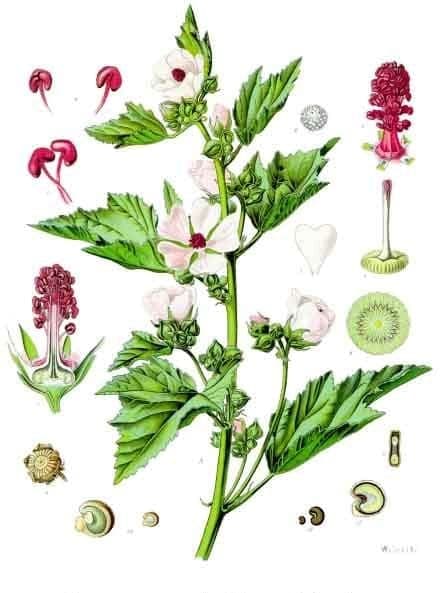
Franz Eugen Köhler, Köhler's Medizinal-Pflanzen / Public domain, via Wikimedia Commons
Marshmallow: complete guide
Althaea officinalis
Want to see Marshmallow: complete guide in your garden?
1 minute, no credit card
Overview
Marshmallow, or Althaea officinalis, is a resilient perennial that's held a special place in cottage gardens and apothecary plots for centuries. Native to damp meadows and riverbanks across Europe, North Africa, and parts of Asia, this member of the Malvaceae family thrives where moisture lingers. While often overlooked in modern gardens, it's a rewarding plant - tall, graceful, and surprisingly tough. In the wild, it grows in wetlands, but it adapts well to cultivated beds. On gardenworld.app, you can design a planting scheme that accounts for moisture retention and seasonal height changes to suit Marshmallow's needs.
Appearance & bloom cycle
Marshmallow reaches 1 to 1.5 meters in height with a spread of about 60 cm. It grows upright, with sturdy, hairy stems and soft, downy, palmate leaves that are deeply veined and light green. The foliage has a velvety texture, typical of mallows. From mid-July to late August, it produces delicate, pale pink to white flowers, each about 4–5 cm wide, with five overlapping petals and a central cluster of stamens. The blooms appear in loose racemes at the stem tips. Each flowering period lasts 6–8 weeks, providing a long display that bridges mid to late summer.
Ideal location
This plant prefers full sun to light shade - aim for at least 6 hours of direct sunlight daily. In cooler climates like the UK or northern Europe, full sun is best to encourage strong growth and flowering. It does well in informal borders, near water features, or at the back of herb gardens. Avoid deep shade, which leads to leggy growth and poor blooming. Because it's naturally found in moist areas, it's ideal for low-lying spots or near ponds. On gardenworld.app, use the sun-mapping tool to find the right microclimate for your Marshmallow.
Soil requirements
Althaea officinalis needs fertile, moisture-retentive soil rich in organic matter. It tolerates clay as long as it doesn't become waterlogged in winter. A pH between 6.0 and 7.5 is optimal. Sandy soils should be amended with compost or well-rotted manure to improve water retention. Before planting, dig in a bucket of compost per square meter to give it a strong start. Avoid overly dry or compacted ground.
Watering
Consistent moisture is key. During its active growth from April to September, water deeply once a week in dry spells - about 20 liters per plant. Use rainwater when possible, as Marshmallow is sensitive to lime and chlorine. Never let the soil dry out completely, especially in the first two growing seasons. Mulch with bark or leaf mould to conserve moisture and suppress weeds.
Free design
Want to see Marshmallow: complete guide in your garden? Make a free design now.
Pruning
In the first year, let the plant establish without pruning. From year two, cut back old stems in early spring (February to March) to around 20 cm above ground. This encourages bushier growth and stronger flowering stems. After blooming, you can lightly trim spent stems to promote a second, smaller flush in late summer. Always remove diseased or broken stems as they appear.
Maintenance calendar
- Jan: Check mulch layer; add more if needed
- Feb: Prepare for spring pruning
- Mar: Cut back last year's growth
- Apr: Start feeding with organic fertilizer
- May: Monitor for aphids; water during dry spells
- Jun: Support tall stems if needed; keep soil moist
- Jul: Peak bloom - watch for slugs on young shoots
- Aug: Deadhead spent flowers; reduce watering slightly
- Sep: Begin weaning off water as growth slows
- Oct: Leave seed heads for winter interest and birds
- Nov: Cut down remaining stems; apply fresh mulch
- Dec: Protect young plants with straw in cold areas
Winter hardiness
Marshmallow is hardy in USDA zones 3–8 (-40°C to -12°C). It dies back in autumn, but the thick, fleshy roots survive winter dormancy. In colder zones, a layer of mulch helps insulate the crown. Avoid planting in areas with poor winter drainage, as wet soil can cause root rot.
Companion plants
Pair Marshmallow with other moisture-loving perennials like Joe-Pye weed (Eutrochium), Meadowsweet (Filipendula), or Iris versicolor. In herb gardens, it grows well alongside chamomile, tansy, and lemon balm. Its height makes it a good backdrop plant. It's highly attractive to bees and hoverflies, making it a valuable pollinator plant. Avoid planting near aggressive spreaders like mint unless contained.
Closing
Marshmallow is a low-maintenance, high-reward plant that brings height, texture, and historical charm to the garden. Once established, it asks for little but gives back in beauty and utility - its roots have been used for centuries in herbal remedies. Plant it in a sunny, moist spot, give it room to grow, and enjoy its soft blooms year after year. You can find healthy stock at garden centres across the UK or online. Remember, good design starts with understanding plant needs. On gardenworld.app, you can design a garden layout that integrates Marshmallow seamlessly into your space.
Want to see Marshmallow: complete guide in your garden? Make a free design now.
Upload a photo, pick a style, and get a photorealistic design with plant list in under a minute.
No credit card required


Similar plants
Crimean linden: complete guide
Tilia × euchlora
Crimean linden is an elegant, fast-growing shade tree ideal for large gardens. Discover cultivars, spacing, maintenance tips and winter hardiness.
California flannelbush: complete guide
Fremontodendron californicum
Everything about California flannelbush (Fremontodendron californicum): sunny placement, drainage, pruning and care for this spectacular yellow-flowering shrub.
Hairy rose mallow: complete guide
Hibiscus moscheutos subsp. lasiocarpos
Full growing guide for hairy rose mallow (Hibiscus moscheutos subsp. lasiocarpos): location, soil, watering, winter hardiness and garden design tips.