
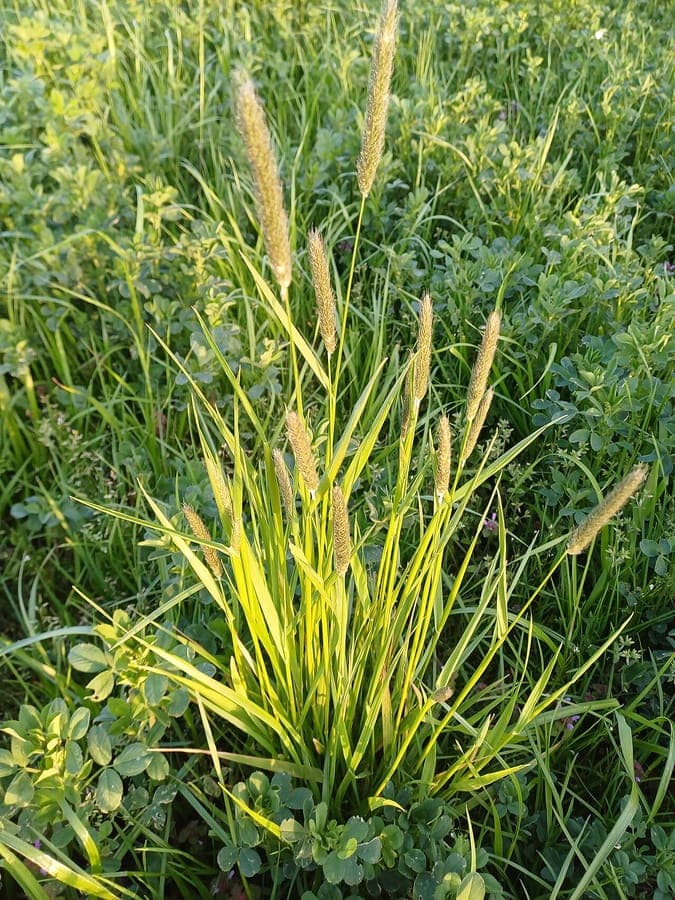
Olivier vandevelde / CC0, via Wikimedia Commons
Meadow foxtail: complete guide
Alopecurus pratensis
Want to see Meadow foxtail: complete guide in your garden?
1 minute, no credit card
Overview
Meadow foxtail, or Alopecurus pratensis, is a resilient and graceful grass that's been part of European meadows for centuries. Belonging to the Poaceae family, it's one of the earliest grasses to flower in spring, often popping up in April. In the garden, it brings soft texture and early movement, making it a valuable addition to naturalistic planting schemes. Native to a wide range of temperate regions - including the UK and much of northern Europe - it's well-suited to the climate of most gardenworld.app users, especially in USDA zones 4 to 8.
Unlike its cousin, Yellow foxtail (Alopecurus aureus), Meadow foxtail prefers moist to wet, nutrient-rich soils and thrives in full sun to light shade. It's a perennial grass, returning year after year, and forms dense, upright clumps that stay green through much of the year. On gardenworld.app, you can design a planting plan where Meadow foxtail complements wildflowers and other early grasses, creating a dynamic spring display.
Appearance & bloom cycle
Meadow foxtail grows 50 to 90 cm tall, with a spread of about 30 cm. The leaves are bright green, narrow, and arching, forming a neat basal clump. The real showpieces are the flower spikes, which appear from April to early June. They're soft green to golden-yellow, dense, and cylindrical - resembling a fox's bushy tail, hence the name. As they mature, the plumes turn a warm straw colour and remain decorative well into summer.
This early flowering period makes it ideal for gardens that need visual interest before most perennials kick in. The plumes sway gently in the breeze, adding life and texture. By late summer, the foliage may open up a bit, but it doesn't collapse entirely, maintaining structure through the seasons.
Ideal location
Plant Meadow foxtail in full sun for the best density and flowering. It tolerates light shade, such as under open-canopy trees or at woodland edges, but will grow leggier and produce fewer flower spikes. Avoid deep shade at all costs.
It works well in damp meadow gardens, wildflower lawns, or as part of a naturalistic border. Try pairing it with oxeye daisy, purple loosestrife (in controlled settings), or tussock-forming sedges. For a structural look, group it in threes or fives. On gardenworld.app, you can experiment with spacing and companion plants to see how it fits into a low-input, wildlife-friendly garden.
Soil requirements
This grass likes fertile, loamy soils that are consistently moist to wet. It handles temporary waterlogging and short-term flooding without issue. Avoid dry, sandy soils unless you're prepared to irrigate regularly. The ideal pH range is slightly acidic to neutral (5.5 to 7.0).
When planting, mix in some well-rotted compost, but don't over-fertilize. Too much nitrogen leads to floppy growth and weak stems. A little organic matter at planting time is all it needs to get established.
Free design
Want to see Meadow foxtail: complete guide in your garden? Make a free design now.
Watering
Once established, Meadow foxtail is fairly drought-tolerant, but it performs best with consistent moisture. Young plants need regular watering during dry springs and early summers. After the first year, they'll cope with occasional dry spells, but prolonged drought reduces vigour and flowering.
Use rainwater when possible - this grass evolved in environments where rainfall sustains soil moisture. Avoid overhead watering, as it can encourage fungal issues, especially in crowded plantings.
Pruning
Minimal pruning is needed. In late winter or early spring (February to March), cut back the old foliage and spent flower stems to about 10–15 cm above ground level. This clears space for fresh growth and prevents dead material from smothering new shoots.
Leave the flower heads standing through winter if possible - they add texture, catch frost, and provide cover for small birds and insects. Only cut back when new growth begins to emerge.
Maintenance calendar
- Jan: Check for accumulated debris; light tidy-up if needed
- Feb: Begin cutting back old growth
- Mar: Complete pruning; prepare for spring growth
- Apr: New shoots emerge; flowering begins
- May: Peak bloom; avoid disturbing plants
- Jun: Flowers fade; plumes turn golden
- Jul: Monitor for stress in dry spells; water if needed
- Aug: Dormant phase; minimal care required
- Sep: Assess clump density; divide if overcrowded
- Oct: Leave standing for winter interest
- Nov: Protect from heavy wet; check for fungal spots
- Dec: Final check; ensure good air circulation
Winter hardiness
Meadow foxtail is hardy to -25°C (USDA zone 4), making it suitable for most temperate climates. In the UK and northern Europe, it overwinters reliably, often retaining green or straw-coloured leaves. The standing foliage and old flower heads help insulate the crown, so it's best to leave them until spring.
In areas with heavy, waterlogged soils, crown rot can be an issue in wet winters. Improve drainage or plant on a slight mound to prevent root saturation.
Companion plants
Pair Meadow foxtail with moisture-loving perennials like meadowsweet (Filipendula ulmaria), purple moor grass (Molinia caerulea), or yellow flag iris (Iris pseudacorus). For contrast, use upright plants like hemp agrimony (Eupatorium cannabinum) or dark-leaved elder (Sambucus nigra 'Black Lace').
Avoid overly aggressive spreaders unless contained. It also works well with spring bulbs like daffodils, which bloom just before the grass flowers.
Closing
Meadow foxtail is a low-maintenance, early-flowering grass that brings subtle beauty and movement to the garden. It's not flashy, but its reliability and soft texture make it a staple in naturalistic designs. It thrives with little input and supports wildlife throughout the seasons.
You can find Meadow foxtail at garden centres across the UK, often sold as bare-root bunches or potted plants in spring. Be sure to distinguish it from similar foxtail species. With the right spot and basic care, it will return year after year. And remember: on gardenworld.app, you can visualise how Meadow foxtail integrates into your garden layout, from meadow edges to damp corners.
Want to see Meadow foxtail: complete guide in your garden? Make a free design now.
Upload a photo, pick a style, and get a photorealistic design with plant list in under a minute.
No credit card required


Similar plants
Sporobolus pungens: complete guide
Sporobolus pungens
Sporobolus pungens is a stoloniferous Mediterranean coastal grass with outstanding salt and drought tolerance, perfect for seaside and dry gardens.
Mediterranean aegilops: complete guide
Aegilops biuncialis
Everything about Aegilops biuncialis, a Mediterranean annual grass with ornamental spikes and outstanding drought tolerance for dry gardens.
Silver bluestem: complete guide
Bothriochloa saccharoides
Full guide to Bothriochloa saccharoides (silver bluestem): site, soil, watering, winter hardiness, pruning, and garden companions.