
Abu Shawka / Public domain, via Wikimedia Commons
Aloe succotrina: complete guide
Aloe succotrina
Want to see Aloe succotrina: complete guide in your garden?
1 minute, no credit card
Overview
The Aloe succotrina, also known as Fynbos aloe or Socotrine aloe, is a magnificent succulent from South Africa. This plant is renowned for being extremely nourishing and thriving on minimal care. With its elegant arrangement of thick gray-green leaves, it creates an almost sculptural presence in your garden or indoors.
This aloe grows as a robust rosette to approximately 60 centimeters height and width. Plants are compact without requiring much pruning. They are perfect for those who want minimal plant care but still enjoy greenery.
Appearance and bloom
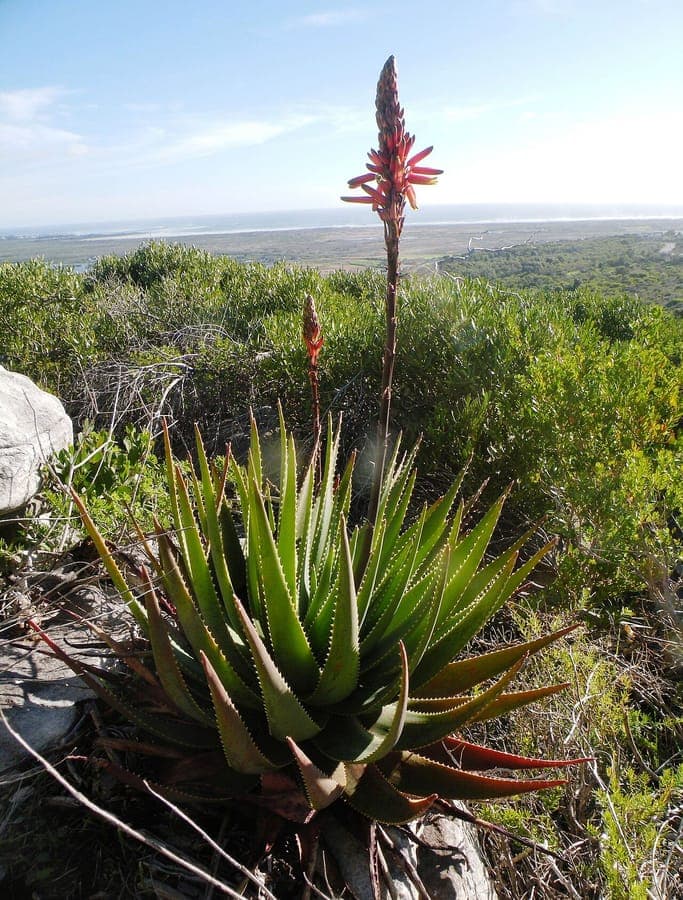
The Aloe succotrina stands out with its thick, fleshy leaves that are gray-green in color. Leaves stand in tight rosette formations with almost geometric precision. They are pointed at their ends and often feature red-tinted teeth along the margins.
In late spring to early summer, flowers appear on tall flower stalks. Blooms are tubular and bright yellow to orange-tinted. They grow in dense panicles that are highly attractive to bees and hummingbirds. After flowering, greenish seed pods develop.
Ideal location
The Aloe succotrina demands full sun. Position it where it receives at least eight hours of direct sunlight daily. Without sufficient light, it becomes spindly and less compact. In warmer regions, it actually tolerates some afternoon shade in extreme heat.
Place the plant in a dry location, not in deep shade under large trees. The site can be quite windy; aloe's love that. Indoors, choose a sunny window, preferably south-facing.
Soil
The Aloe succotrina needs extremely well-draining soil. Heavy clay is completely unsuitable. Use cactus or succulent compost, or make your own mix of universal potting soil with sand and small gravel.
When planting in gardens, add coarse sand and small pebbles to the planting hole. The plant prefers slightly acidic to neutral pH, somewhere between 6.0 and 7.0. Wet soil is absolute death for this plant.
Watering
The Aloe succotrina is extremely drought-tolerant and it helps if you almost forget to water! During growing season (spring and summer), water very sparingly. Check that soil is completely dry before watering again.
In autumn and winter, give almost no water. This is the dormant season when many succulents enter a sleep-like state. Ensure drainage is always perfect; otherwise, roots rot. Too much water is far more dangerous than too little.
Free design
Want to see Aloe succotrina: complete guide in your garden? Make a free design now.
Pruning
The Aloe succotrina barely needs pruning. It grows more compactly than many other aloe's and naturally maintains its shape well. Remove only dead or damaged leaves at the base.
If spent flower stalks look unsightly, simply trim them off at the base. The plant quickly forms new rosettes. Minimal intervention is really the motto here; let the plant maintain its natural form.
Maintenance calendar
Throughout the year you can carefully water when soil is completely dry. In spring (March-April), you can apply some organic fertilizer, cautiously. This stimulates flowering.
From May through July, enjoy magnificent blooms. From August through October, gradually reduce watering. November through February is dormancy; minimal care is needed. Check regularly for pests; aphids love aloe's.
Winter hardiness
The Aloe succotrina is not truly cold hardy in severe freezing conditions. Temperatures below -5 degrees Celsius can damage or kill the plant. In milder coastal regions, it might survive outdoors, but usually, you're better keeping it indoors or in a greenhouse.
In temperate climates, you can risk outdoors if you provide extra drainage and protection. Mulch around the plant with gravel, not leaves, which retain too much moisture.
Companion plants
The Aloe succotrina looks beautiful as a solitary specimen, both in garden and in pots. However, you can combine it with other drought-tolerant succulents like sedum, echeveria, or aeonium. Avoid planting water-loving neighbors alongside.
Grasses like Festuca glauca (blue fescue) can decoratively contrast with the blue-green aloe. Stones and gravel around it harmonize well and underscore the dry character.
Closing thoughts
The Aloe succotrina is truly a care-free plant for those with minimal gardening time. It remains a fascinating plant with its elegant forms and spectacular flowers. This is an investment that lasts years with minimal support.
Available at larger garden centers and online plant specialists. Ensure you select healthy specimens without brown discoloration. Indoors, you find them virtually everywhere for sale.
With this guide, you're ready to welcome this South African beauty into your world. Enjoy years of worry-free greenery!
Want to see Aloe succotrina: complete guide in your garden? Make a free design now.
Upload a photo, pick a style, and get a photorealistic design with plant list in under a minute.
No credit card required


Similar plants
Aloe castanea: complete guide
Aloe castanea
Discover Chestnut aloe, a South African succulent. Growth, nutrition, and garden integration for warm climates and container culture.
Aloe pratensis: complete guide
Aloe pratensis
Learn how to grow Meadow aloe, a South African succulent. Nutrition, propagation, and front yard integration for warm climates or containers.
Pretoria aloe: complete guide
Aloe pretoriensis
Discover Aloe pretoriensis, an elegant South African succulent with striking red blooms. Learn care tips, ideal conditions, and companion planting for this hardy, drought-tolerant plant.