
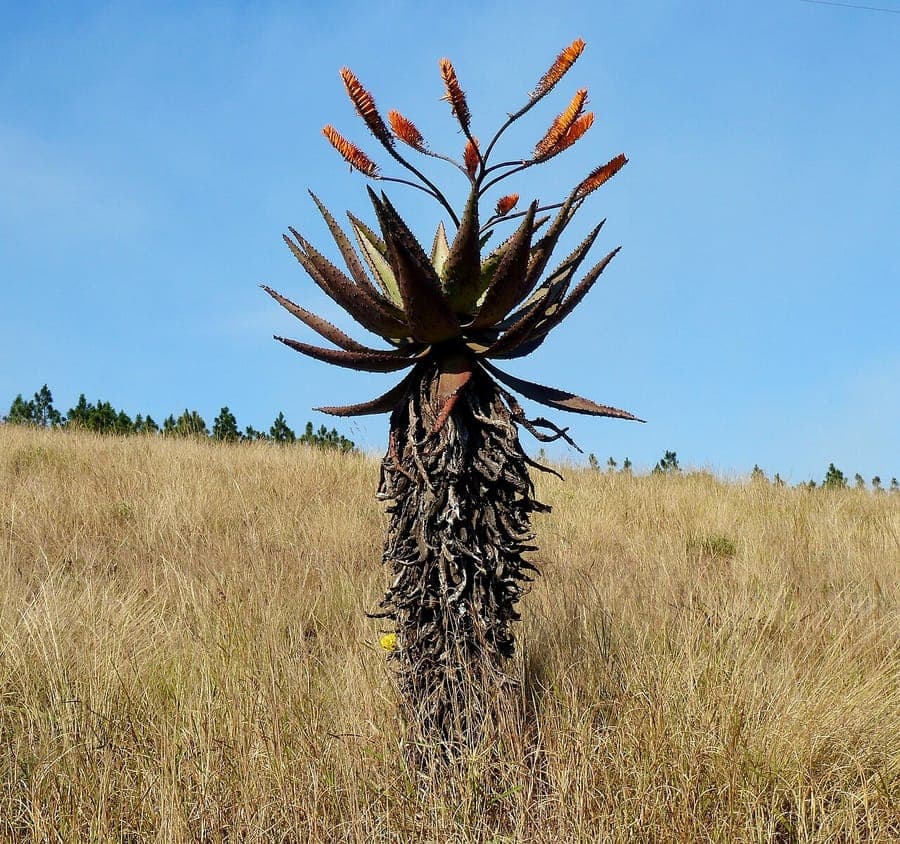
JMK / CC BY-SA 3.0, via Wikimedia Commons
Aloe marlothii: complete guide
Aloe marlothii
Want to see Aloe marlothii: complete guide in your garden?
1 minute, no credit card
Overview
Aloe marlothii, commonly called Transvaal aloe or mountain aloe, is an impressive succulent native to South Africa's rocky highlands. This sturdy plant forms large, elegant rosettes of thick grey-green leaves, reaching up to 1.5 meters in diameter. It is ideal for Mediterranean gardens, rock gardens, and roof terraces in warm climates. In its native habitat, it thrives in the mountains and scrublands of Botswana, Mozambique, and KwaZulu-Natal.
Appearance and Bloom
The Transvaal aloe produces tall, columnar flower spikes bearing yellow-orange blooms that typically emerge in late winter through early spring (February to April). These flowers are highly ornamental and attract pollinators. The thick, succulent leaves are densely arranged with small marginal prickles and terminal spines. Mature plants reach 1.5 to 2 meters in height and width, depending on growing conditions and site exposure.
Ideal Location
Absolutely prioritize full sun for Aloe marlothii. This plant requires 6 to 8 hours of direct sunlight daily to thrive. Without adequate light, foliage becomes pale and growth becomes weak and stretched. Position it in gardens with excellent drainage, against south or west-facing walls, or in large containers on sunny terraces. In temperate climates, bring potted specimens indoors for winter or protect outdoor plants with burlap covering.
Soil
Excellent drainage is non-negotiable for this aloe. Heavy clay soils inevitably cause root rot. Mix cactus or succulent compost with sand and pea gravel to achieve a very porous medium, targeting 40% inorganic material. Neutral to slightly alkaline soil (pH 6.5-7.5) suits it well. In garden beds, amend native soil by incorporating sand and coarse gravel thoroughly. For container growing, use specialized succulent mixes; never standard potting compost, which retains too much moisture.
Watering
Water sparingly year-round. During the growing season (May to September), water only when soil is completely dry at least 5 centimetres deep. In autumn and winter, reduce watering to a bare minimum; many plants survive the dormant period completely dry. Check periodically that the plant's crown does not begin to rot. Excessive moisture is the leading cause of failure. For container plants, ensure water drains freely from drainage holes after watering.
Free design
Want to see Aloe marlothii: complete guide in your garden? Make a free design now.
Pruning
Regular pruning is unnecessary. Remove only dead or diseased leaves at the base to prevent fungal issues. If the plant becomes too wide, carefully detach offsets and replant them. Fortunately, this aloe grows slowly, so pruning is seldom required. Damaged or discoloured foliage from winter frost can be removed once temperatures stabilize in spring.
Maintenance Calendar
May to September: moderate watering, pest checks, possible offset propagation. October to April: minimal watering, no feeding, frost protection in temperate zones. February to April: flowering period; no intervention needed. July to August: peak heat; monitor to prevent excessive drought stress in extreme conditions.
Winter Hardiness
Aloe marlothii is sensitive to frost below 5-10 degrees Celsius. In regions where winter temperatures drop below -5 degrees C, protection is essential: use frost cloth, straw mulch, or burlap wrapping. Good drainage and a dry winter minimize damage. In warm regions (USDA zones 9b-11), this aloe overwinters reliably outdoors. Heavy, wet snow can snap leaves; protective covering is advisable.
Companion Plants
The Transvaal aloe pairs beautifully with other drought-tolerant Mediterranean species: Echeveria, Sempervivum, Lavandula, Rosmarinus, Salvia, Phormium, and ornamental grasses like Stipa. Hard landscaping with boulders and gravel enhances a Mediterranean or alpine garden theme. Avoid crowding; allow air circulation around the rosette to prevent fungal issues.
Closing Remarks
Aloe marlothii is a stunning, mature-plant choice for gardeners confident in growing true tropicals. With minimal care, full sun, and excellent drainage, this impressive succulent flourishes for decades. Its winter blooms and sculptural form make it a showstopper in south-facing gardens. Protect against frost in temperate zones and enjoy this natural marvel season after season.
Want to see Aloe marlothii: complete guide in your garden? Make a free design now.
Upload a photo, pick a style, and get a photorealistic design with plant list in under a minute.
No credit card required


Similar plants
Aloe castanea: complete guide
Aloe castanea
Discover Chestnut aloe, a South African succulent. Growth, nutrition, and garden integration for warm climates and container culture.
Aloe pratensis: complete guide
Aloe pratensis
Learn how to grow Meadow aloe, a South African succulent. Nutrition, propagation, and front yard integration for warm climates or containers.
Pretoria aloe: complete guide
Aloe pretoriensis
Discover Aloe pretoriensis, an elegant South African succulent with striking red blooms. Learn care tips, ideal conditions, and companion planting for this hardy, drought-tolerant plant.