
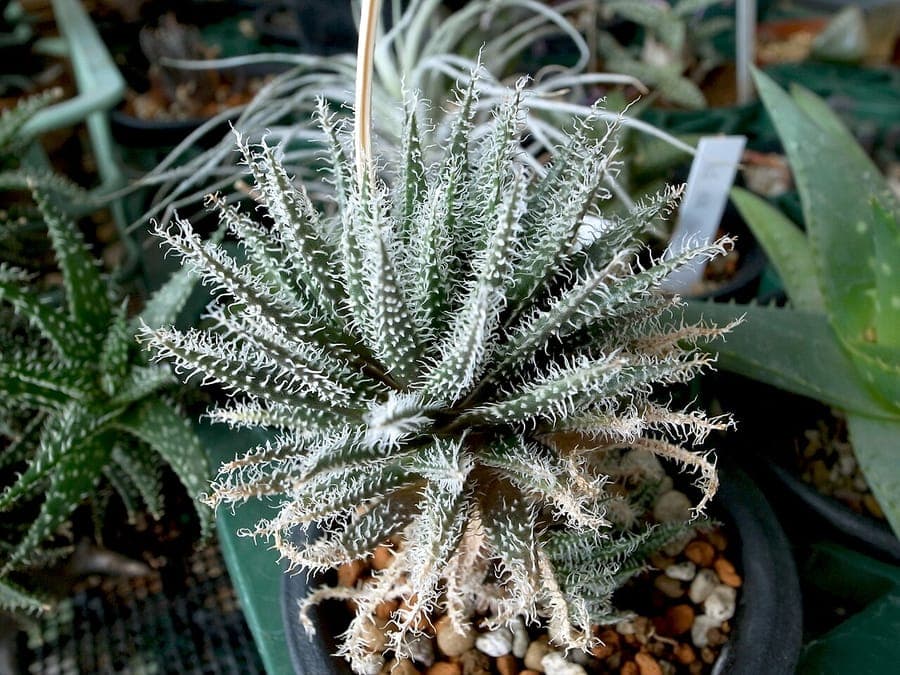
salchu from Japan / CC BY-SA 2.0, via Wikimedia Commons
Haworth Aloe (Aloe haworthioides): complete guide
Aloe haworthioides
Want to see Haworth Aloe (Aloe haworthioides): complete guide in your garden?
1 minute, no credit card
Overview
Aloe haworthioides, known as Haworth Aloe or Twelve-rows Aloe, is a compact and decorative succulent from Madagascar. This aloe belongs to the Asphodelaceae family and is a very popular houseplant choice. The Haworth Aloe is significantly smaller than many other aloe species and forms dense, clustered groups.
The plant is extremely drought-tolerant and low-maintenance, making it perfect for beginners with succulents. Although native to Madagascar, it's remarkably robust and can thrive in many different conditions.
Appearance and Bloom
Haworth Aloe forms small rosettes of approximately 5-10 centimeters diameter with thick, light greenish to gray-green leaves. The leaves are pointed and linear, giving it a compact, decorative form. The plant grows very slowly and forms offsets over years, creating small colonies.
Flowers appear in spring in yellow to yellow-orange color, grouped in small, clustered flower spikes atop thin stems. The flowers are small but charming and attract bees. After blooming, the plant can go many years without flowering again.
Ideal Location
Haworth Aloe prefers a very bright location indoors, preferably with direct sunlight for at least 4-5 hours daily. Windows with southeast or south-facing aspects work best. In very warm climates, some shade during the hottest part of the day is welcome.
The plant can also be grown under grow lights if direct sunlight isn't available. Use Haworth Aloe as an indoor plant on windowsills, in display cabinets with good light, or as part of a succulent collection.
Soil
Haworth Aloe requires very well-draining soil. Use special succulent or cactus soil mixed with extra perlite or sand. This combination prevents water stagnation, which is very dangerous for this plant.
There's no need for nutrient-rich soil; the plant actually grows better in poor, mineral soil. Don't add organic matter or use only minimally. In pots, use clay or terracotta pots that allow water to evaporate.
Free design
Want to see Haworth Aloe (Aloe haworthioides): complete guide in your garden? Make a free design now.
Watering
Haworth Aloe requires very minimal watering. Water only when soil is completely dry, usually once every 2-3 weeks in summer. In fall and winter, water can be reduced almost entirely to once monthly or less.
The plant can go very long without water. Overwatering is the biggest enemy. Ensure water doesn't accumulate in the rosette. In winter, when the plant goes dormant, significantly reduce watering frequency.
Pruning
Haworth Aloe requires no pruning. Remove only completely dead leaves at the base. Since the plant grows very slowly, shaping isn't necessary.
Offsets can be removed and potted separately if you want to expand the collection or propagate. This is best done during the growing season.
Maintenance Calendar
In spring (March-April), flowers carefully begin to appear. This is the growing season and some water and feeding can be given. In May-June, flowers fade and seeds begin to set.
In July-August the plant grows slowly. Water minimally. In September-October growing periods begin to decline. From November to February the plant is completely dormant; minimal water.
Winter Hardiness
Haworth Aloe cannot be grown outdoors in cold climates. It must always be grown indoors or in very warm, sheltered gardens. The plant cannot tolerate temperatures below 5-8°C.
In warm living rooms the plant grows best. A light winter temperature around 15°C is ideal. Not near heating pipes or cold windows.
Companion Plants
Haworth Aloe works well with other compact succulents in a shared pot or display cabinet. Echeveria, sedums, and other small aloe species are good neighbors. It can also be underplanted with very small rosette-forming plants.
Avoid wet-loving plants or plants that need lots of water in the immediate vicinity.
Final Thoughts
Haworth Aloe is a charming and very low-maintenance plant, perfect for rooms and living spaces. With its compact growth, decorative appearance, and minimal watering needs, it's an ideal plant for indoor gardeners. The plant is sometimes available from plant sellers and online retailers.
Whether building an indoor succulent collection, planting a display cabinet, or simply looking for a robust houseplant, Haworth Aloe is a good choice. Visit gardenworld.app and gardenworld.app for more inspiration about houseplant choices.
Want to see Haworth Aloe (Aloe haworthioides): complete guide in your garden? Make a free design now.
Upload a photo, pick a style, and get a photorealistic design with plant list in under a minute.
No credit card required


Similar plants
Aloe castanea: complete guide
Aloe castanea
Discover Chestnut aloe, a South African succulent. Growth, nutrition, and garden integration for warm climates and container culture.
Aloe pratensis: complete guide
Aloe pratensis
Learn how to grow Meadow aloe, a South African succulent. Nutrition, propagation, and front yard integration for warm climates or containers.
Pretoria aloe: complete guide
Aloe pretoriensis
Discover Aloe pretoriensis, an elegant South African succulent with striking red blooms. Learn care tips, ideal conditions, and companion planting for this hardy, drought-tolerant plant.