
Quadell / CC BY-SA 3.0, via Wikimedia Commons
Grey alder: complete guide
Alnus incana
Want to see Grey alder: complete guide in your garden?
1 minute, no credit card
Overview
The grey alder (Alnus incana) is a resilient, fast-growing tree or large shrub that thrives in challenging conditions where many other species struggle. Native to regions including Alaska, British Columbia, the Baltic States, and central Europe, it's well adapted to cool temperate climates and wet soils. Mature trees reach 10–15 m in height with a spread of 6–8 m, making them ideal for larger gardens, riparian buffers, or naturalistic plantings. Unlike many trees, Alnus incana actually improves soil quality through nitrogen fixation, thanks to symbiotic bacteria in its root nodules.
This species is particularly valuable for gardeners dealing with poorly drained clay or heavy loam. It's not fussy about soil fertility and can grow in neglected or recovering land. On gardenworld.app, you can create a garden design that incorporates grey alder into wetland areas or slope stabilisation projects, ensuring it's placed where it will thrive.
Appearance & bloom cycle
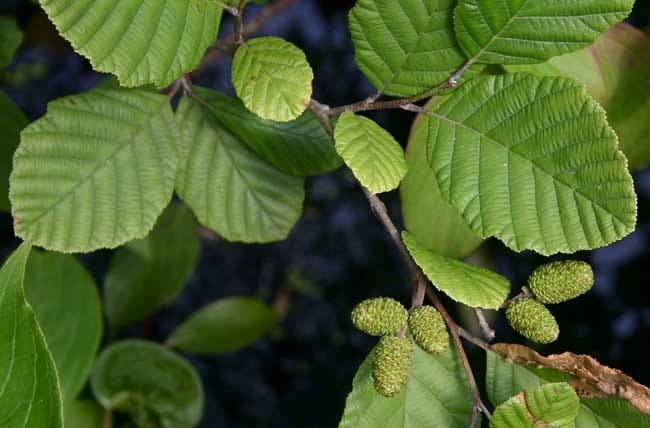
The grey alder is instantly recognisable by its smooth, pale grey bark that develops shallow fissures with age. The leaves are broadly oval, 4–10 cm long, with a doubly serrated margin and a slightly wrinkled upper surface. Young foliage emerges in April with a soft, downy texture and a bright green hue, maturing to a deeper green by midsummer. In autumn, the leaves turn a pale yellow, sometimes with hints of orange, before falling.
Flowering occurs early, from February through March. Male catkins appear first-long, pendulous, yellowish-brown structures that release pollen in the wind. Female flowers are smaller, upright, and dark red to purple, maturing into woody, cone-like strobiles that persist through winter. These 'cones' contain tiny winged seeds and provide visual interest during the dormant season.
Ideal location
With a light requirement of 7 out of 10, grey alder performs best in full sun to partial shade. Aim for at least 6 hours of direct sunlight daily. While it tolerates light shade, too much reduces flowering and slows growth.
Because it loves moisture, the grey alder is perfect for planting near ponds, ditches, or in low-lying areas that collect rainwater. It's also excellent for erosion control on stream banks or damp slopes. Avoid dry, sandy soils or exposed, windy sites that promote dehydration. USDA hardiness zones 3–7 are ideal, covering most of the UK, northern US, and Canada.
Soil requirements
Grey alder prefers soils with a pH between 5.0 and 7.0-slightly acidic to neutral. It handles heavy clay and compacted soils with ease, as long as there's consistent moisture. One of its greatest strengths is its ability to fix atmospheric nitrogen through Frankia bacteria in root nodules. This means it enriches the soil and can act as a nurse tree for slower-growing species.
While it tolerates waterlogged conditions better than most trees, standing water for prolonged periods can still lead to root rot. Improve drainage in dense soils with organic matter or coarse grit. No fertiliser is needed-this plant thrives on neglect.
Free design
Want to see Grey alder: complete guide in your garden? Make a free design now.
Watering
Young trees require regular watering during their first two to three years, especially in summer droughts. Provide 15–20 litres per week during dry spells. Once established, grey alder is largely self-sufficient, drawing moisture from deep in the soil profile.
In naturally damp areas, supplemental watering is rarely necessary. In urban gardens or compacted sites, monitor soil moisture and water when the top 5 cm of soil feels dry. Mulching with wood chips helps retain moisture and suppress weeds.
Pruning
Pruning is rarely needed. The grey alder naturally develops a strong central leader and open canopy. Only remove dead, damaged, or crossing branches, and do so in late winter or early spring before budbreak.
Avoid heavy pruning, as it can weaken the tree and stimulate excessive suckering. Use clean, sharp tools and disinfect between cuts to prevent disease spread. If you're training it as a multi-stemmed shrub, prune lower branches gradually over several seasons.
Maintenance calendar
- January: Inspect for deadwood; prepare tools.
- February: Catkins emerge; avoid pruning during pollen release.
- March: Final pruning window; check for pests.
- April: New leaves appear; monitor for aphids.
- May: Watch for fungal issues in wet weather.
- June–August: Minimal care; water only in extended droughts.
- September: No feeding; leave leaf litter to decompose.
- October: Collect seed cones for propagation; inspect structural integrity.
- November: Protect young trunks from rodents with guards.
- December: Enjoy winter form; note any storm damage.
Winter hardiness
Extremely hardy, grey alder survives in USDA zones 3–7, enduring temperatures down to -40°C. It's fully deciduous and sheds leaves in late autumn. The bark and wood are resilient to ice and snow load. While mature trees need no protection, young saplings benefit from tree guards to prevent rabbit or vole damage.
Companion plants
Pair grey alder with moisture-loving species such as goat's beard (Aruncus dioicus), marsh marigold (Caltha palustris), or tussock sedge (Carex stricta). Underplant with wild ginger (Asarum europaeum) or European ginger for ground cover. For vertical interest, consider dogwoods (Cornus sericea) or willows (Salix spp.), which share similar growing conditions.
On gardenworld.app, you can explore garden designs featuring grey alder alongside compatible companions, helping you build a low-maintenance, wildlife-friendly space.
Closing
The grey alder is a powerhouse in ecological gardening. It stabilises soil, supports pollinators, and enriches the land-making it a smart choice for sustainable landscapes. Though not flashy in bloom, its early catkins and winter cones add quiet charm. With minimal care and high adaptability, it's a tree that gives back more than it takes. Find healthy specimens at garden centres across the UK and US, especially during spring planting season. Give it space, moisture, and a little time, and it will serve your garden for decades.
Want to see Grey alder: complete guide in your garden? Make a free design now.
Upload a photo, pick a style, and get a photorealistic design with plant list in under a minute.
No credit card required


Similar plants
Heart-leaf birch: complete guide
Betula cordifolia
Heart-leaf birch is an attractive North American birch tree for large gardens. Discover growth, white papery bark and winter hardiness.
Tropical hornbeam: complete guide
Carpinus tropicalis
Everything about Carpinus tropicalis, the tropical hornbeam from Central America. Growing tips, location, care, and garden use explained.
Japanese Alder (Alnus firma): complete guide
Alnus firma
Learn everything about Japanese Alder in our complete guide. Discover care, growth, and applications for larger gardens.