
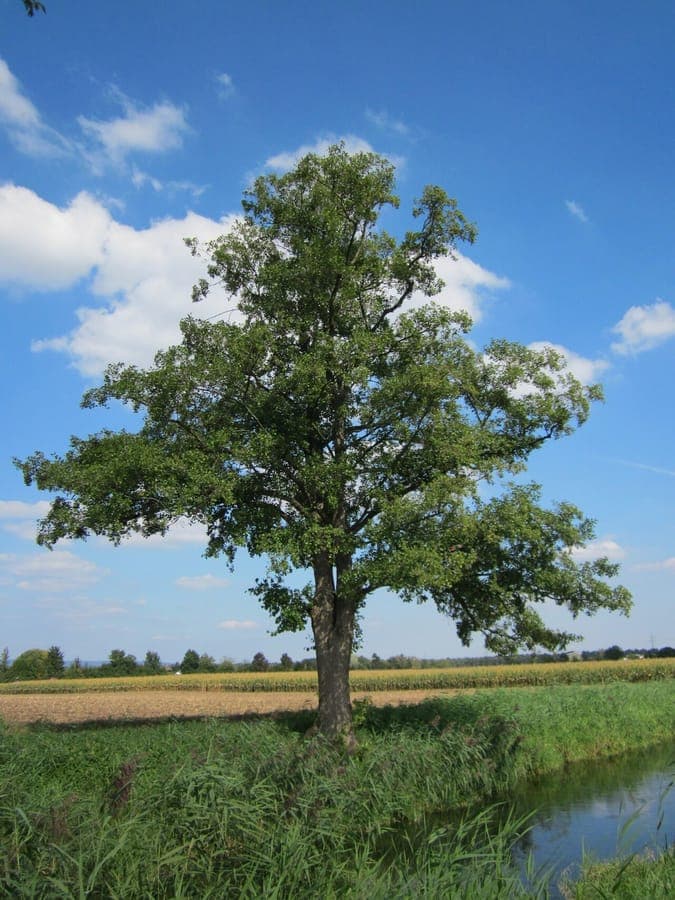
AnRo0002 / CC0, via Wikimedia Commons
European alder: complete guide
Alnus glutinosa
Want to see European alder: complete guide in your garden?
1 minute, no credit card
Overview
The European alder, Alnus glutinosa, isn't the flashiest tree in the garden, but it's one of the toughest. Native across much of Europe, from the Baltic States down to the Balkans and west into France, it thrives where other trees struggle - particularly in wet, poorly drained soils. If you've got a soggy corner in your garden, a low spot that floods after heavy rain, or even a stream bank you're trying to stabilise, this tree should be on your shortlist.
It grows fast - 30 to 50 cm per year when young - and reaches 15 to 25 meters in height with a spread of 8 to 12 meters. It's deciduous, with a straight trunk and a rounded crown. What makes it special isn't just its tolerance for wet feet, but its ability to fix nitrogen in the soil thanks to symbiotic bacteria in root nodules. That means it actually enriches the ground around it, making life easier for nearby plants.
On gardenworld.app, you can design a planting scheme that uses the European alder as a backbone for wetland-style gardens, combining it with moisture-loving perennials and shrubs. It's also a great choice for naturalising in larger plots or along boundaries.
Appearance & bloom cycle
The European alder has a distinctive look. Young twigs are sticky to the touch - that's what "glutinosa" means - and dark brown. Leaves are 4 to 8 cm wide, rounded or slightly heart-shaped, with a serrated edge and a blunt tip. They're dark green and glossy on top, paler underneath, often with fine hairs along the veins.
Flowering happens early. From January onwards, male catkins appear - long, pendulous, golden-yellow tassels up to 10 cm long. At the same time, tiny reddish-brown female flowers develop, which mature into woody, cone-like fruits that persist through winter. These open in spring to release tiny winged seeds, dispersed by wind and water.
In autumn, the leaves turn a soft yellow-green, not showy but pleasant. The real standout is the winter silhouette: bare branches hung with catkins and old cones, catching the low winter sun.
Ideal location
Full sun to partial shade works fine. The key isn't light - it's moisture. This tree needs consistently damp to waterlogged soil. Plant it in a spot that stays wet year-round, or where water collects after rain.
Avoid planting near septic tanks, drainage pipes, or house foundations - its roots are vigorous and can infiltrate cracked lines. Keep at least 5 meters from buildings. If you're unsure about spacing or placement, use gardenworld.app to visualise how the tree will grow over time, including root spread and canopy size.
Soil requirements
Heavy clay, silt, or loam - all fine, as long as the soil stays wet. It tolerates pH from 4.5 to 7.5, so both acidic and slightly alkaline conditions are okay. What it won't tolerate is dryness. Sandy, fast-draining soils are a no-go unless you're prepared to irrigate regularly.
The tree doesn't need fertile soil - it actually does better in nutrient-poor conditions because it makes its own nitrogen.
Free design
Want to see European alder: complete guide in your garden? Make a free design now.
Watering
Young trees need consistent watering in their first two to three years, especially during dry spells in summer. Give them 20 litres per week, more if temperatures rise above 25°C. Once established, they're self-sufficient in wet conditions.
In regions with dry summers, even mature trees may show stress - curling leaves, early yellowing. Then, supplemental watering helps.
Pruning
Minimal pruning needed. The natural shape is attractive and balanced. Only prune to remove dead wood, damaged branches, or to clear paths and structures. Best time: late winter or early spring, before bud break.
Avoid pruning in winter - the tree "bleeds" sap, which can weaken it. Use clean, sharp tools. And wear gloves - the sticky resin on young shoots can irritate skin.
Maintenance calendar
- January: Check for winter damage, observe catkins
- February: Final pruning window before growth resumes
- March: New leaves emerge, water if dry
- April: Catkins release pollen, ensure soil moisture
- May: Seeds develop, watch for fungal issues in wet weather
- June: Monitor for aphids or caterpillars
- July: Water young trees during droughts
- August: No action needed, tree is dormant
- September: Hold off on pruning, leaves begin colouring
- October: Leave fallen leaves - they enrich the soil
- November: Check for loose branches after storms
- December: Minimal care, tree is in winter rest
Winter hardiness
Hardy in USDA zones 4 to 8. It handles temperatures down to -30°C without issue. No winter protection needed in the UK, Ireland, or most of continental Europe. The persistent cones and early catkins add winter interest.
Companion plants
Pair with moisture-loving species: Meadowsweet (Filipendula ulmaria), Flag iris (Iris pseudacorus), or Purple loosestrife (Lythrum salicaria). Underplant with Carex species or Rodgersia for texture.
Avoid drought-tolerant plants like lavender, sedum, or ornamental grasses that need dry roots.
Closing
The European alder isn't grown for its flowers or fruit, but for its resilience and ecological benefits. It stabilises soil, supports wildlife, and improves growing conditions for other plants. If you've got a wet patch that's hard to use, this tree could be your solution.
Young trees are available at garden centres across the UK and Europe. Look for healthy root balls - avoid those that are dry or circling.
On gardenworld.app, you can explore landscape designs that feature the European alder as a functional and attractive element. It's not a show-off, but it's a workhorse - and every garden needs a few of those.
Want to see European alder: complete guide in your garden? Make a free design now.
Upload a photo, pick a style, and get a photorealistic design with plant list in under a minute.
No credit card required


Similar plants
Heart-leaf birch: complete guide
Betula cordifolia
Heart-leaf birch is an attractive North American birch tree for large gardens. Discover growth, white papery bark and winter hardiness.
Tropical hornbeam: complete guide
Carpinus tropicalis
Everything about Carpinus tropicalis, the tropical hornbeam from Central America. Growing tips, location, care, and garden use explained.
Japanese Alder (Alnus firma): complete guide
Alnus firma
Learn everything about Japanese Alder in our complete guide. Discover care, growth, and applications for larger gardens.