
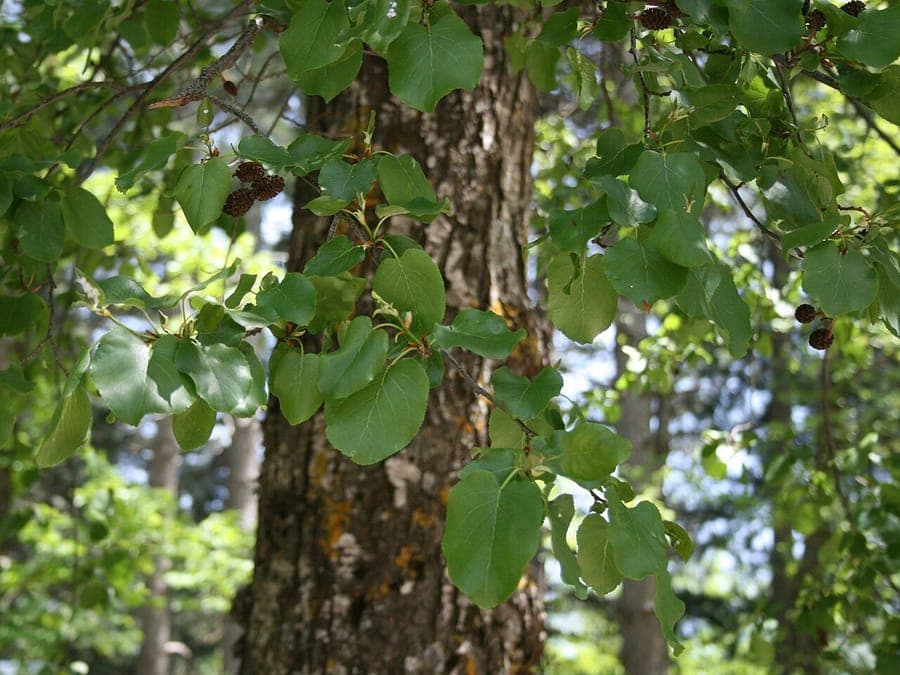
Franz Xaver / CC BY-SA 3.0, via Wikimedia Commons
Italian alder: complete guide
Alnus cordata
Want to see Italian alder: complete guide in your garden?
1 minute, no credit card
Overview
Alnus cordata, commonly known as Italian alder, is a striking deciduous tree that behaves almost evergreen in milder climates. Native to Corsica and southern Italy, it's adapted to Mediterranean conditions but thrives in temperate gardens across USDA zones 7 to 9 (-15°C to -7°C). It grows quickly - often 30 to 40 cm per year - and can reach 15 to 20 meters in height with a spread of 8 to 10 meters over time. Its upright, rounded crown makes it ideal as a specimen tree, windbreak, or shade provider in larger gardens.
One of its most distinctive traits is its persistent foliage. Unlike most deciduous trees, Italian alder holds onto its leaves well into winter, with leaf drop typically occurring in February, just before new growth emerges. This gives it year-round presence and makes it useful for screening or structure in garden design.
On gardenworld.app, you can create a custom garden layout that accounts for the mature size and shade cast of an Italian alder, ensuring it fits your space without overcrowding. It's also tolerant of urban pollution, making it a good choice for city gardens or streetscapes.
Appearance & bloom cycle
The Italian alder gets its name from its heart-shaped leaves - glossy, dark green, and 5 to 10 cm wide. They're leathery to the touch and remain on the tree much longer than typical deciduous species. In autumn, they don't develop bright fall colors but gradually turn dull and dry before falling in late winter.
Flowering occurs in February, when male catkins appear as long, pendulous greenish-yellow spikes, 5 to 8 cm in length. Female flowers are tiny, upright, and reddish-brown, developing into small woody cones that persist through winter and release seeds in spring. The contrast between the dangling catkins and the stiff cones adds texture and interest during the dormant season.
Ideal location
Italian alder prefers full sun to light shade - around 8 out of 10 on the light scale. It performs best in open areas with unobstructed access to sunlight and air circulation. Plant it at least 3 meters from buildings or driveways to avoid root pressure on foundations or paving.
It's excellent near ponds or in damp areas but also tolerates average garden soils if moisture is consistent. If you're considering planting one in a city garden, use gardenworld.app to visualize how it will fit within your space, including future canopy spread and root zone.
Soil requirements
This tree is adaptable but thrives in moist, well-drained loam or clay soils with a neutral to slightly alkaline pH of 7.0 to 7.5. It tolerates occasional waterlogging but doesn't like permanently saturated roots. Avoid strongly acidic soils (below pH 6.5), as this can lead to nutrient deficiencies, particularly iron chlorosis.
If planting in sandy soil, amend with compost or well-rotted manure to improve water retention. A 5 to 8 cm layer of organic mulch helps maintain moisture and suppresses weeds around the base.
Free design
Want to see Italian alder: complete guide in your garden? Make a free design now.
Watering
Young trees need consistent watering during their first two growing seasons - at least 20 liters per week during dry spells. Deep, infrequent watering encourages strong root development. Once established, Italian alder is moderately drought-tolerant but grows best with reliable soil moisture.
During prolonged summer droughts, occasional deep watering will prevent stress and leaf scorch, especially in exposed sites.
Pruning
Minimal pruning is required. Remove dead, damaged, or crossing branches in late winter (January to early February) before new growth begins. Avoid heavy pruning - the tree responds slowly and may become vulnerable to fungal infections.
If shaping is needed, do so gradually over several years. Never top the tree, as this ruins its natural form and weakens the structure.
Maintenance calendar
- January: Inspect for winter damage, light pruning
- February: Catkins emerge, final pruning window
- March: New leaves begin to unfurl, start light feeding
- April–June: Rapid growth phase, monitor for pests
- July–August: Water during extended dry periods
- September–October: Leaves begin to yellow and dry
- November–December: Check mulch layer, protect young trunks from frost
Winter hardiness
Hardy to USDA zone 7, Italian alder can survive temperatures down to -15°C. Young trees benefit from trunk wrapping or hessian protection in colder areas. Mature trees handle cold well but may suffer bark splitting during rapid freeze-thaw cycles.
Its semi-evergreen nature means it keeps visual interest in winter, though leaves may brown in harsh conditions. This doesn't harm the tree and is mostly aesthetic.
Companion plants
Underplant with shade-tolerant, moisture-loving perennials like Helleborus foetidus, Carex elata 'Aurea', or Tellima grandiflora. For a woodland look, pair with ferns or epimediums. Avoid invasive groundcovers like ivy, which can smother surface roots.
In formal settings, low boxwood hedges or ornamental grasses work well, provided they don't compete heavily for water.
Closing
Italian alder is a resilient, fast-growing tree that brings structure, shade, and year-round presence to the garden. Its glossy foliage, winter catkins, and adaptability make it a standout choice for larger landscapes. You can find it at garden centres across the UK, often as a 80–120 cm whips or container-grown saplings.
With proper siting and care, it will thrive for decades. Remember to plan ahead - this tree needs space. Use gardenworld.app to map out its growth over time, including root spread and future shade patterns, so you can design a balanced, sustainable garden.
Want to see Italian alder: complete guide in your garden? Make a free design now.
Upload a photo, pick a style, and get a photorealistic design with plant list in under a minute.
No credit card required


Similar plants
Heart-leaf birch: complete guide
Betula cordifolia
Heart-leaf birch is an attractive North American birch tree for large gardens. Discover growth, white papery bark and winter hardiness.
Tropical hornbeam: complete guide
Carpinus tropicalis
Everything about Carpinus tropicalis, the tropical hornbeam from Central America. Growing tips, location, care, and garden use explained.
Japanese Alder (Alnus firma): complete guide
Alnus firma
Learn everything about Japanese Alder in our complete guide. Discover care, growth, and applications for larger gardens.