
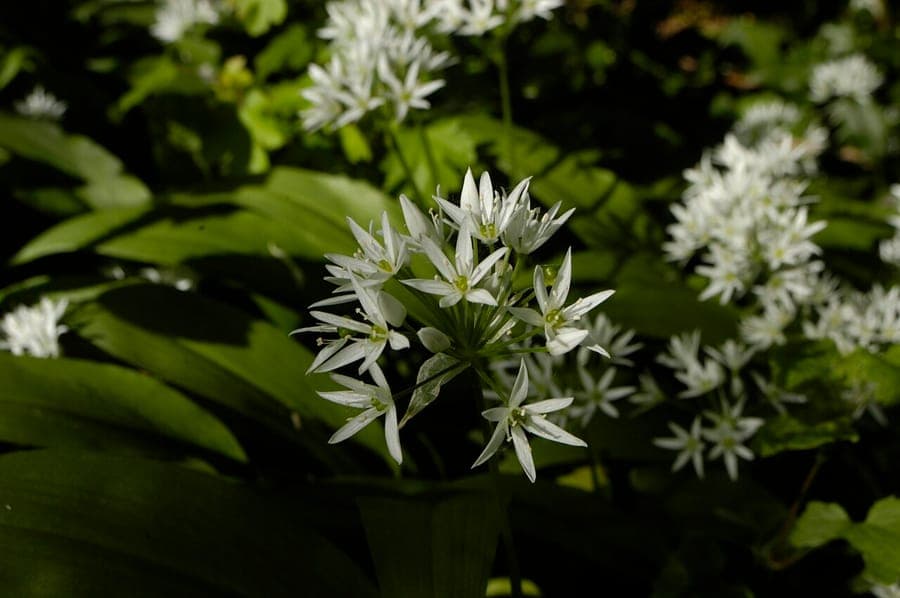
Rodolph / CC BY-SA 3.0, via Wikimedia Commons
Bear garlic: complete guide
Allium ursinum
Want to see Bear garlic: complete guide in your garden?
1 minute, no credit card
Overview
Bear garlic (Allium ursinum) is a hardy, perennial bulb plant that brings a burst of fresh green to shaded garden corners each spring. Native to forests in Central and Eastern Europe, it's perfectly adapted to temperate climates and thrives in USDA zones 4 through 8. What sets it apart is its dual value: it's both ornamental and edible. The young leaves have a delicate garlic flavor, ideal for pesto, soups, or salads, and the plant itself helps suppress weeds and enriches the soil with organic matter as it decomposes.
Unlike cultivated garlic, bear garlic spreads naturally through seed and rhizomes, forming dense colonies over time. This makes it a smart pick for difficult spots under trees or along woodland edges. It's also deer-resistant and deters slugs, which is a bonus in many gardens. If you're planning a naturalistic planting scheme, gardenworld.app offers design tools that let you map out where bear garlic will perform best based on light and soil data.
Appearance & bloom cycle
Bear garlic emerges as early as February in milder regions, with narrow, pointed leaves unfurling from a central sheath. The leaves are glossy, deep green, and typically 10–25 cm long and 2–3 cm wide. By mid-March, flower stalks rise to about 30 cm, topped with dense umbels of star-shaped white flowers. Each flower has six petals and emits a mild garlic scent that attracts early bees, hoverflies, and butterflies.
Flowering runs from April to early May, depending on local conditions. After blooming, the foliage remains green and active until June, photosynthesizing to store energy in the bulbs for next year. Cutting the leaves too early weakens the plant, so it's best to let them die back naturally. By July, the plant goes dormant, leaving no visible trace until the following spring.
Ideal location
With a light requirement of 4 out of 10, bear garlic prefers light shade to partial shade. It does best under deciduous trees like beech, birch, or hazel, which allow sunlight in early spring but provide cover once summer begins. Full sun will scorch the leaves; deep shade will stunt growth and reduce flowering.
Choose a north- or east-facing spot with consistent moisture and minimal root competition. Space plants about 30 cm apart to allow for spreading. If you're designing a natural woodland garden, bear garlic is an excellent anchor species. Use gardenworld.app to create a layered planting plan that balances bear garlic with hellebores, trilliums, and spring ephemerals.
Soil requirements
Bear garlic thrives in rich, humus-rich, loamy soil with a pH between 7.5 and 8. Avoid acidic or sandy soils unless amended with compost, leaf mold, or well-rotted manure. Before planting, work a 5–10 cm layer of organic matter into the topsoil. Steer clear of excessive lime – while bear garlic tolerates slightly alkaline conditions, too much can inhibit growth.
If your soil is heavy clay, improve drainage by mixing in perlite or grit. The roots are prone to rot in waterlogged conditions, so ensure the site doesn't hold standing water. A light mulch of fallen leaves in autumn helps retain moisture and mimics its natural forest floor habitat.
Free design
Want to see Bear garlic: complete guide in your garden? Make a free design now.
Watering
Bear garlic needs consistent moisture from March through May, its main growing season. During dry springs, water deeply once a week, preferably with rainwater to avoid chlorine and excess lime. Let the soil stay evenly moist but never soggy.
From June onward, reduce watering as the leaves begin to yellow. Once the plant enters dormancy, it requires little to no supplemental water, even during dry summers. Overwatering in summer can lead to bulb rot.
Pruning
Pruning is minimal. The only real task is removing dead or yellowing foliage after June. Never cut back the leaves during active growth – they're essential for energy storage. If harvesting leaves for cooking, pick no more than one-third per plant, and only after March when the plant is well-established.
Be careful not to confuse bear garlic with lily of the valley or wild garlic, which look similar when young. A quick sniff test helps: bear garlic smells distinctly of garlic when crushed. If you're unsure, upload a photo to gardenworld.app for instant plant ID.
Maintenance calendar
- Jan: Dormant, no action needed
- Feb: Watch for first shoots, avoid disturbance
- Mar: Plant new bulbs or divide clumps, keep moist
- Apr: Flowers open, maintain even moisture
- May: Bloom fades, let foliage grow
- Jun: Leaves yellow, stop watering gradually
- Jul–Aug: Dormant, no visible growth
- Sep: No care required
- Oct: Apply light leaf mulch
- Nov: No action
- Dec: Dormant period
Winter hardiness
Bear garlic is fully hardy in USDA zones 4–8. The bulbs survive freezing temperatures without protection, and the plant re-emerges reliably each spring. In areas with heavy snow, a thin layer of leaves or straw can offer extra insulation, but it's rarely necessary.
Companion plants
Bear garlic pairs well with other spring woodland species. Try it with hellebores, bloodroot (Sanguinaria canadensis), Anemone nemorosa, or native ferns. It also works in edible forest gardens alongside ramps or woodland strawberries, provided moisture levels match.
Avoid aggressive spreaders like mint or ivy, which can overpower it. Also, keep it away from allium-sensitive crops like beans or peas, as bear garlic may release compounds that inhibit their growth.
Closing
Bear garlic is an underrated gem for temperate gardens. It's low-maintenance, edible, and ecologically beneficial. With the right spot and a little patience, it forms a lush, green carpet that returns stronger each year. Find bulbs or plants at local garden centres in early spring, or order online. And remember: gardenworld.app helps you design a garden layout that maximizes the impact of bear garlic, with seasonal care reminders and companion planting suggestions.
Want to see Bear garlic: complete guide in your garden? Make a free design now.
Upload a photo, pick a style, and get a photorealistic design with plant list in under a minute.
No credit card required


Similar plants
Douglas' Onion: complete guide
Allium douglasii
Douglas' onion is a compact ornamental allium with purple flowers, perfect for rock gardens and sunny borders. Learn care, siting and hardiness.
Oblique onion: complete guide
Allium obliquum
The oblique onion is a hardy ornamental allium with chartreuse flower heads and blue-green foliage. Location, soil and care explained.
False hooded garlic: complete guide
Allium pseudocalyptratum
Discover false hooded garlic (Allium pseudocalyptratum): a rare ornamental onion from Lebanon for rock gardens and alpine troughs.