
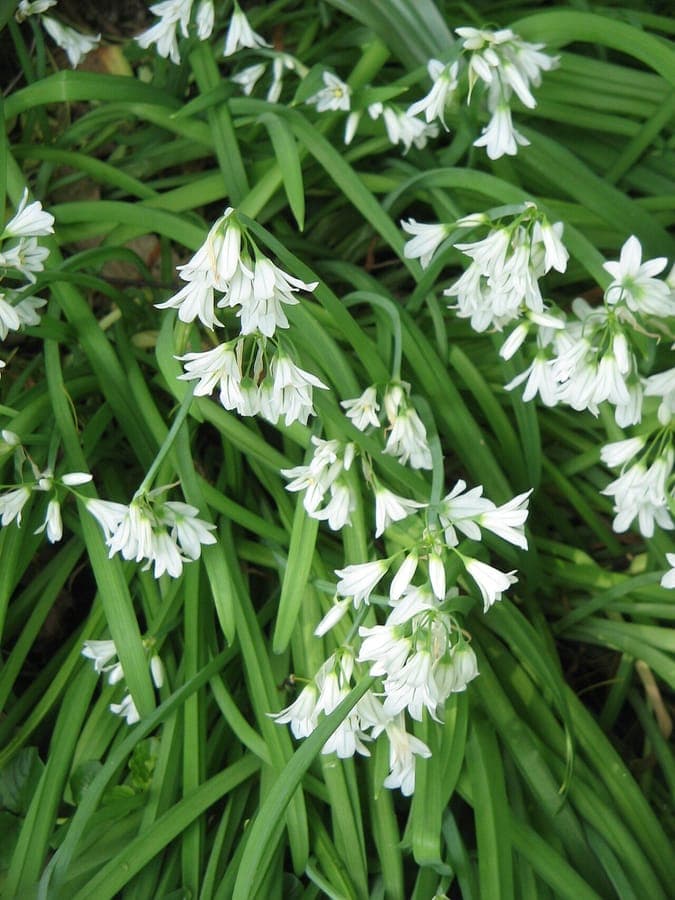
Meneerke bloem / CC BY-SA 3.0, via Wikimedia Commons
Triquetrous garlic: complete guide
Allium triquetrum
Want to see Triquetrous garlic: complete guide in your garden?
1 minute, no credit card
Overview
Allium triquetrum, commonly known as Triquetrous garlic, is a slender, bulbous perennial native to southern Europe and parts of North Africa. It thrives in woodland margins, rocky slopes, and scrubland across regions like Spain, Italy, Morocco, and southern France. In milder climates, including the UK and coastal areas of the Pacific Northwest, it naturalises easily in shaded gardens, often appearing where least expected but most welcome.
This member of the Amaryllidaceae family stands out for its delicate, nodding white flowers and subtle garlic scent when foliage is crushed. Unlike culinary garlic, it's not grown for the kitchen - its charm lies in its quiet elegance and early-season presence. It blooms when few other plants are active, offering nectar to emerging bees and hoverflies in late winter to early spring.
On gardenworld.app, you can design a low-maintenance woodland garden where Triquetrous garlic blends seamlessly with other spring ephemerals. Its soft, vertical lines complement rounded foliage and groundcovers, creating layered texture.
Appearance & bloom cycle
Triquetrous garlic grows 20–40 cm tall with a distinctive triangular stem - the origin of its name triquetrum. From late February to April, depending on local conditions, it produces branched stems topped with clusters of 5–10 drooping, bell-shaped flowers. Each bloom is about 1.5 cm long, pure white with pale green midribs, resembling miniature lily-of-the-valley bells.
The leaves are narrow, hollow, and grass-like, arranged in three vertical rows along the stem. They emerge with or just before the flowers and die back completely by late June. After that, the plant goes dormant, leaving no trace until the next season. This makes it ideal for pairing with summer perennials that fill the space once it retreats.
One of its most appealing traits is self-seeding. The seed capsules dry and split open, scattering small black seeds that germinate easily in moist, humus-rich soil. Over time, it forms loose colonies - not invasive, but persistent in the right setting.
Ideal location
Triquetrous garlic prefers light to partial shade. It performs best under deciduous trees, on north-facing slopes, or along shaded garden edges where it receives dappled sunlight. In full sun, it survives only if the soil remains consistently moist. In dry, exposed sites, it fades quickly.
Avoid windy spots, especially in winter, as young shoots are tender. It works beautifully in naturalistic plantings, cottage gardens, or wildflower areas. On gardenworld.app, you can visualise how to integrate this plant into a shaded border with companion species like hellebores and early crocus.
Free design
Want to see Triquetrous garlic: complete guide in your garden? Make a free design now.
Soil requirements
Well-drained, humus-rich soil is essential. A mix of loam and sand works well. Heavy clay soils should be improved with compost and grit to prevent bulb rot. The ideal pH range is slightly acidic to neutral (6.0–7.0). While not a heavy feeder, a top dressing of compost in autumn supports healthy regrowth.
Avoid limestone-rich soils if possible - this species prefers moderate mineral content and dislikes extreme alkalinity.
Watering
During active growth (January to June), keep the soil evenly moist but not waterlogged. Water during dry spells, especially in late winter. Once flowering ends and foliage yellows, stop watering. The plant enters summer dormancy and requires no supplemental irrigation.
Overwatering in summer is a common mistake - it leads to bulb decay. Ensure the site doesn't collect standing water.
Pruning
No pruning is necessary. Allow the leaves to die back naturally to feed the bulb for next year's growth. Only remove foliage when it turns brown. If you want to limit self-seeding, snip off spent flower heads before seeds mature.
Maintenance calendar
- January: Check for emerging shoots. Apply light compost if needed.
- February: Blooms begin. Water during dry periods.
- March: Peak flowering. Protect from late frost with horticultural fleece if necessary.
- April: Flowers fade. Remove seed heads if self-seeding is unwanted.
- May: Foliage begins to yellow. Reduce watering.
- June: Dormancy begins. Mark planting spots for next year.
- July–December: No care required.
Winter hardiness
Hardy in USDA zones 7–10. In zone 7, a light mulch of leaf litter or compost in December helps protect bulbs from freeze-thaw cycles. In zones 8–10, it requires no winter protection. It tolerates light snow and occasional frost.
Companion plants
Pair with early bloomers such as Crocus tommasinianus, Scilla siberica, or Puschkinia scilloides. Hellebores, Epimedium, and Anemone blanda create a harmonious understory. Low evergreens like Pachysandra terminalis or Galium odoratum provide structure.
Avoid aggressive spreaders like Aegopodium podagraria that could smother emerging shoots.
Closing
Triquetrous garlic isn't a showstopper, but it's a quietly dependable performer in the early garden. It asks for little, returns much, and supports pollinators when they need it most. It's perfect for gardeners who appreciate subtlety and self-sufficiency.
Bulbs are available in autumn at garden centres across the UK and North America. Look for them at independent nurseries or online retailers. Plant at 5–8 cm deep, spaced 10 cm apart. And remember: on gardenworld.app, you can plan a seasonal garden layout that highlights this plant's fleeting beauty without overcrowding.
Want to see Triquetrous garlic: complete guide in your garden? Make a free design now.
Upload a photo, pick a style, and get a photorealistic design with plant list in under a minute.
No credit card required


Similar plants
Douglas' Onion: complete guide
Allium douglasii
Douglas' onion is a compact ornamental allium with purple flowers, perfect for rock gardens and sunny borders. Learn care, siting and hardiness.
Oblique onion: complete guide
Allium obliquum
The oblique onion is a hardy ornamental allium with chartreuse flower heads and blue-green foliage. Location, soil and care explained.
False hooded garlic: complete guide
Allium pseudocalyptratum
Discover false hooded garlic (Allium pseudocalyptratum): a rare ornamental onion from Lebanon for rock gardens and alpine troughs.