
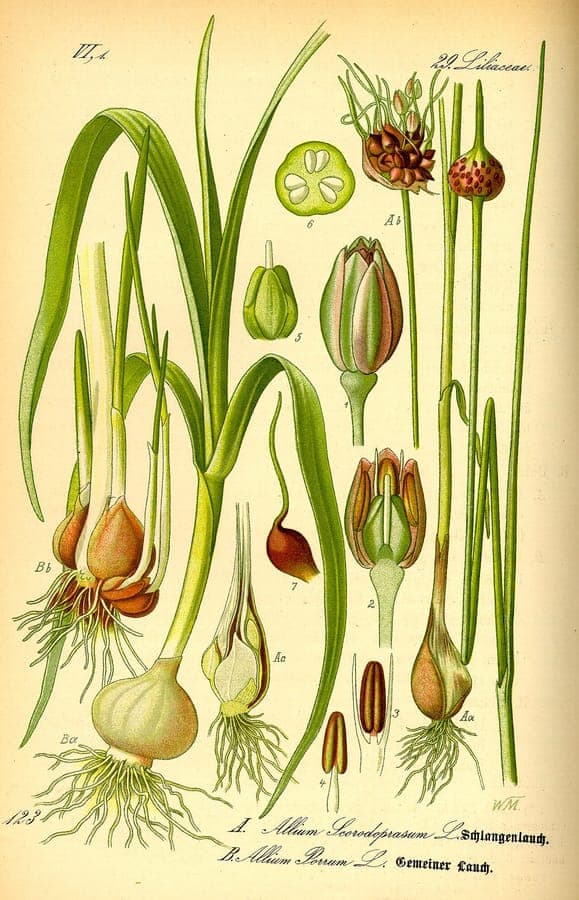
Wikimedia Commons / Public domain, via Wikimedia Commons
Spanish garlic: complete guide
Allium scorodoprasum
Want to see Spanish garlic: complete guide in your garden?
1 minute, no credit card
Overview
Allium scorodoprasum, commonly known as Spanish garlic, is a resilient and understated member of the Allium genus that thrives in temperate gardens. Native to central and eastern Europe - including Austria, Germany, the Baltic states and parts of the UK - it's adapted to a wide range of conditions, making it a smart choice for gardeners looking for low-maintenance, architectural plants. Unlike its showier cousins like Allium giganteum, Spanish garlic grows in loose clumps with a relaxed, almost wild appearance, perfect for naturalistic planting schemes.
The plant grows from small bulbs and spreads gradually through seed and bulb offsets. It's not invasive, but it will self-seed gently in the right conditions, creating colonies over time. Its foliage has a mild garlic scent when crushed, which deters deer and rabbits - a bonus in wildlife-prone gardens. It's also beneficial for pollinators, attracting bees and hoverflies during its bloom period.
On gardenworld.app, you can create a custom planting plan that integrates Spanish garlic with other late-spring perennials and structural grasses for year-round interest.
Appearance & bloom cycle
Spanish garlic reaches a height of 30–60 cm, with upright, hollow stems and narrow, grey-green leaves that arch slightly. The bloom period runs from June to July, when dense, rounded umbels of purple star-shaped flowers appear. Each flower head is made up of 20–30 individual florets and measures about 3–4 cm across. The color is a soft to medium purple, not as intense as some ornamental alliums, but with a subtle charm.
After flowering, the heads often develop into seed capsules that remain intact through autumn and winter, adding textural interest. These can be left in place for visual effect or removed to prevent self-seeding. The plant has a herbaceous growth habit, dying back completely in late autumn.
Ideal location
Spanish garlic performs best in full sun to partial shade - a light requirement of 7/10. This means it thrives in open borders, meadow gardens or at the front of sunny beds where it receives at least 5–6 hours of direct sunlight daily. In hotter climates, afternoon shade helps prevent leaf scorch.
Avoid planting it in deep shade or under dense tree canopies, as this leads to weak, leggy growth and poor flowering. It combines well with plants like Eupatorium maculatum, Salvia nemorosa and Stachys byzantina. Space plants 25–30 cm apart to allow air circulation and prevent fungal issues.
Soil requirements
It prefers well-drained soil with a neutral to slightly alkaline pH of 7.0–7.5. While adaptable to various soil types, it does poorly in waterlogged conditions. Heavy clay soils should be amended with grit or composted bark to improve drainage. Sandy soils benefit from added organic matter to retain moisture.
Spanish garlic isn't a heavy feeder. A light application of well-rotted compost in early spring is usually sufficient. Avoid high-nitrogen fertilizers, which promote leaf growth at the expense of flowers.
Free design
Want to see Spanish garlic: complete guide in your garden? Make a free design now.
Watering
Once established, Spanish garlic is drought-tolerant. Water young plants regularly in their first growing season, especially during dry spells in spring. After that, supplemental watering is rarely needed, except during prolonged droughts. Overwatering, particularly in winter, can lead to bulb rot.
Water deeply but infrequently to encourage deep root development. Early morning is the best time to water, reducing fungal risk.
Pruning
No pruning is required for health, but you can deadhead spent flowers if you want to limit self-seeding. Leave some seed heads intact for winter structure and to provide food for birds. Cut back foliage only after it has fully yellowed and died back - this allows the bulb to store energy for the next season.
Use clean, sharp shears to avoid disease transmission. Never pull or twist the leaves, as this can damage the bulb.
Maintenance calendar
- Jan: Check for bulb rot in wet soils
- Feb: Monitor for early shoot emergence
- Mar: Apply a thin layer of compost around the base
- Apr: Water young plants during dry periods
- May: Watch for pest activity (slugs on new growth)
- Jun: Bloom begins; inspect for pollinator activity
- Jul: Flowers fade; remove or leave seed heads
- Aug: Dormancy begins; reduce watering
- Sep: Allow seeds to ripen if self-sowing is desired
- Oct: Cut back dead foliage
- Nov: Prepare soil for bulb offsets
- Dec: Protect in areas with excessive winter moisture
You can set up a maintenance alert system on gardenworld.app to track care tasks based on your local climate and bloom cycle.
Winter hardiness
Spanish garlic is hardy in USDA zones 4–8. It tolerates winter temperatures down to -25°C and requires no mulch in most climates. The bulbs remain dormant underground and re-emerge reliably each spring. In areas with heavy winter rainfall, ensure good drainage to prevent rot.
Companion plants
Pair Spanish garlic with plants that complement its height and bloom time. Good companions include Geranium 'Rozanne', Nepeta racemosa, and Allium flavum. It also works well in cottage garden schemes with Digitalis and Echinacea. Avoid overcrowding with vigorous spreaders like mint or goldenrod.
Closing
Spanish garlic is a quiet achiever in the garden - not flashy, but dependable. It brings structure, scent and ecological value with minimal effort. Plant bulbs in autumn for spring emergence, and source them from trusted garden centres like those listed on gardenworld.app or local nurseries in spring.
Want to see Spanish garlic: complete guide in your garden? Make a free design now.
Upload a photo, pick a style, and get a photorealistic design with plant list in under a minute.
No credit card required


Similar plants
Douglas' Onion: complete guide
Allium douglasii
Douglas' onion is a compact ornamental allium with purple flowers, perfect for rock gardens and sunny borders. Learn care, siting and hardiness.
Oblique onion: complete guide
Allium obliquum
The oblique onion is a hardy ornamental allium with chartreuse flower heads and blue-green foliage. Location, soil and care explained.
False hooded garlic: complete guide
Allium pseudocalyptratum
Discover false hooded garlic (Allium pseudocalyptratum): a rare ornamental onion from Lebanon for rock gardens and alpine troughs.