
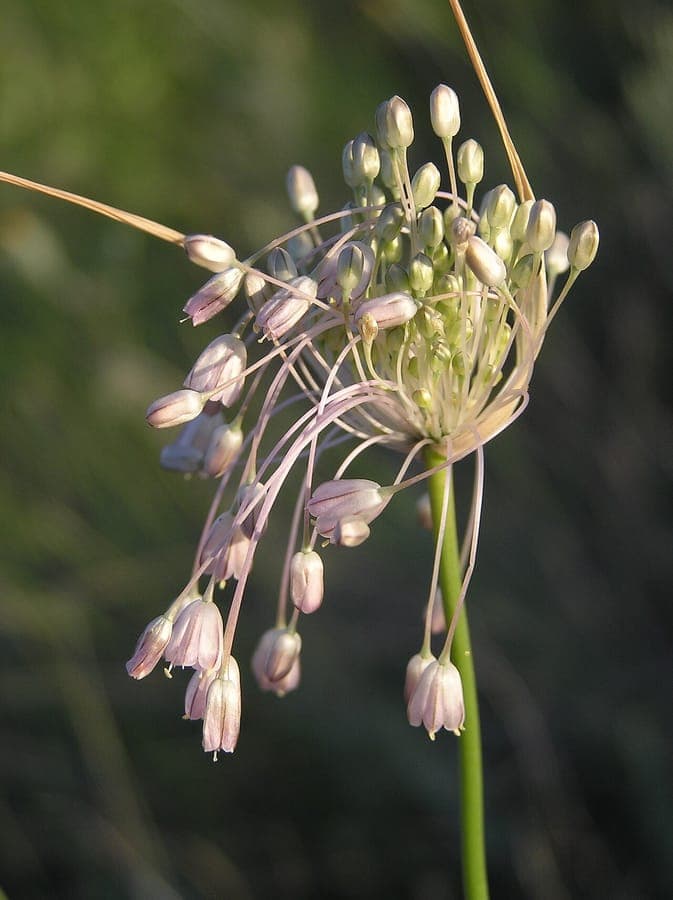
Le.Loup.Gris / CC BY-SA 3.0, via Wikimedia Commons
Pale garlic: complete guide
Allium paniculatum
Want to see Pale garlic: complete guide in your garden?
1 minute, no credit card
Overview
Allium paniculatum, commonly known as Pale garlic, is a resilient ornamental onion that thrives in tough garden conditions. Native to regions stretching from Bulgaria through the Caucasus to Central Asia, this plant has adapted to hot, dry summers and cold winters. It's a standout choice for gardeners in the UK and northern Europe looking to add structure and subtle colour to sunny borders. With its airy flower heads and minimal care needs, it's ideal for naturalistic planting schemes and gravel gardens.
On gardenworld.app, you can design a planting plan that integrates Allium paniculatum seamlessly into dry, wildlife-friendly garden layouts.
Appearance & bloom cycle
Pale garlic grows to a height of 40–60 cm, forming upright, hollow stems with narrow, grass-like leaves that emerge in early spring. The flowering period runs from late May through June, depending on location and weather. During this time, the plant produces loose, branched inflorescences - a true panicle - holding dozens of small, pale yellow to creamy-white florets.
Unlike the dense spherical heads of Allium giganteum, this species has an open, delicate structure that sways gently in the breeze. The blooms last about three weeks and are followed by small seed capsules that persist into autumn. Though not strongly scented, the flowers attract hoverflies, bees, and other beneficial insects.
After blooming, the foliage yellows and dies back by mid-summer. The dried stems add winter interest and should be left standing until early spring to avoid disturbing the bulb's energy cycle.
Ideal location
Full sun is essential for Allium paniculatum. It needs at least 6 hours of direct sunlight daily to flower well and maintain sturdy stems. Choose a spot in a rock garden, on a dry bank, or at the front of a sunny border. It also works well in meadow-style plantings or gravel gardens where competition from grasses is low.
Avoid shaded areas or spots with heavy leaf litter, as these can smother emerging shoots. In small gardens, plant bulbs in groups of 5–7 for visual impact. For layout inspiration, gardenworld.app offers customizable garden designs that highlight spacing and companion planting for maximum effect.
Soil requirements
Well-drained soil is non-negotiable. This species hates wet feet and will rot in clay-heavy or waterlogged soils. Sandy, loamy, or gravelly soils are ideal. A pH between 6.5 and 7.8 is suitable, and the plant tolerates alkaline conditions well - in fact, it often grows wild on limestone slopes.
If planting in heavy soil, amend with sharp sand or grit to improve drainage. Raised beds or slopes are excellent options. Avoid organic-rich soils that retain moisture, as they increase the risk of bulb decay.
Free design
Want to see Pale garlic: complete guide in your garden? Make a free design now.
Watering
Once established, Pale garlic is drought-tolerant and rarely needs supplemental watering. Newly planted bulbs (autumn-planted, October to November) should be watered once if the season is dry. In spring, during active growth, occasional watering during prolonged dry spells is helpful but not essential.
After flowering, reduce watering and let the plant dry out completely by mid-summer. Never water during dormancy - excess moisture is the main cause of bulb failure.
Pruning
No pruning is required. Allow the foliage and flower stems to die back naturally. Cutting them too early prevents the bulb from storing energy for next year's growth. If self-seeding is undesirable, remove the flower heads before seeds ripen. Otherwise, leave them for winter texture and to feed birds.
Maintenance calendar
- February–March: Check for signs of pests or rot. No action needed in most cases.
- April: Resume light watering if soil is dry. Watch for emerging shoots.
- May–June: Peak bloom. No feeding required.
- July: Flowers fade. Begin reducing water.
- August–September: Ideal time to divide or relocate bulbs if needed.
- October–November: Plant new bulbs 10 cm deep, spaced 15 cm apart.
- December–January: Dormant period. No maintenance unless winters are exceptionally wet.
Winter hardiness
Allium paniculatum is hardy to USDA zone 5 (–29°C). In the UK (zone 8) and most of western Europe, it survives without protection. In areas with prolonged wet winters, consider planting in raised beds or adding a thin gravel mulch to keep bulbs dry. Overall, it's a tough, reliable perennial that returns year after year.
Companion plants
Pair Pale garlic with drought-tolerant perennials like Echinacea purpurea, Salvia nemorosa, or Stachys byzantina. The pale yellow blooms contrast beautifully with purple and blue tones. It also blends well with ornamental grasses such as Festuca ovina or Carex species. Avoid aggressive ground covers that might crowd the bulbs.
Closing
Allium paniculatum is a low-maintenance, long-lived bulb that brings subtle elegance to sunny, dry gardens. Its airy blooms, resilience, and wildlife value make it a smart choice for modern, sustainable landscapes. It's available from garden centres across the UK, especially in autumn. For planting ideas and garden layouts, check out gardenworld.app - a practical tool for visualising your ideal garden with this hardy onion species.
Want to see Pale garlic: complete guide in your garden? Make a free design now.
Upload a photo, pick a style, and get a photorealistic design with plant list in under a minute.
No credit card required


Similar plants
Douglas' Onion: complete guide
Allium douglasii
Douglas' onion is a compact ornamental allium with purple flowers, perfect for rock gardens and sunny borders. Learn care, siting and hardiness.
Oblique onion: complete guide
Allium obliquum
The oblique onion is a hardy ornamental allium with chartreuse flower heads and blue-green foliage. Location, soil and care explained.
False hooded garlic: complete guide
Allium pseudocalyptratum
Discover false hooded garlic (Allium pseudocalyptratum): a rare ornamental onion from Lebanon for rock gardens and alpine troughs.