
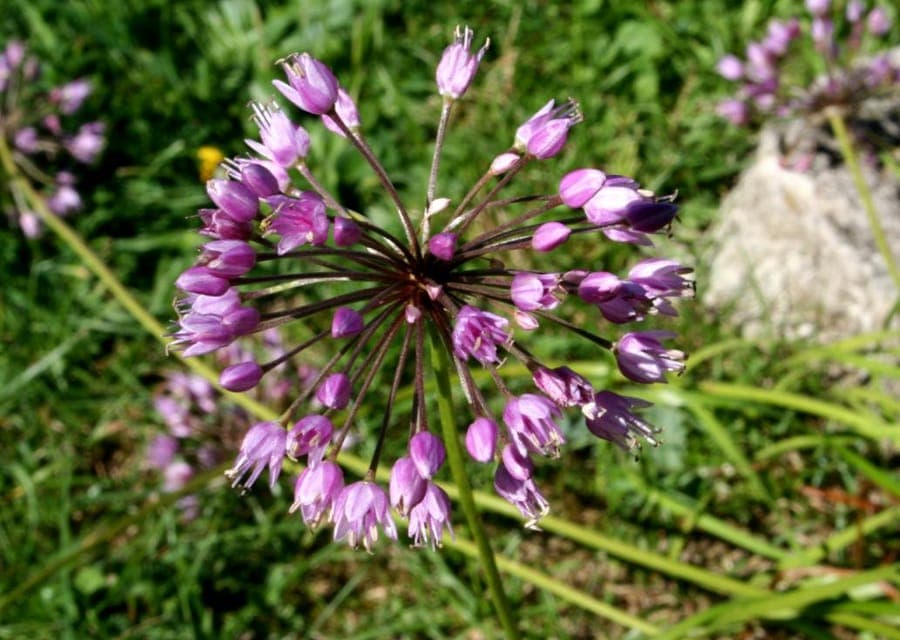
Enrico Blasutto at Italian Wikipedia / CC BY-SA 3.0, via Wikimedia Commons
German garlic: complete guide
Allium lusitanicum
Want to see German garlic: complete guide in your garden?
1 minute, no credit card
Overview
Allium lusitanicum, commonly known as German garlic, is a modest yet elegant bulb plant that thrives in well-drained, sunny spots across gardens in Europe. Despite its name suggesting Portuguese origins, it's widely distributed from Austria to France and even into the Baltic States. It's not the showiest allium, but it's reliable, tough, and blends seamlessly into naturalistic planting schemes. If you're tired of high-maintenance perennials that demand constant attention, this one's a breath of fresh air.
Part of the Amaryllidaceae family, it shares traits with other alliums-like onion-scented foliage and star-shaped flowers-but stands out for its compact size and unobtrusive growth habit. It won't take over your borders, yet it adds structure and seasonal interest without fuss.
On gardenworld.app, you can design a planting plan that highlights the quiet elegance of Allium lusitanicum, especially in gravel gardens or dry slopes where few other plants survive.
Appearance & bloom cycle
German garlic grows between 30 and 45 cm tall, with narrow, hollow green leaves that emerge early in spring. The flower stems rise gracefully, carrying dense, hemispherical clusters of reddish-purple buds. In June, these open into starry, pale mauve flowers, each about 1.5 cm across. The bloom lasts four to six weeks, depending on weather conditions.
One of its charms is the colour shift: buds start deep burgundy, almost maroon, then soften to a delicate lilac as they open. The scent is faintly garlicky-noticeable up close, but never overpowering. Bees and hoverflies love the nectar, making it a valuable addition to pollinator-friendly gardens.
After flowering, the seed heads dry in place, adding texture through late summer and autumn. Self-seeding occurs lightly, but never invasively.
Ideal location
This allium wants full sun. It tolerates light afternoon shade in hotter climates, but performs best where it gets at least 6–8 hours of direct sunlight. Ideal spots include rock gardens, raised beds, dry stone walls, or the front of sunny borders. Its compact height makes it perfect for edging paths or tucking between drought-tolerant perennials.
If you're unsure about sun exposure in your garden, gardenworld.app offers a sunlight mapping tool to help you identify the perfect spot for sun-loving plants like Allium lusitanicum.
Soil requirements
Well-drained soil is non-negotiable. Sandy, gravelly, or loamy soils work best. Heavy clay? Amend it with plenty of grit or sharp sand to improve drainage. The pH range can be slightly acidic to slightly alkaline (5.8–7.5). Poor, lean soils are actually preferred-rich soils encourage excessive leaf growth at the expense of flowers.
For container growing, use a mix of two parts multipurpose compost, one part horticultural grit, and one part perlite. Ensure pots are at least 20 cm deep to accommodate root development.
Free design
Want to see German garlic: complete guide in your garden? Make a free design now.
Watering
Once established, German garlic is drought-tolerant. Water only during prolonged dry spells in spring and early summer. Avoid overhead watering to prevent fungal issues. Use a soaker hose or water at the base.
After flowering, reduce watering gradually. By mid-summer, let the foliage die back naturally. Do not cut it down prematurely-this is how the bulb stores energy for next year.
Pruning
No pruning is required. Leave seed heads intact for winter interest and potential self-seeding. Cut back dead foliage in late autumn or early spring when it turns brown and unsightly. Use sterilised secateurs to prevent disease spread.
Maintenance calendar
- February–March: Check for emerging foliage. Remove old debris if needed.
- April: No action required unless planting new bulbs.
- May: Apply a light dose of phosphate-rich fertiliser if soil is poor.
- June–July: Peak bloom. Monitor for drought stress.
- August–September: Dormancy period. No watering or feeding.
- October–November: Ideal time to plant new bulbs (best done by mid-November).
- December–January: Fully dormant. No care needed.
Winter hardiness
Allium lusitanicum is hardy to USDA zone 5 (-29°C). In the UK and most of northern Europe, it survives winter without protection-as long as the soil doesn't stay waterlogged. In wetter gardens, consider planting in raised beds or containers. A light mulch of gravel or grit helps prevent moisture retention around the crown.
Avoid organic mulches like bark or compost in winter-they hold too much moisture and can rot the bulb.
Companion plants
Pair German garlic with other sun-loving, drought-tolerant plants. Great companions include lavender (Lavandula angustifolia), catmint (Nepeta faassenii), stonecrop (Sedum spectabile), and Russian sage (Perovskia atriplicifolia). The soft purple hues complement silver-foliaged plants like Artemisia or Stachys byzantina.
Avoid pairing with moisture-loving perennials such as hostas or astilbes-they have completely different needs.
Closing
Allium lusitanicum isn't a plant that shouts for attention. It whispers. But for gardeners who value resilience, simplicity, and quiet beauty, it's a gem. Plant in groups of five or more for visual impact. Look for healthy bulbs at garden centres in autumn, especially in late September to October. And remember: gardenworld.app lets you create a custom garden layout that fits your soil, light, and style-perfect for integrating German garlic into a cohesive, low-maintenance design.
Want to see German garlic: complete guide in your garden? Make a free design now.
Upload a photo, pick a style, and get a photorealistic design with plant list in under a minute.
No credit card required


Similar plants
Douglas' Onion: complete guide
Allium douglasii
Douglas' onion is a compact ornamental allium with purple flowers, perfect for rock gardens and sunny borders. Learn care, siting and hardiness.
Oblique onion: complete guide
Allium obliquum
The oblique onion is a hardy ornamental allium with chartreuse flower heads and blue-green foliage. Location, soil and care explained.
False hooded garlic: complete guide
Allium pseudocalyptratum
Discover false hooded garlic (Allium pseudocalyptratum): a rare ornamental onion from Lebanon for rock gardens and alpine troughs.