
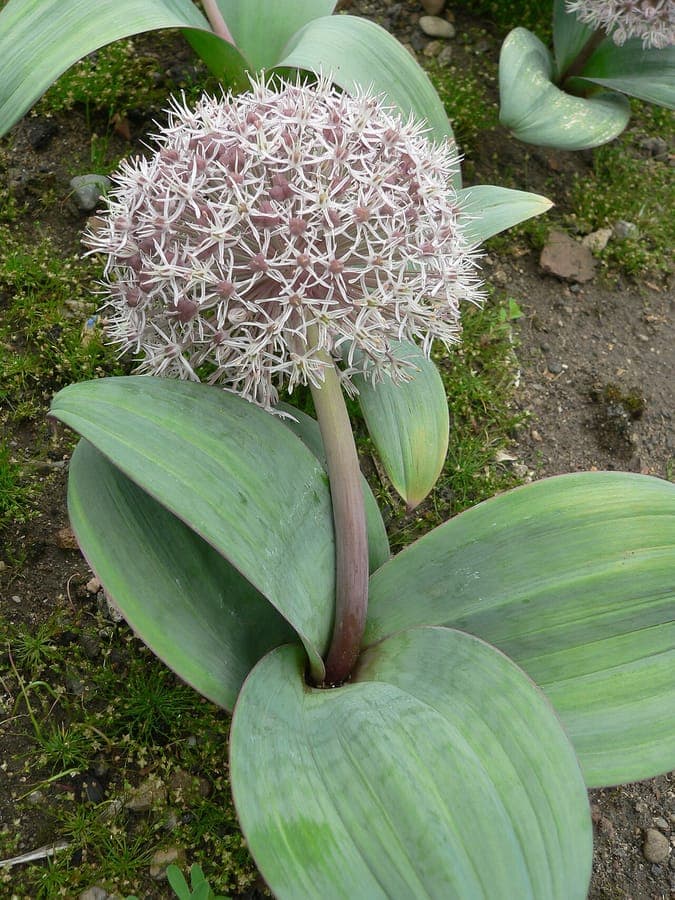
BS Thurner Hof / CC BY-SA 3.0, via Wikimedia Commons
Turkestan onion: complete guide
Allium karataviense
Want to see Turkestan onion: complete guide in your garden?
1 minute, no credit card
Overview
Allium karataviense, commonly known as Turkestan onion, is a standout ornamental bulb that's gaining popularity in UK and North American gardens. Native to the rocky slopes of Central Asia-Afghanistan, Kazakhstan, Kyrgyzstan, Tajikistan, and Uzbekistan-this plant thrives in harsh, dry conditions with intense sun and minimal moisture. In temperate gardens, it brings unique texture and architectural form, growing just 15–20 cm tall.
Unlike its tall-flowering cousins like Allium giganteum, this species keeps it low and compact. The foliage forms a dense, cushion-like mound that remains attractive for most of the year. It's perfect for rock gardens, gravel beds, or the front of sunny borders. If you're using gardenworld.app, you can visualise how this plant fits into a xeriscaped design or a modern cottage front garden with drought-tolerant perennials.
Appearance & bloom cycle
The leaves are the star early in the season. Broad, fleshy, and a striking blue-green, they form a tight rosette about 20 cm wide. A fine, waxy bloom covers the surface, which helps reflect sunlight and reduce water loss-perfect for its native arid climate.
Flower buds emerge in late May, nestled just above the foliage. By early June, they open into rounded, pom-pom-like clusters of rosy-purple to mauve-brown flowers, roughly 5 cm across. The bloom lasts through June and into early July. Though not tall, the flowers stand out due to their rich colour and the way they sit atop the silvery foliage.
After flowering, the stems dry slowly, but the leaves stay green and tidy until autumn. From September onward, they gradually yellow and die back, but even then, they add subtle texture to the garden scene.
Ideal location
Full sun is non-negotiable. Allium karataviense needs at least 6–8 hours of direct sunlight daily. In shade, it becomes leggy, prone to fungal issues, and produces fewer flowers.
This plant excels in hot, dry spots where others struggle. Think south-facing rockeries, stone walls, or the front edges of borders. It also does very well in containers on sunny patios or balconies. If you're planning a gravel garden or a low-water border, gardenworld.app lets you map out sun exposure and plant spacing to get the most from your Turkestan onions.
Soil requirements
Well-drained soil is essential. Sandy or gravelly soils are ideal. Heavy clay must be amended with horticultural grit, coarse sand, or perlite to prevent waterlogging.
Aim for a pH between 6.5 and 7.5. While it's not too fussy, overly acidic or alkaline soils can slow growth. In pots, use a mix of loam-based compost, grit, and perlite (2:1:1). Always ensure containers have drainage holes-soggy roots mean rot, and rot means goodbye to your bulbs.
Free design
Want to see Turkestan onion: complete guide in your garden? Make a free design now.
Watering
Once established, Allium karataviense is highly drought-tolerant. Water only during prolonged dry spells in the growing season (May–July). When you do water, soak deeply but infrequently-never let it sit in wet soil.
No supplemental watering is needed in winter. If your soil drains well, rain is enough. Overwatering in dormancy is the biggest threat to bulb survival.
Pruning
This plant needs almost no pruning. Leave flower stems intact until they've fully dried-usually by late summer. This allows the bulb to reabsorb nutrients for next year's growth.
Never cut back the foliage as it yellows. Doing so weakens the bulb. Once the leaves collapse naturally, you can tidy up for appearance, but it's not necessary for plant health.
Maintenance calendar
- Jan: Dormant. No action.
- Feb: Check bulbs for rot after wet periods.
- Mar: Plant new bulbs now (10–15 cm deep, 15 cm apart) if missed in autumn.
- Apr: Growth begins. Watch for aphids or mildew in damp weather.
- May: Foliage full. Flower buds appear.
- Jun: In bloom. Water only if extremely dry.
- Jul: Flowers fade. Leave stems standing.
- Aug: Growth slows. No feeding.
- Sep: Foliage starts to yellow. No action needed.
- Oct: Best time to plant new bulbs.
- Nov: Soil cools. Ensure site doesn't collect water.
- Dec: Fully dormant. Protect from prolonged wetness with gravel mulch.
Winter hardiness
Hardy in USDA zones 5–8, which covers most temperate regions. Bulbs tolerate frost down to -20°C as long as the soil drains well. The real danger is cold, wet soil-this leads to rot.
In heavy soils or wet winters, plant on a slope, add a gravel topdressing, or grow in raised beds. In extreme cases, lift bulbs in autumn and store dry, but this is rarely needed.
Companion plants
Thanks to its low habit, Allium karataviense pairs well with taller, airy perennials. Try it with Salvia nemorosa, Nepeta racemosa, or dwarf ornamental grasses like Festuca glauca. These add height without crowding.
Low-growers like Sedum spurium, Thymus serpyllum, or Arabis caucasica also thrive in the same dry, sunny conditions. Avoid aggressive spreaders like mint or ground ivy that can overwhelm it.
Combining it with silver-foliaged plants-such as Artemisia ludoviciana or Stachys byzantina-enhances the drought-tolerant aesthetic. Use gardenworld.app to preview these combos and test visual balance before planting.
Closing
Allium karataviense isn't just another ornamental onion. It's a textural gem that brings year-round interest with minimal effort. Whether you're designing a modern gravel garden or refreshing a sunny border, this plant earns its spot.
You'll find bulbs at garden centres in autumn, especially at trusted retailers like garden centres across the UK. Look for firm, dry bulbs-avoid any with mould or soft spots. Plant in full sun, well-drained soil, and let it shine. And if you're unsure about placement or spacing, gardenworld.app helps you create a custom garden plan that considers growth habits, light needs, and seasonal impact.
Want to see Turkestan onion: complete guide in your garden? Make a free design now.
Upload a photo, pick a style, and get a photorealistic design with plant list in under a minute.
No credit card required


Similar plants
Douglas' Onion: complete guide
Allium douglasii
Douglas' onion is a compact ornamental allium with purple flowers, perfect for rock gardens and sunny borders. Learn care, siting and hardiness.
Oblique onion: complete guide
Allium obliquum
The oblique onion is a hardy ornamental allium with chartreuse flower heads and blue-green foliage. Location, soil and care explained.
False hooded garlic: complete guide
Allium pseudocalyptratum
Discover false hooded garlic (Allium pseudocalyptratum): a rare ornamental onion from Lebanon for rock gardens and alpine troughs.