
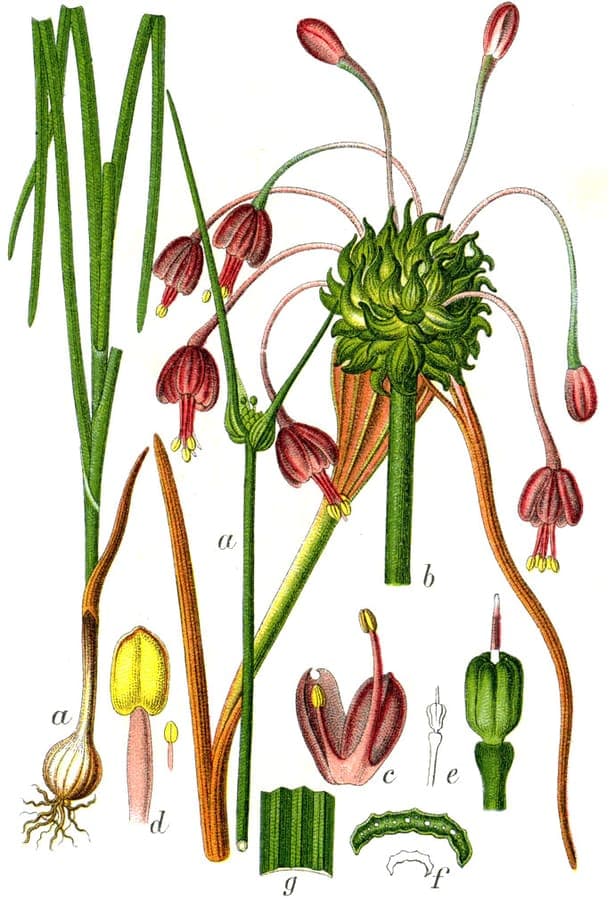
Johann Georg Sturm, Painted by Jacob Sturm; published by Kurt Stüber / Public domain, via Wikimedia Commons
Keeled garlic: complete guide
Allium carinatum
Want to see Keeled garlic: complete guide in your garden?
1 minute, no credit card
Overview
Allium carinatum, commonly known as keeled garlic, is a graceful yet resilient bulb that deserves more attention in the average garden. Native to rocky slopes and dry meadows across Central and Southern Europe - including Austria, Greece, and Hungary - it's adapted to thrive in lean soils and full sun. Unlike its showier cousins like Allium giganteum, this species offers a more understated charm, with delicate, nodding flowers that dance above the foliage on slender, arching stems.
Reaching heights of 30 to 50 cm, Allium carinatum fits perfectly in cottage-style borders, rock gardens, or even gravel beds. It's a perennial that returns year after year with minimal fuss, making it a smart choice for sustainable, low-input gardens. On gardenworld.app, you can design a planting scheme that highlights its airy structure and late-summer bloom, integrating it seamlessly with other drought-tolerant perennials.
Appearance & bloom cycle
The defining feature of Allium carinatum is its pendulous, star-shaped flowers. Each bloom measures about 1.5 cm across, with pointed, keeled tepals in a soft purple hue - a detail that gives the plant its name. The flowers appear from July to August, just when many spring and early summer perennials are fading. This timing makes it a valuable addition to extend seasonal interest.
The blooming period lasts roughly three weeks. During this time, the flowers attract pollinators like hoverflies, small bees, and hover wasps, contributing to garden biodiversity. The narrow, grass-like foliage grows to about 30 cm and begins to yellow as flowering progresses. For best visual impact, plant in clusters of 6–10 bulbs. This creates a natural drift effect, mimicking how it grows in the wild.
Ideal location
Keeled garlic thrives in full sun - aim for a light exposure of 8 or higher, meaning at least 6–8 hours of direct sunlight daily. Choose open, unshaded spots such as south-facing borders, gravel gardens, or dry stone walls. Avoid areas with heavy shade or where water pools after rain, as wet soil leads to bulb rot.
It also performs well in containers, provided they have excellent drainage. Terra cotta pots or wooden planters with drainage holes work best. On gardenworld.app, you can map out container arrangements that match the plant's growth habit and seasonal rhythm, ensuring your pots look balanced all season.
Soil requirements
Allium carinatum prefers well-drained, alkaline soil with a pH of 7.5–8.0. It does best in gritty, sandy, or chalky soils. Heavy clay should be amended with horticultural grit, coarse sand, or perlite to improve drainage. Avoid rich, moist soils - they promote lush foliage at the expense of flowers and increase disease risk.
The plant thrives in lean to moderately fertile conditions. If your soil is too rich, reduce organic matter and consider adding crushed oyster shell or limestone chips to raise pH and improve texture.
Free design
Want to see Keeled garlic: complete guide in your garden? Make a free design now.
Watering
Water only during prolonged dry spells in the growing season (May to August). When you do, give a light soak and allow the soil to dry out completely between waterings. Once flowering finishes in late August, stop watering altogether. The bulbs go dormant and rely on natural rainfall through winter. Overwatering, especially in humid summers, can lead to fungal issues and rot.
Pruning
No pruning is needed. Leave the flower heads intact after blooming - they remain decorative through autumn and provide food and shelter for insects. Cut back only in late autumn or early winter, once foliage has turned brown and dried. This helps maintain garden hygiene and prevents disease carryover.
Maintenance calendar
- February: Check potted bulbs for moisture or signs of rot.
- March: Plant new bulbs 10 cm deep in well-drained soil.
- April: Watch for slugs targeting emerging shoots.
- May: Begin light watering during dry periods.
- June: Clear weeds around plants to reduce competition.
- July–August: Peak bloom. Observe pollinator activity.
- September: Allow seed heads to mature; stop watering.
- October: Trim back dead stems if desired.
- November–January: Dormant period. No action needed.
Winter hardiness
Allium carinatum is hardy in USDA zones 5–9 (-20°C to -1°C). In colder zones, a light mulch of dry leaves or straw can protect potted bulbs. In-ground plants usually survive without cover, especially in well-drained soils. Avoid wet mulches like compost, which retain too much moisture.
Companion plants
Pair keeled garlic with plants that share its preferences: full sun, dry soil, and good drainage. Excellent companions include Salvia nemorosa, Nepeta faassenii, Eryngium planum, and Stachys byzantina. These create texture contrast and extend bloom time. Avoid invasive spreaders like mint or ground ivy, which can overwhelm the delicate clumps.
Closing
Allium carinatum is a quiet achiever - not flashy, but deeply reliable and full of quiet charm. Its slender stems and late bloom fill a niche many gardens lack. You can find bulbs at garden centres in autumn, especially at independents or larger retailers like those stocking specialty bulbs. Plant in groups for impact, and let them naturalize over time. With little care, they'll return year after year. For layout ideas and planting combos, visit gardenworld.app and build a custom garden plan that works with your soil and light conditions.
Want to see Keeled garlic: complete guide in your garden? Make a free design now.
Upload a photo, pick a style, and get a photorealistic design with plant list in under a minute.
No credit card required


Similar plants
Douglas' Onion: complete guide
Allium douglasii
Douglas' onion is a compact ornamental allium with purple flowers, perfect for rock gardens and sunny borders. Learn care, siting and hardiness.
Oblique onion: complete guide
Allium obliquum
The oblique onion is a hardy ornamental allium with chartreuse flower heads and blue-green foliage. Location, soil and care explained.
False hooded garlic: complete guide
Allium pseudocalyptratum
Discover false hooded garlic (Allium pseudocalyptratum): a rare ornamental onion from Lebanon for rock gardens and alpine troughs.