
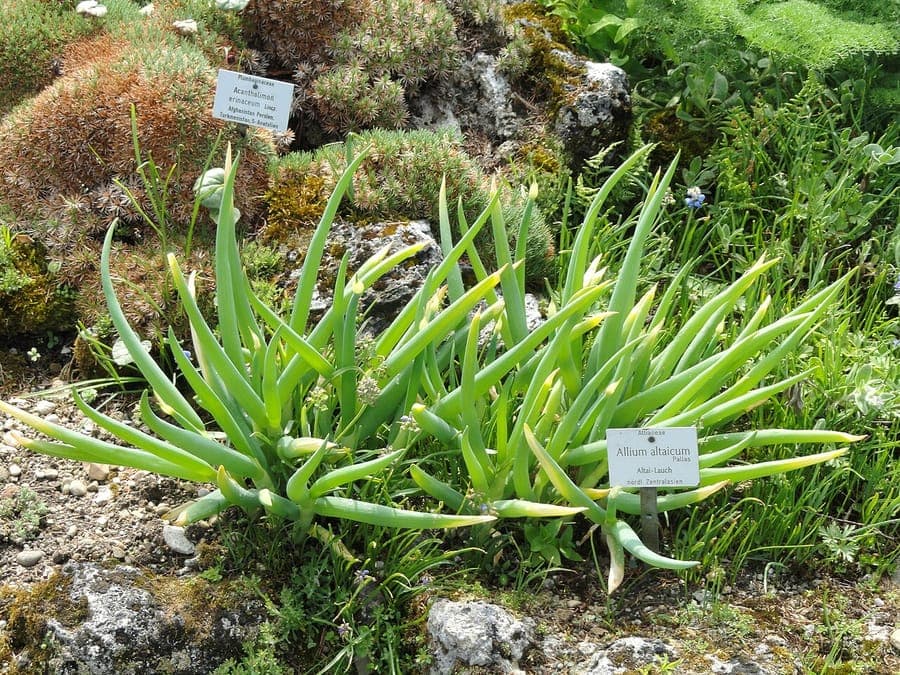
Daderot / Public domain, via Wikimedia Commons
Altai onion: complete guide
Allium altaicum
Want to see Altai onion: complete guide in your garden?
1 minute, no credit card
Overview
Allium altaicum, commonly known as Altai onion, is a striking, clump-forming perennial that hails from the high steppes of Central Asia. Hardy, low-maintenance, and full of architectural charm, this forb/herb brings late-summer drama to gardens across USDA zones 4–8. It's a member of the Amaryllidaceae family and thrives in well-drained, sunny spots where little else might flourish.
This ornamental onion doesn't just look good-it supports pollinators and adds vertical interest without demanding constant care. If you're planning a dry garden or a naturalistic planting scheme, Altai onion is a reliable performer. You can use gardenworld.app to design a planting layout that matches bloom times and plant heights for maximum visual impact.
Appearance & bloom cycle
Altai onion stands 40–60 cm tall with a narrow spread of about 20 cm. Its foliage emerges in early spring as slender, hollow, blue-green leaves that form a tidy clump. These die back slightly as the flower stalks rise, but they don't disappear completely until after blooming.
Flowering occurs from July to August. The blossoms form dense, rounded umbels 4–6 cm in diameter, packed with dozens of tiny star-shaped flowers in a soft lavender to pale purple hue. The color is subtle but luminous, especially in morning or late afternoon light.
After blooming, the flower heads dry into attractive seed heads that persist well into winter. These silvery, translucent pods sway gently in the wind and provide structure and movement in the dormant garden. They're excellent for cut and dried arrangements too.
Ideal location
Allium altaicum thrives in full sun-rate it a solid 9 out of 10 for light needs. In shaded areas, stems become weak, flopping is common, and flowering is sparse or absent. Choose a spot that gets at least 6–8 hours of direct sunlight daily.
It works beautifully in rock gardens, gravel beds, or the middle to back of sunny borders. Plant in groups of 5–7 for a natural, drift-like effect. Avoid overcrowding with aggressive spreaders. Consider pairing it with plants like sedum, Russian sage, or ornamental grasses for textural contrast.
Using gardenworld.app, you can simulate how these combinations will look in your space before planting a single bulb.
Soil requirements
This species demands sharp drainage. It prefers alkaline soils with a pH between 7.5 and 8.0. Sandy loam or gravelly soils are ideal. Avoid heavy clay unless amended with grit, pumice, or coarse sand to improve permeability.
For container planting, mix equal parts potting soil, perlite, and horticultural grit. Plant bulbs 10–15 cm deep and space them 15 cm apart. Shallow planting leads to poor anchoring and reduced flowering over time.
Free design
Want to see Altai onion: complete guide in your garden? Make a free design now.
Watering
Once established, Altai onion is highly drought-tolerant. Water moderately during active growth (April to July), especially in dry springs. Reduce watering as flowering ends.
In winter, keep the soil nearly dry-especially in containers. Overwatering during dormancy is the most common cause of bulb rot. If your garden has heavy winter rainfall, consider planting on a slope or raised bed.
Pruning
No pruning is needed. Let the foliage die back naturally after blooming. The leaves feed the bulb for next year's growth, so cutting them too early weakens the plant.
You can remove spent flower heads if you prefer a tidier look, but leaving them benefits wildlife and adds winter interest.
Maintenance calendar
- January: Check container-grown plants for moisture; keep dry.
- February: Prepare planting beds; order bulbs for spring.
- March: Plant bulbs 10–15 cm deep in well-drained soil.
- April: Begin light watering if spring is dry.
- May: Watch for slugs on emerging foliage.
- June: Stakes may be needed in windy areas.
- July–August: Peak bloom. Attracts bees and hoverflies.
- September: Stop watering. Let foliage wither.
- October: Divide clumps or transplant seedlings.
- November: Inspect bulbs for rot; protect pots from freeze-thaw cycles.
- December: Dormant period. No care needed.
Winter hardiness
Altai onion is reliably hardy in USDA zones 4–8. It tolerates temperatures down to -30°C. In colder zones, a light mulch helps, but avoid thick organic layers that trap moisture.
In containers, move pots against a sheltered wall or wrap with bubble wrap to prevent root damage from repeated freezing.
Companion plants
Pair Allium altaicum with drought-tolerant perennials like Echinacea, Salvia nemorosa, or Stipa tenuissima. The airy seed heads contrast beautifully with upright spires or fuzzy foliage.
Avoid moisture-loving plants like hostas or astilbes, which demand different soil conditions. Stick to companions that thrive in lean, dry soils.
Closing
Allium altaicum is a quiet powerhouse in the garden. With minimal effort, it delivers months of interest-from fresh spring foliage to summer blooms and winter silhouettes. Its resilience makes it ideal for modern, low-input gardens.
You can find Altai onion bulbs at garden centres across the UK and North America, especially in spring. Look for them at independent nurseries or online suppliers. Plan your planting scheme ahead-using tools like gardenworld.app helps ensure your garden flows seamlessly from one season to the next.
Want to see Altai onion: complete guide in your garden? Make a free design now.
Upload a photo, pick a style, and get a photorealistic design with plant list in under a minute.
No credit card required


Similar plants
Douglas' Onion: complete guide
Allium douglasii
Douglas' onion is a compact ornamental allium with purple flowers, perfect for rock gardens and sunny borders. Learn care, siting and hardiness.
Oblique onion: complete guide
Allium obliquum
The oblique onion is a hardy ornamental allium with chartreuse flower heads and blue-green foliage. Location, soil and care explained.
False hooded garlic: complete guide
Allium pseudocalyptratum
Discover false hooded garlic (Allium pseudocalyptratum): a rare ornamental onion from Lebanon for rock gardens and alpine troughs.