
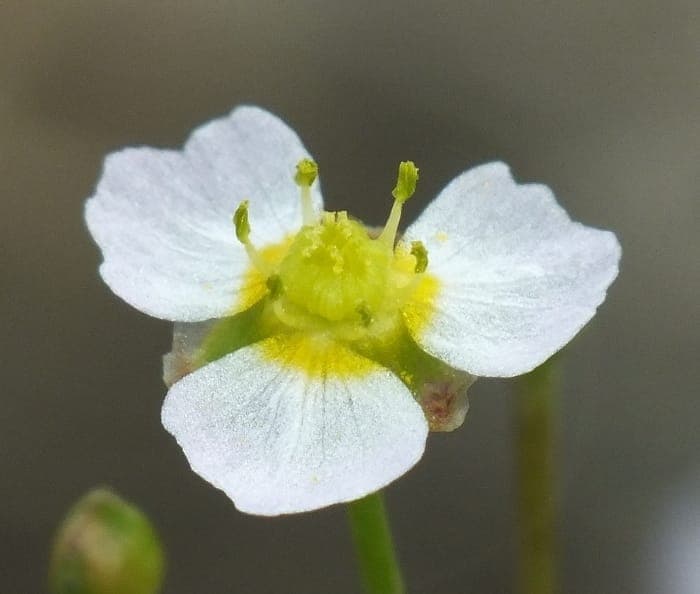
Иван Пристрем / CC0, via Wikimedia Commons
Geyer waterplantain: complete guide
Alisma gramineum
Want to see Geyer waterplantain: complete guide in your garden?
1 minute, no credit card
Overview
Geyer waterplantain (Alisma gramineum) is a slender, grass-like aquatic perennial that brings quiet elegance to pond margins and wetland areas. Unlike its broader-leaved relative, Alisma plantago-aquatica, this species features narrow, linear foliage that closely resembles true grasses. Native to wetlands across Europe, parts of Asia, and scattered regions in North America, it thrives in shallow, still to slow-moving waters. For gardeners looking to add ecological value and subtle beauty to their water features, this plant is an excellent choice.
It's particularly well-suited for naturalistic pond designs where functionality meets aesthetics. On gardenworld.app, you can design a custom garden layout that highlights the ideal placement of Geyer waterplantain, ensuring it gets the right depth and light without being overshadowed by dominant species.
Appearance & bloom cycle
Geyer waterplantain typically reaches heights of 20 to 60 cm, depending on water depth and nutrient availability. The leaves are long, narrow (2–6 mm wide), and bright green, emerging in a basal rosette. They stand upright and often extend above the water surface, giving the plant a delicate, reed-like silhouette.
From May through September, it produces small, star-shaped flowers on slender, erect stems. Each bloom is about 1 cm in diameter, with six petals ranging from white to pale purple, often with faint veining. The flowers appear in whorled clusters and attract small pollinators like hoverflies and minute beetles. After blooming, seed capsules form and dehisce when mature, releasing tiny seeds that disperse via water flow or birds.
Ideal location
This plant prefers full sun to light shade, needing at least 6–8 hours of direct sunlight daily (light level 8/10). It grows best in shallow water, ideally 5 to 30 cm deep. Perfect spots include pond edges, bog gardens, or the submerged shelves of wildlife ponds.
Avoid placing it where aggressive spreaders like cattails or Phragmites can overtake it. It works well in transition zones between open water and drier land. On gardenworld.app, you can simulate water depth gradients and check how Geyer waterplantain fits into your overall pond ecosystem, including competition risks and sun exposure maps.
Soil requirements
Geyer waterplantain thrives in nutrient-rich, silty, or clay-loam substrates. Sandy soils are acceptable as long as moisture remains consistent. The ideal pH range is 5.8 to 7.4. Avoid highly acidic conditions (below 5.8), which can slow growth, especially in high-rainfall areas.
Do not use high-phosphate fertilizers-they promote algal blooms. Instead, enrich the soil with well-rotted leaf litter or aquatic compost. If your tap water is hard, use rainwater to prevent mineral buildup, especially calcium carbonate, which can alter soil chemistry over time.
Free design
Want to see Geyer waterplantain: complete guide in your garden? Make a free design now.
Watering
This plant requires constant moisture and should never be allowed to dry out. In container ponds or bog gardens, maintain a stable water level between 5 and 30 cm. Use rainwater when possible to avoid introducing chlorine or excess minerals.
During dry summers, monitor the water level closely. Top up as needed, but avoid sudden flooding or drastic changes in depth, which can stress the plant. Remember, it grows in water, not just damp soil.
Pruning
Pruning is rarely necessary. In ornamental settings, you may tidy up dead or damaged foliage in late autumn or early spring. Leave seed heads intact through winter to support insects and birds.
If self-seeding becomes excessive, cut off flower stalks after blooming. Use clean, sterilized shears to prevent disease transmission. Never pull the plant by hand-this can damage the fragile root system.
Maintenance calendar
- Jan: Check root health, remove ice if it seals the surface
- Feb: Dormant; no action needed
- Mar: Inspect for new growth
- Apr: Clear old foliage, check water levels
- May: Blooms begin; watch for algae
- Jun: Peak bloom; monitor for pests
- Jul: Full flowering; ensure stable water depth
- Aug: Seeds develop; maintain moisture
- Sep: Cut back seed stalks if desired
- Oct: Leave plant debris for wildlife
- Nov: Divide or transplant if needed
- Dec: Dormant; minimal care
Winter hardiness
Geyer waterplantain is hardy in USDA zones 5 to 9. While the top growth dies back in winter, the roots survive submerged in water. Prevent complete ice cover by using a pond heater or bubbler to maintain an open area.
In temporary pools, the plant may not survive if the water dries up or freezes solid. Consider collecting seeds or overwintering a backup plant in a deeper pond.
Companion plants
Pair with marginal plants like Sedges (Carex spp.), Bog Bean (Menyanthes trifoliata), or Dwarf Rush (Juncus effusus 'Spiralis'). For color contrast, try Purple Loosestrife (Lythrum salicaria) or Water Mint (Mentha aquatica). Avoid invasive species like Water Hyacinth or Broadleaf Cattail.
These combinations enhance texture and seasonal interest. On gardenworld.app, you can generate planting schemes featuring Geyer waterplantain as a key species, with spacing and depth recommendations.
Closing
Geyer waterplantain may not be the flashiest pond plant, but it's a quiet performer with real ecological merit. It supports pollinators, blends naturally into wet areas, and asks for little in return. Whether you're managing a backyard bog or a large natural pond, this plant deserves a spot. Find it at garden centres like those stocking native aquatic species, or check online suppliers. With the right conditions and a bit of patience, Geyer waterplantain will become a self-sustaining part of your garden's ecosystem.
Want to see Geyer waterplantain: complete guide in your garden? Make a free design now.
Upload a photo, pick a style, and get a photorealistic design with plant list in under a minute.
No credit card required


Similar plants
California damsonium: complete guide
Damasonium californicum
Full guide to Damasonium californicum (California damsonium): shallow water, bog soil, care and companion plants for this rare western aquatic.
Yellow water lily: complete guide
Limnocharis flava
Discover the yellow water lily. Everything you need to know about cultivation, care and water placement.
Sagittaria subulata: complete guide
Sagittaria subulata
Discover narrow-leaf arrowhead (Sagittaria subulata), an aquatic plant for ponds and water gardens. Complete cultivation and care guide.