
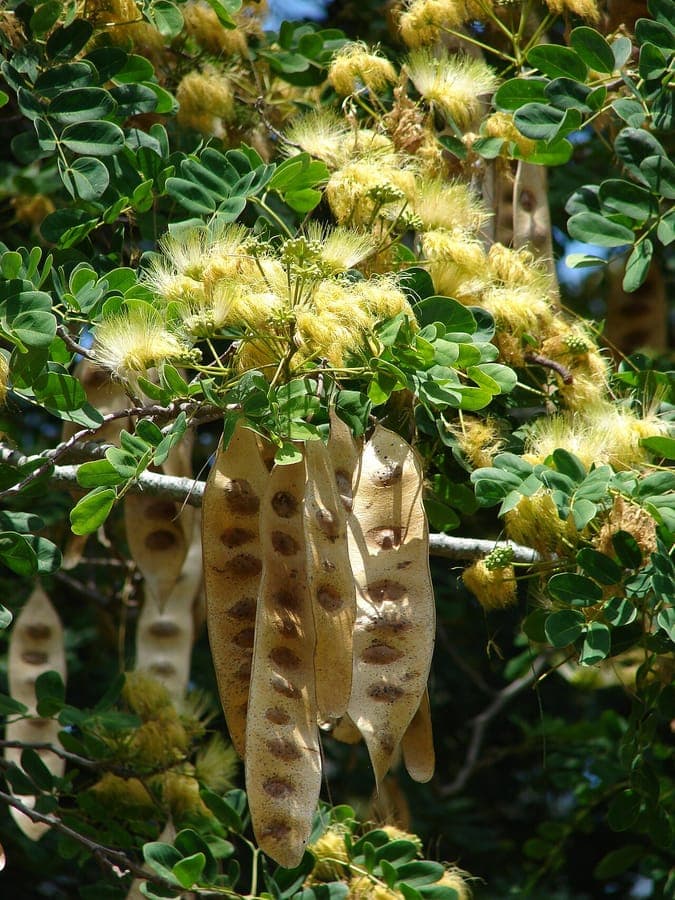
Forest & Kim Starr / CC BY 3.0, via Wikimedia Commons
Broome Raintree: complete guide
Albizia lebbeck
Want to see Broome Raintree: complete guide in your garden?
1 minute, no credit card
Albizia lebbeck, commonly known as Broome raintree, woman's tongue tree, or Siris tree, is a beautiful tropical tree native to the Indian subcontinent and Myanmar. This tree distinguishes itself with fine, doubly pinnate leaves, light yellow flowers with long red stamens, and large, flat pods called 'woman's tongues' because of their shape.
Appearance and Bloom
The Broome raintree can reach 12 to 25 meters tall and forms a broad, open crown. The leaves are finer than many other trees, doubly pinnate and light green, giving a fine, airy appearance. In early summer (May to July in the Southern Hemisphere) striking yellow to cream flowers with long red to pink stamens appear, packed in dense, spherical clusters. The scent is sweet and attracts many pollinators. After blooming, large brown pods up to 60 centimeters long develop that ripen in autumn.
Ideal Location
The Broome raintree grows best in full sun to partially shaded places. The tree tolerates shade better than many other tropical species, making it suitable for various situations. It prefers protected places away from direct sea wind. In Europe, it is only suitable for Mediterranean climates (USDA zones 9-11). Plant it where it has room to grow without hindrance from buildings.
Soil
The Broome raintree grows in almost all soil types, from heavy clay to sandy soils. The pH can be between 5.5 and 7.5. The tree appreciates well-draining soil, especially in areas with higher rainfall. It prefers moderately nutrient-rich soil but also tolerates poor soils once established. The deeply rooting tree is drought-tolerant after establishment.
Free design
Want to see Broome Raintree: complete guide in your garden? Make a free design now.
Watering
Young trees should be watered regularly, about 1-2 times per week during the growing season. Ensure the soil drains well to prevent root rot. Once established (after 2-3 years), the mature tree is relatively drought-tolerant. In Mediterranean climates, you can water regularly during dry periods. Mulching helps moisture retention around the roots.
Pruning
The Broome raintree requires minimal pruning. Remove dead branches and damaged wood in spring. Formative pruning can be done in early summer, after blooming. Avoid heavy pruning, as this can disturb the shape. The tree grows naturally well and needs no strict form.
Maintenance Calendar
May to July: main blooming period; water regularly. July to September: growing period; monitor for disease and pests. September to November: seeding; pods ripen. November to May: rest period; minimal maintenance, spring preparation.
Winter Hardiness
Albizia lebbeck is frost-sensitive. The tree grows best in climates with minimum winter temperatures above 5 degrees Celsius. In USDA zones 9-11, it can remain outside permanently. In colder regions, you can grow it in containers and bring it indoors for winter. Frost above -2 degrees Celsius normally causes no serious damage, but the foliage dies.
Good Companions
The Broome raintree combines well with other tropical trees such as Plumeria and Lagerstroemia. Underplanting can consist of shade-loving plants such as Philodendron and Anthurium. The open crown provides ideal conditions for climbers and other climbing plants. Avoid direct competition from other large trees.
Closing Tip
The Broome raintree is a spectacular choice for gardeners in Mediterranean or tropical climates. The combination of fine leaves, fragrant flowers, and interesting pods makes it a multi-seasonal attraction. The tree is relatively low-maintenance and very durable. Plant it where you can enjoy it for a long time - it can live 50 to 100 years or longer!
Want to see Broome Raintree: complete guide in your garden? Make a free design now.
Upload a photo, pick a style, and get a photorealistic design with plant list in under a minute.
No credit card required


Similar plants
Tall Silky Lupine: complete guide
Lupinus elatus
Tall silky lupine is a fast-growing Californian perennial with silvery foliage and blue-purple flower spikes, ideal for a prairie-style garden.
Garfield Lupine: complete guide
Lupinus garfieldensis
The Garfield lupine is a rare, fast-growing American perennial for alkaline, dry grassland gardens, with striking blue flower spikes.
Lupinus elegans: complete guide
Lupinus elegans
Lupinus elegans, the elegant lupine, is a spectacular blooming plant from Mexico with blue flower spikes. Care, cultivation and garden use.