
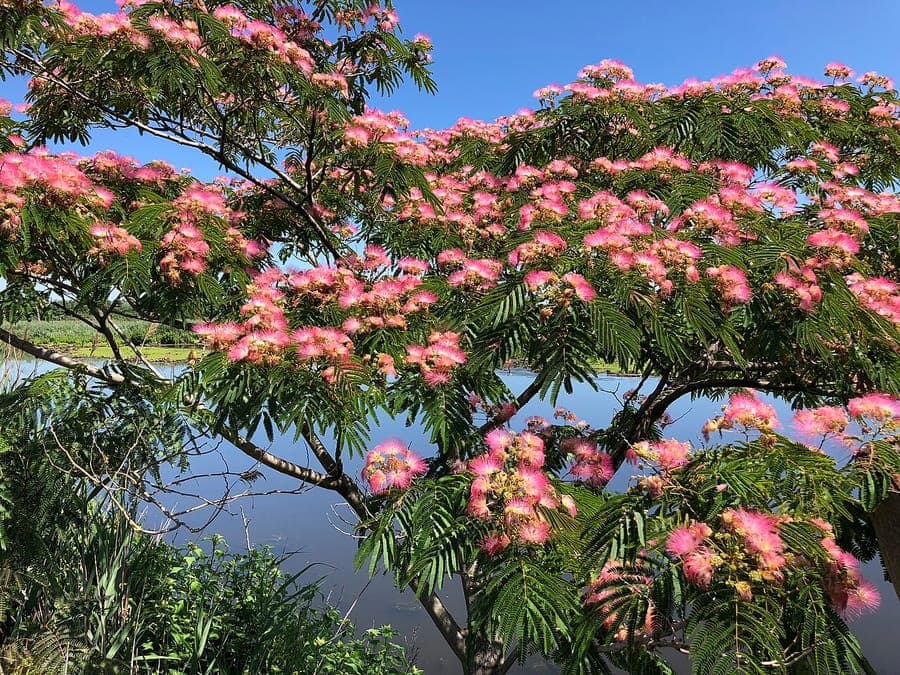
Famartin / CC BY-SA 4.0, via Wikimedia Commons
Mimosa: complete guide
Albizia julibrissin
Want to see Mimosa: complete guide in your garden?
1 minute, no credit card
Overview
Albizia julibrissin, commonly known as mimosa, is a small to medium deciduous tree native to regions from Iran to Japan. In temperate gardens, it's prized for its delicate, fern-like foliage and fluffy summer blooms. It typically reaches 6–8 meters in height and spreads 5–6 meters wide, making it an excellent choice for small to medium-sized gardens.
Despite being deciduous, the mimosa's architectural branching and smooth grey bark add winter interest. The leaves fold up at night or during rain - a quirky behaviour that gives it the nickname 'silk tree' or 'sleeping tree'. If you're planning a new planting scheme, gardenworld.app offers design tools to help you position the mimosa for maximum seasonal impact.
Appearance & bloom cycle
The bipinnate leaves are finely divided, giving the canopy a soft, lacy texture. From June to mid-August, the tree produces spherical, pom-pom-like flowers in soft pink. Each flower head is about 3–4 cm wide and packed with long stamens that create a feathery, silky effect.
These blooms are rich in nectar and attract bees, butterflies, and hoverflies. After flowering, 10–20 cm long seed pods form and may persist into winter, adding structure. The pods can self-seed in warm climates, so remove them if you want to avoid volunteer seedlings.
Ideal location
Mimosa thrives in full sun - aim for at least 6 hours of direct sunlight daily. It prefers sheltered spots, especially when young, as branches can snap in strong winds. Avoid frost pockets and north-facing walls that stay cold and damp.
It performs well in urban gardens due to its tolerance for pollution. Plant it as a standalone specimen on a lawn, near a patio, or at the edge of a mixed border. For gardeners in borderline hardiness zones, consider growing it against a south-facing wall to benefit from radiant heat. Use gardenworld.app to simulate sun exposure and spacing before planting.
Soil requirements
The mimosa is adaptable to various soil types - sandy, loamy, or clay - as long as drainage is good. It struggles in waterlogged soils, where root rot can quickly set in. The ideal pH range is 5.5 to 7.5.
No soil amendments are usually needed. As a member of the Fabaceae family, it fixes nitrogen through root nodules, so avoid high-nitrogen fertilisers. If your soil is very poor, mix in compost at planting time, but don't over-enrich.
Free design
Want to see Mimosa: complete guide in your garden? Make a free design now.
Watering
Water deeply and regularly during the first growing season - about 10–15 liters per week. After that, the tree is drought-tolerant and only needs supplemental watering during prolonged dry spells (3+ weeks without rain).
Avoid frequent shallow watering. Instead, soak the root zone infrequently but thoroughly. Keep mulch away from the trunk by at least 10 cm to prevent rot and rodent damage.
Pruning
Minimal pruning is required. Focus on structural shaping in the first few years. Remove dead, damaged, or crossing branches in late winter (February) or early spring before bud break.
Avoid heavy pruning - Albizia recovers slowly and may not bloom the following year if over-pruned. Never prune in autumn, as this can stimulate tender growth vulnerable to frost. Use sharp, clean tools and make clean cuts just above a bud or lateral branch.
Maintenance calendar
- January: Check for winter storm damage.
- February: Light pruning if weather permits.
- March: Loosen soil around base; no feeding needed.
- April: Watch for aphids on new growth.
- May: Monitor soil moisture as temperatures rise.
- June–August: Peak bloom; water during drought.
- September: Remove seed pods to prevent self-seeding.
- October: Leaves drop; no action required.
- November–December: Protect young trunks with tree guards if rabbits or voles are present.
Winter hardiness
Mimosa is hardy in USDA zones 6b to 9. In zone 6b (–20°C), young trees may suffer dieback, but mature specimens often survive with protection. In colder areas, plant near a warm wall or grow in a large container that can be moved.
Late spring frosts can damage new growth. In marginal zones, consider wrapping the trunk with hessian for the first 2–3 winters. Snow load rarely harms the tree, but strong winds can break branches.
Companion plants
Under the open canopy, plant shade-tolerant perennials like lungwort (Pulmonaria), foxglove (Digitalis), or bellflower (Campanula). Around the base, pair with drought-tolerant sun-lovers such as lavender, yarrow (Achillea), or catmint (Nepeta).
Avoid invasive ground covers that might climb the trunk. Also, steer clear of heavy feeders that could compete for resources.
Closing
Albizia julibrissin brings tropical charm to temperate gardens with surprisingly low demands. It's widely available at garden centres across the UK and US, often sold in 100–150 cm containers. Look for healthy specimens with flexible stems and no signs of pests.
With proper siting and minimal care, it rewards with years of summer blooms and graceful foliage. Whether you're refreshing your garden layout or adding a focal point, check gardenworld.app for design inspiration and planting simulations tailored to your space.
Want to see Mimosa: complete guide in your garden? Make a free design now.
Upload a photo, pick a style, and get a photorealistic design with plant list in under a minute.
No credit card required


Similar plants
Tall Silky Lupine: complete guide
Lupinus elatus
Tall silky lupine is a fast-growing Californian perennial with silvery foliage and blue-purple flower spikes, ideal for a prairie-style garden.
Garfield Lupine: complete guide
Lupinus garfieldensis
The Garfield lupine is a rare, fast-growing American perennial for alkaline, dry grassland gardens, with striking blue flower spikes.
Lupinus elegans: complete guide
Lupinus elegans
Lupinus elegans, the elegant lupine, is a spectacular blooming plant from Mexico with blue flower spikes. Care, cultivation and garden use.