
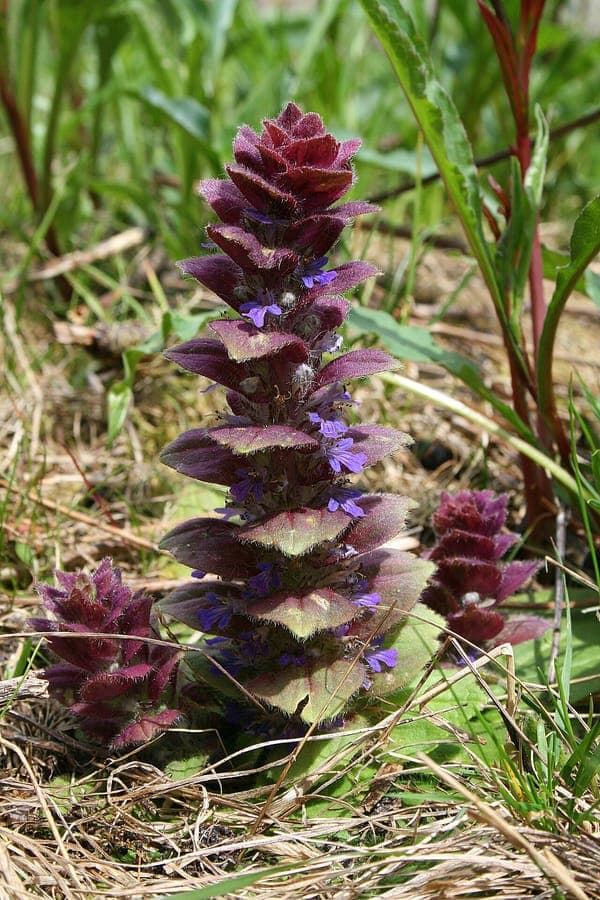
Jean-Pol GRANDMONT / CC BY-SA 3.0, via Wikimedia Commons
Pyramid bugle: complete guide
Ajuga pyramidalis
Want to see Pyramid bugle: complete guide in your garden?
1 minute, no credit card
Overview
Pyramid bugle (Ajuga pyramidalis) isn't as widely known as its cousin Ajuga reptans, but it deserves a spot in more gardens. Native to forested regions of central and eastern Europe - including Austria, Finland, and Belarus - this perennial brings structure and seasonal interest without aggressive spreading. It's a reliable ground cover for tricky areas where other plants struggle, like under trees or on shaded slopes. If you're planning a low-maintenance, shade-friendly garden, this is one to consider. On gardenworld.app, you can create a custom design that integrates pyramid bugle seamlessly into your existing layout, especially in zones with dappled light.
Appearance & bloom cycle
Pyramid bugle forms tight rosettes of dark green, slightly hairy leaves that grow in a spreading but controlled manner. The foliage stays attractive most of the year, turning bronze in cooler weather. The standout feature is the flower spike - 15 to 25 cm tall - that rises in late spring, typically from late May to mid-June. The flowers are a rich violet-purple, densely packed in a pyramid-shaped inflorescence, which gives the plant its common name.
Each spike lasts three to four weeks, and during that time, it's a magnet for bees, hoverflies, and other pollinators. Once flowering finishes, the spent spikes remain upright, adding winter texture. Unlike Ajuga reptans, this species spreads more slowly via rhizomes, so it's easier to manage in mixed borders.
Ideal location
This plant thrives in partial shade - think morning sun with afternoon shade, or light shade under deciduous trees. Full sun works only if the soil stays consistently moist. Deep shade reduces flowering and leads to leggy growth, so avoid planting it under dense evergreens. It's ideal for woodland edges, under shrubs, or along north-facing walls.
It's a solid choice for erosion control on gentle slopes where mowing is difficult. If you're unsure about light levels in your garden, use gardenworld.app's sun mapping tool to test how much direct sunlight your area gets before planting.
Soil requirements
Ajuga pyramidalis prefers moist, well-drained loam or clay-loam soils with a pH between 5.5 and 7.0. It tolerates sandy soils if mulched regularly to retain moisture. Avoid waterlogged conditions, especially in winter, as this can lead to crown rot. Amend heavy clay with compost or grit to improve drainage.
For container growing, use a mix of standard potting soil with 20% perlite. Add a slow-release granular fertiliser at planting time, but avoid over-feeding - too much nitrogen promotes leafy growth at the expense of flowers.
Free design
Want to see Pyramid bugle: complete guide in your garden? Make a free design now.
Watering
Water newly planted specimens twice a week for the first month, especially during dry springs. Once established, it's moderately drought-tolerant but performs best with consistent moisture. In summer, water deeply every 7–10 days during dry spells. Avoid overhead watering to prevent fungal issues like powdery mildew.
Mulch with leaf mould or shredded bark to conserve moisture and suppress weeds. This also mimics the plant's natural forest floor environment.
Pruning
No regular pruning is needed, but cutting back old flower spikes in late autumn or early spring keeps the patch looking tidy. If the center of the clump starts to thin, lift and divide the plant every 3–4 years in early spring. Replant divisions 20 cm apart to maintain a dense cover.
Use clean, sharp tools to prevent disease transfer. Remove any damaged or diseased foliage promptly.
Maintenance calendar
- Jan: Check for winter damage; no action needed
- Feb: Monitor for early growth
- Mar: Clear old foliage; apply light compost top-dressing
- Apr: Watch for slug activity; protect young growth
- May: Flower spikes emerge; reduce watering slightly
- Jun: Peak bloom; pollinators active
- Jul: Minimal care; avoid fertilising
- Aug: Water if prolonged drought; inspect for pests
- Sep: Consider division if clumps are sparse
- Oct: Cut back old stems; mulch lightly
- Nov: Final tidy-up before winter
- Dec: Dormant; no intervention required
Winter hardiness
Pyramid bugle is hardy in USDA zones 5–9, surviving temperatures down to -23°C. Foliage often remains evergreen in milder climates, turning bronze in cold snaps. In harsh winters, the top growth may die back, but roots survive and resprout in spring. No winter protection is needed in the ground.
Potted plants are more vulnerable. Move containers to a sheltered spot or wrap the pots with hessian to prevent root freeze.
Companion plants
Pair pyramid bugle with shade-loving perennials like Lamium maculatum, Heuchera, or Pulmonaria. It works well under shrubs such as rhododendrons or viburnums. For spring interest, plant bulbs like Muscari or Chionodoxa beneath the rosettes.
Avoid pairing with invasive ground covers like ivy, which can smother it. Keep competing weeds like nettles or ground elder under control.
Closing
Pyramid bugle is a quiet achiever - not flashy, but dependable. It fills gaps, supports pollinators, and asks for little in return. You'll find it at garden centres in late spring, often near other ground covers. Look for healthy, compact plants with fresh green leaves and no signs of slug damage. With the right conditions, it will spread slowly and steadily, forming a lush carpet with vertical blooms. And if you're designing a new bed, use gardenworld.app to visualise spacing and companion pairings before you buy. Whether you're refreshing a shady corner or stabilising a slope, pyramid bugle is a smart, low-effort choice.
Want to see Pyramid bugle: complete guide in your garden? Make a free design now.
Upload a photo, pick a style, and get a photorealistic design with plant list in under a minute.
No credit card required


Similar plants
Apple mint (Mentha x villosa): complete guide
Mentha x villosa
Meet apple mint (Mentha x villosa): a fruity-scented kitchen herb with woolly leaves, perfect for tea and mojitos.
Salvia peyronii: complete guide
Salvia peyronii
Discover Salvia peyronii, a rare Lebanese mountain sage. Growing tips, hardiness, and companion planting for a Mediterranean gravel garden.
Bigleaf mint (Mentha x rotundifolia): complete guide
Mentha x rotundifolia
Discover bigleaf mint: cultivation, care tips, and garden uses. Learn how to grow this aromatic herb with soft, hairy leaves.