
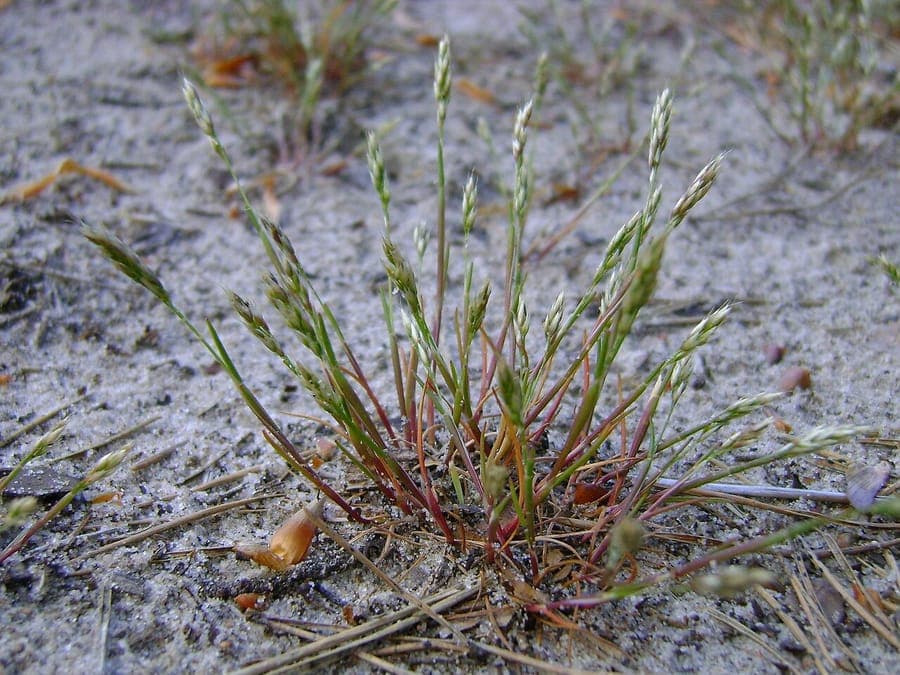
Kenraiz, Krzysztof Ziarnek / CC BY-SA 4.0, via Wikimedia Commons
Early hair grass: complete guide
Aira praecox
Want to see Early hair grass: complete guide in your garden?
1 minute, no credit card
Overview
Early hair grass, or Aira praecox, is a delicate ornamental grass that brings subtle movement and texture to garden landscapes. Native to parts of Western and Northern Europe-including Belgium, Germany, the Baltic States, and the Azores-it naturally thrives in dry, open habitats like sandy banks, road verges, and rocky meadows. In the garden, it's valued not for bold color but for its airy structure and early emergence, making it a quiet yet essential player in naturalistic planting schemes.
This short-lived perennial or biennial grass typically reaches 20 to 40 cm in height, forming neat tufts from a central base. It's non-invasive, clump-forming, and doesn't spread via runners, which makes it perfect for smaller gardens or controlled designs. Its unobtrusive nature belies its usefulness-Early hair grass adds rhythm to borders and softness between bolder perennials.
On gardenworld.app, you can design a planting scheme that integrates Early hair grass with complementary textures and bloom times. The platform helps visualize seasonal changes, so you know exactly how your garden will look in May when this grass hits its peak.
Appearance & bloom cycle
Early hair grass features fine, bright green blades that arch gently from the base. The flowering stems rise in April, reaching full display by May and June. The flowers are small, greenish to silvery-grey, and held aloft on slender, branching panicles that catch the breeze with a whisper-light motion.
As the name suggests, its bloom time is early-often among the first grasses to flower. This makes it valuable for extending seasonal interest before taller grasses like Calamagrostis or Stipa take over. After flowering, the plant sets seed and often dies back, especially in annual forms, but the dried stems persist, adding winter silhouette and habitat for overwintering insects.
The plant grows in tight clumps, typically 15–20 cm wide, and doesn't self-invade aggressively. This restrained growth habit is ideal for curated designs where control is key.
Ideal location
Full sun is best for Early hair grass-aim for at least 6 hours of direct light daily. In partial shade, the stems may elongate and flop, reducing its structural appeal. It performs well in dry, open sites such as rock gardens, gravel beds, or the front of sunny borders.
Containers work too, as long as drainage is excellent. Use a gritty mix and space plants at least 15 cm apart to ensure airflow and prevent fungal issues. Avoid overcrowding, especially in humid climates.
Soil requirements
This grass thrives in poor, well-drained soils. Sandy or gravelly substrates are ideal. Avoid rich, fertile soils high in organic matter, as they encourage excessive leaf growth and weak stems. A pH between 5.8 and 7.5 is acceptable-slightly acidic to neutral.
Heavy clay soils should be amended with coarse sand or grit to improve drainage. Raised beds or mounded planting areas can also help prevent waterlogging, especially in winter.
Free design
Want to see Early hair grass: complete guide in your garden? Make a free design now.
Watering
Once established, Early hair grass is drought tolerant and rarely needs supplemental watering. During the first few weeks after planting, water deeply but infrequently to encourage deep root development. After that, rely on natural rainfall.
Overwatering is a common mistake and can lead to crown rot or fungal diseases. If you're growing it in a container, let the soil dry out completely between waterings.
Pruning
No formal pruning is required. In early spring, remove old foliage and spent flower stems to make way for new growth. Cut back to just above the crown using sharp shears. If you prefer to limit self-seeding, snip off the flower heads after blooming.
In naturalistic or wildlife gardens, however, leaving the dried stems through winter adds visual interest and provides shelter for small invertebrates.
Maintenance calendar
- Jan: Clear debris; check for crown damage
- Feb: Remove old growth; prepare soil surface
- Mar: Cut back remaining dead material; watch for new shoots
- Apr: Monitor emergence; no watering unless exceptionally dry
- May: Peak bloom; inspect for fungal issues in wet weather
- Jun: Flowering fades; consider deadheading for control
- Jul: Plant often dies back; leave structure if desired
- Aug: Watch for seedlings; thin or relocate as needed
- Sep: Assess natural reseeding; adjust spacing
- Oct: Leave some seed heads for winter effect
- Nov: Apply light compost if soil is poor
- Dec: Minimal care; protect from heavy mulch
Winter hardiness
Aira praecox is generally hardy in USDA zones 6b to 9. As a short-lived species, it often relies on self-seeding to persist. In colder zones, mulching heavily can inhibit germination, so use only a light leaf litter if winter protection is needed.
To encourage reseeding, avoid deep mulching and let seed heads disperse naturally. In milder climates, it may behave as a biennial or even a short-lived perennial.
Companion plants
Pair Early hair grass with drought-tolerant companions like Thymus, Sedum, or Eryngium. It contrasts beautifully with bolder forms such as Achillea or Salvia. For texture, combine with fine-leaved ferns or small bulbs like Ornithogalum nutans.
Avoid aggressive spreaders like mint or ground-covering ivy, which can smother its delicate clumps. The goal is balance-use Aira praecox as a filler that enhances, not competes.
On gardenworld.app, you can test plant combinations to see how Early hair grass interacts with neighboring perennials. This helps avoid overcrowding and ensures each plant has room to thrive.
Closing
Early hair grass won't grab attention with flashy blooms, but it earns its place through grace and reliability. It's a low-effort, high-reward plant for gardeners who appreciate subtlety and seasonal change. With minimal care, it delivers texture, movement, and ecological value.
Find Aira praecox at garden centres across the UK and US, especially those specializing in ornamental grasses or native plants. Look for local ecotypes when possible-they adapt better to regional conditions. And remember: in a well-thought-out garden, even the quietest grass has a role to play.
Want to see Early hair grass: complete guide in your garden? Make a free design now.
Upload a photo, pick a style, and get a photorealistic design with plant list in under a minute.
No credit card required


Similar plants
Sporobolus pungens: complete guide
Sporobolus pungens
Sporobolus pungens is a stoloniferous Mediterranean coastal grass with outstanding salt and drought tolerance, perfect for seaside and dry gardens.
Mediterranean aegilops: complete guide
Aegilops biuncialis
Everything about Aegilops biuncialis, a Mediterranean annual grass with ornamental spikes and outstanding drought tolerance for dry gardens.
Silver bluestem: complete guide
Bothriochloa saccharoides
Full guide to Bothriochloa saccharoides (silver bluestem): site, soil, watering, winter hardiness, pruning, and garden companions.