
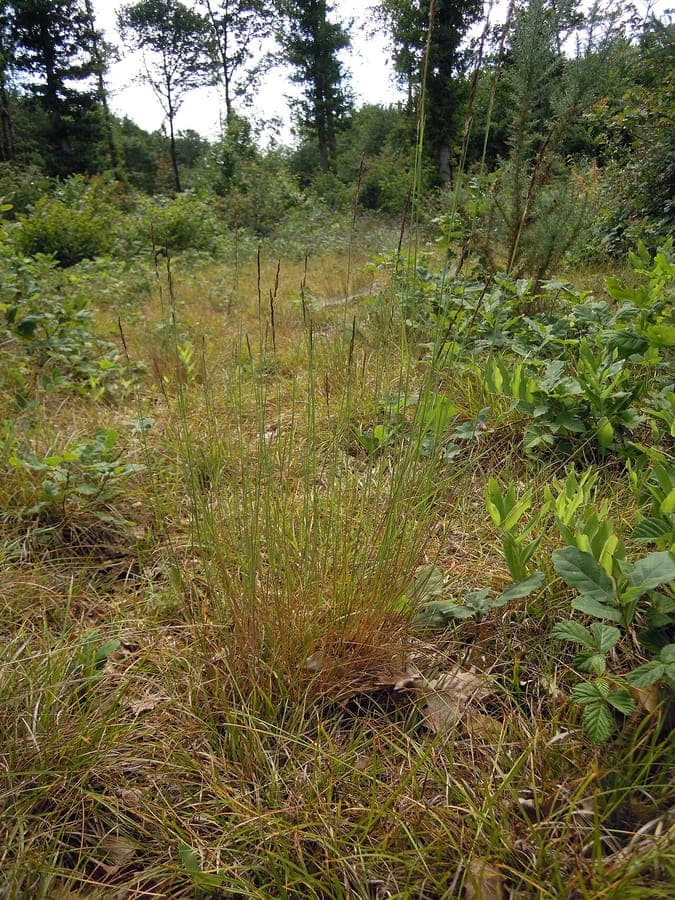
David Mercier / CC BY-SA 2.0 fr, via Wikimedia Commons
Brown bent: complete guide
Agrostis vinealis
Want to see Brown bent: complete guide in your garden?
1 minute, no credit card
Overview
Brown bent (Agrostis vinealis) is a finely textured, airy grass that brings subtle movement and structure to the garden. Native to parts of Europe, Asia, and North America, it thrives in dry, open habitats like heathlands, sandy slopes, and forest margins. It's not the kind of plant that shouts for attention, but once you notice it, you'll appreciate its quiet elegance.
This grass has a loose, open growth habit, reaching 30 to 60 cm in height and spreading up to 40 cm wide. It's becoming a go-to choice for gardeners designing drought-tolerant or naturalistic planting schemes. On gardenworld.app, you can build a custom planting plan that highlights Brown bent's strengths, pairing it with complementary textures and bloom times.
Appearance & bloom cycle
The foliage is narrow, bright green to grey-green, and often slightly inrolled, giving it a delicate look. From June to August, airy panicles rise above the leaves, initially pale green, then turning a warm brown or purplish hue. These flower heads catch the light beautifully, especially in morning and evening sun.
The blooms persist well into autumn, providing visual interest long after flowering ends. In winter, the plant fades to a soft beige, adding subtle structure and movement to the dormant garden. It doesn't collapse - it stands upright, swaying gently in the breeze, which makes it a valuable asset in low-maintenance winter landscapes.
Ideal location
Brown bent thrives in full sun. Aim for at least 6 hours of direct sunlight daily. It can tolerate light shade, but growth will be looser and flowering reduced. It's perfect for sunny borders, gravel gardens, rockeries, or dry slopes where soil is thin and water scarce.
Avoid shady, damp corners. This grass likes open skies and good airflow. It's ideal for xeriscaping or modern cottage-style gardens where natural movement and texture matter. On gardenworld.app, you can simulate how Brown bent performs in different light conditions and alongside drifts of other ornamental grasses or perennials.
Soil requirements
This grass prefers well-drained, sandy or loamy soils. It struggles in heavy clay or water-retentive soils, which can lead to crown rot. The ideal pH range is slightly acidic to neutral (5.5–7.0). If your soil is heavy, amend it with coarse sand or fine gravel to improve drainage.
Brown bent actually performs better in poorer soils. Rich, fertile mixes encourage floppy growth and reduce flowering. Skip the compost unless mixing it with gritty material. It's a plant that thrives on neglect - a rare quality in today's high-maintenance gardens.
Free design
Want to see Brown bent: complete guide in your garden? Make a free design now.
Watering
Once established, Brown bent is highly drought-tolerant. During the first growing season, water weekly in dry spells to help roots settle. After year one, supplemental irrigation is rarely needed - even in prolonged droughts, it holds up well.
Water at the base to avoid wetting the foliage, which can encourage fungal issues. Use drip lines or a watering can rather than overhead sprinklers. Rainwater is ideal. This grass fits perfectly into water-wise gardening strategies, especially in USDA zones 5–8.
Pruning
Minimal pruning is required. Leave the old growth standing over winter - it offers visual interest and protects the crown. In early spring (March to early April), cut back the previous year's foliage to about 10 cm above ground level using hand shears or lightweight loppers.
Avoid cutting too late, as new shoots may already be emerging. The trimmed material can be lightly used as mulch for nearby drought-tolerant plants, but don't pile it thickly - you don't want moisture trapped around the base.
Maintenance calendar
- Jan: Dormant; check for snow damage
- Feb: Monitor for early growth, keep clear of heavy snow
- Mar: Cut back old growth to 10 cm
- Apr: Inspect for new shoots; no feeding needed
- May: Growth picks up; reduce watering
- Jun: Flowering begins; avoid disturbing plants
- Jul: Peak bloom; enjoy the airy panicles
- Aug: Continue bloom; minimal care
- Sep: Seed heads mature; leave intact
- Oct: Add winter interest; no action
- Nov: Dormancy begins; leave standing
- Dec: Fully dormant; no maintenance
Winter hardiness
Brown bent is hardy in USDA zones 5 to 8. It handles cold winters well, provided the soil drains properly. In zone 7 and above, it often stays semi-evergreen. The main threat isn't cold - it's wet feet. Ensure planting sites have excellent drainage to prevent rot.
No winter protection is needed. The plant is naturally adapted to open, exposed environments. Its upright form persists through snow and frost, adding quiet drama to winter borders.
Companion plants
Pair Brown bent with other sun-loving, drought-tolerant plants for cohesive planting. Great companions include:
- Stipa tenuissima – for fine texture and movement
- Echinacea purpurea – bold contrast in form and colour
- Salvia officinalis – aromatic and structural
- Sedum 'Herbstfreude' – late-season interest
- Achillea millefolium – airy foliage and flat blooms
Avoid moisture-loving plants like hostas or astilbes. Brown bent is not for shaded, moist borders - it's a plant of open, sunny spaces.
Closing
Brown bent isn't flashy, but it's reliable, graceful, and full of quiet character. It's a smart choice for modern, low-input gardens where texture and movement matter more than colour. Once established, it asks for almost nothing and gives back all year.
You can find Agrostis vinealis at garden centres in the UK and Europe, often under its botanical name. Look for healthy plugs or small pots with vibrant green shoots. And remember: on gardenworld.app, you can test how Brown bent integrates into your space, long before you buy a single plant.
Want to see Brown bent: complete guide in your garden? Make a free design now.
Upload a photo, pick a style, and get a photorealistic design with plant list in under a minute.
No credit card required


Similar plants
Sporobolus pungens: complete guide
Sporobolus pungens
Sporobolus pungens is a stoloniferous Mediterranean coastal grass with outstanding salt and drought tolerance, perfect for seaside and dry gardens.
Mediterranean aegilops: complete guide
Aegilops biuncialis
Everything about Aegilops biuncialis, a Mediterranean annual grass with ornamental spikes and outstanding drought tolerance for dry gardens.
Silver bluestem: complete guide
Bothriochloa saccharoides
Full guide to Bothriochloa saccharoides (silver bluestem): site, soil, watering, winter hardiness, pruning, and garden companions.