
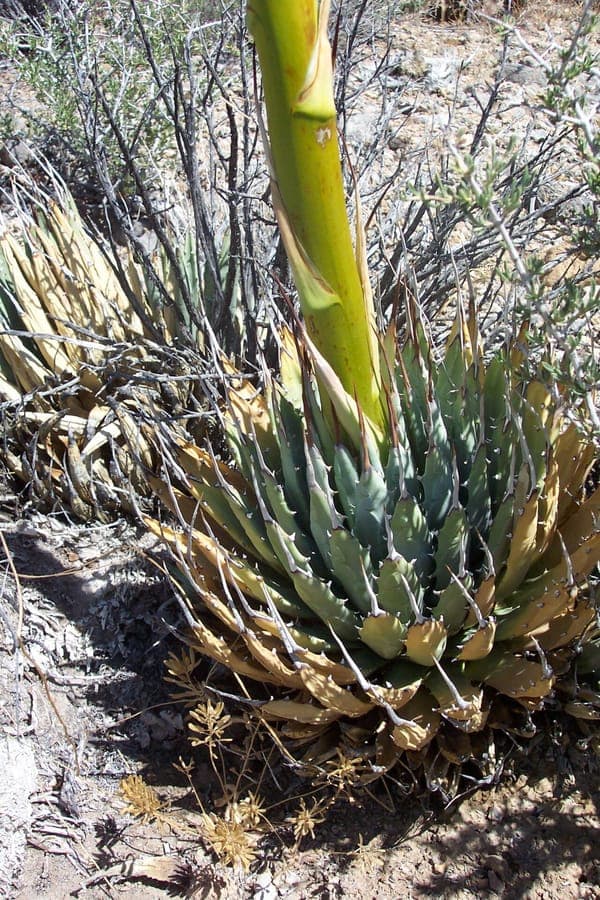
USDA-NRCS PLANTS Database / Public domain, via Wikimedia Commons
Utah agave: complete guide
Agave utahensis
Want to see Utah agave: complete guide in your garden?
1 minute, no credit card
Overview
Agave utahensis, commonly known as the Utah agave or grey agave, is a compact to medium-sized succulent native to the southwestern United States, particularly Arizona, Nevada, Utah, and California. This plant is remarkably cold-hardy for an agave and can withstand harsh winters. Reaching only 30 to 70 cm in height with comparable width, it forms a neat rosette. The foliage is grey-green to blue-green, rigid and pointed. This agave is extremely drought-tolerant and ideal for desert gardens and xeriscaping projects.
Appearance and bloom
The Utah agave has narrow to medium-width, stiff leaves that grow in a dense rosette. Foliage color is grey-green to blue-green, depending on age and light exposure. Leaf margins feature fine teeth (marginal spines), and each leaf terminates in a sharp spine. The plant reaches 30 to 70 centimeters tall. When mature (5-10 years old), it produces an upright flower stalk with yellow-green clustered flowers. After flowering, the rosette dies back but not before producing numerous offsets that perpetuate the plant.
Ideal location
This plant thrives in full sun with at least 6 hours of direct sunlight daily. In extremely hot desert areas, some afternoon shade is tolerated. Choose a location with good air circulation to prevent fungal problems. The plant is wind-resistant and suitable for exposed gardens. Ensure it does not sit in water-collecting depressions or remain wet after rain.
Soil
Agave utahensis thrives in poor, extremely well-draining soil. In gardens with heavy clay, improve soil by digging deep planting holes and adding 30-40% coarse sand or perlite. For container culture, use specialized cactus/succulent potting mix. Soil pH between 5.5 and 8.0 is acceptable. The plant even tolerates gravelly, subsoil conditions. Drainage is paramount.
Watering
Agave utahensis is extremely drought-tolerant. Water very sparingly. Water only when soil is completely dry, typically 4-6 weeks apart during the growing season. In winter, provide almost no water. Young plants in their first year benefit from slightly more moisture than mature plants, but still very minimal. This is a plant that dies from moisture excess, not drought.
Free design
Want to see Utah agave: complete guide in your garden? Make a free design now.
Pruning
The Utah agave requires no pruning. Remove only dead or damaged leaves. Be cautious of sharp leaf tips and marginal spines. Dead leaves can be gently removed.
Maintenance calendar
March-April: Inspect for winter damage. Remove damaged leaves. Begin feeding only as new growth appears. May-June: Start sparse watering as growing season begins. Monitor for scale insects. July-September: Water more sparingly than other plants, even in heat. Enjoy growth. October-November: Reduce watering as temperatures decline. December-February: No to minimal water. Protect from snow loading on leaves.
Winter hardiness
Agave utahensis is hardy in USDA zones 4-5, unusually cold-hardy for an agave. It can tolerate temperatures down to -25 to -30 degrees Celsius with good drainage. In snowy regions, ensure good drainage around the plant to prevent meltwater rot. In the harshest years, some foliage dieback may occur, but the plant recovers. Mulching can help in very severe winters. This makes it suitable for far more climates than typical agaves.
Companion plants
This compact agave works well in xeric borders with other drought-loving plants. Combine with Yucca brevifolia, other Agave species, Opuntia and Echinocereus cacti. Add grey shrubs such as Artemisia, Atriplex, and Zauschneria. For groups, plant in clusters of odd numbers with spacing between specimens. Mulch with gravel or stone chips. Avoid moisture-loving plants. This composition creates an authentic desert atmosphere.
Closing thoughts
Agave utahensis offers hardy gardeners a true desert plant with minimal maintenance requirements. Its compact size suits smaller gardens. Its cold hardiness sets it apart from most other agaves. With well-draining soil and full sun, this plant will retain its grey beauty for years. This plant is sometimes available from native plant nurseries or online suppliers. For desert and xeriscape design tailored to your local climate, visit GardenWorld for professional guidance.
Want to see Utah agave: complete guide in your garden? Make a free design now.
Upload a photo, pick a style, and get a photorealistic design with plant list in under a minute.
No credit card required


Similar plants
Narrow-leaved dracaena: complete guide
Dracaena angustifolia
Everything about Dracaena angustifolia - the narrow-leaved dracaena: location, care, overwintering and use as a houseplant or patio plant.
Chaparral yucca: complete guide to Hesperoyucca whipplei
Hesperoyucca whipplei
Hesperoyucca whipplei (Our Lord's candle) is a dramatic rosette-forming plant from California that produces a towering flower spike, ideal for dry and gravel gardens.
False lily-of-the-valley: complete guide
Maianthemum dilatatum
Everything about Maianthemum dilatatum, the false lily-of-the-valley. Care, shade location, propagation and garden combinations for this popular shade ground cover.