
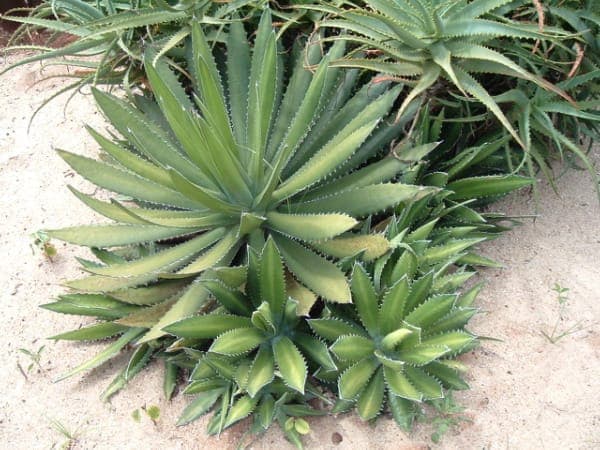
Wikimedia Commons / CC BY-SA 3.0, via Wikimedia Commons
McKelvey agave: complete guide
Agave univittata
Want to see McKelvey agave: complete guide in your garden?
1 minute, no credit card
Overview
The McKelvey agave (Agave univittata), also known as Thorncrest century plant or McKelvey's century plant, is an elegant succulent from the Asparagaceae family. This refined agave is characterized by its upright, blue-gray foliage with distinctive silver stripe markings. It's a less massive agave than some relatives, but considerably more elegant in form and leaf texture. Perfect for garden designers seeking architectural interest without overwhelming size.
Appearance and Bloom
The McKelvey agave forms compact, upright rosettes of blue to blue-green leaves with subtle gray-silver striping along their length. The leaves are more linear than many agaves, narrower and more refined. Leaves typically reach 12-20 inches long and terminate in sharp dark brown terminal spines.
The plant grows moderately slowly, reaching a diameter of approximately 16-24 inches. After many years, it produces yellow tubular flowers on a shaft reaching 6-10 feet tall. After seeding, the plant dies but typically produces a few offsets.
Ideal Location
The McKelvey agave thrives in full sun to light partial shade. Provide the plant a minimum of 5-6 hours direct sunlight daily for optimal growth and leaf color. In extremely hot desert climates, some afternoon shade may be beneficial but is not strictly necessary.
Perfect for USDA zones 9-11, though this plant sometimes thrives in zone 8b with good protection.
Soil
Like all agaves, the McKelvey agave requires exceptionally well-draining soil. Heavy clay soils will cause root rot. Amend heavy soils with sand and gravel in a 1:1:1 ratio, or plant in pure sandy-gravelly mix.
A pH between 6.5 and 8.0 is acceptable. Avoid organic matter that promotes moisture retention.
Free design
Want to see McKelvey agave: complete guide in your garden? Make a free design now.
Watering
Once established (1-2 years), the McKelvey agave is profoundly drought-tolerant. Provide less supplemental water than many other agaves - this plant's native habitat receives minimal annual precipitation.
During the first growing season, moderate watering may be provided. Thereafter, minimize water. Winter must be very dry with no watering. Protect against wet winters, which are more damaging than frost for this species.
Pruning
The McKelvey agave requires minimal pruning. Carefully remove dead, withered, or damaged leaves using heavy gloves (sharp spines!). Leave damaged leaves largely intact unless they appear very unsightly.
Maintenance Calendar
January-February: Dormancy; very dry March-April: Careful growth begins; minimal water May-June: Moderate growth; minimal water July-August: Continued growth; keep dry September-October: Growth slows; no water November-December: Complete rest; extremely dry
Winter Hardiness
The McKelvey agave is hardy to approximately 23 Fahrenheit (-5°C), suitable for USDA zones 9-11. In zone 8b, it can survive in very protected locations. Protect against prolonged wet winters and frost lasting more than a few weeks.
Companion Plants
The McKelvey agave pairs well with other refined desert plants:
- Yucca rostrata (Blue Yucca)
- Dasylirion texanum (Texas Dasylirion)
- Agave havardiana
- Cacti (Echinocereus, Ferocactus)
- Senita (Senita cacti)
Closing Remarks
The McKelvey agave offers elegance and sophistication for gardens where refined architecture matters. With its slender, blue leaves striped in silver and compact growth habit, it's a sophisticated choice. Less dramatic than some agaves, it's certainly striking enough to anchor an interesting garden scheme.
Available from specialty cactus nurseries and desert plant growers. Consult GardenWorld.app for design inspiration and growing guidance.
Want to see McKelvey agave: complete guide in your garden? Make a free design now.
Upload a photo, pick a style, and get a photorealistic design with plant list in under a minute.
No credit card required


Similar plants
Narrow-leaved dracaena: complete guide
Dracaena angustifolia
Everything about Dracaena angustifolia - the narrow-leaved dracaena: location, care, overwintering and use as a houseplant or patio plant.
Chaparral yucca: complete guide to Hesperoyucca whipplei
Hesperoyucca whipplei
Hesperoyucca whipplei (Our Lord's candle) is a dramatic rosette-forming plant from California that produces a towering flower spike, ideal for dry and gravel gardens.
False lily-of-the-valley: complete guide
Maianthemum dilatatum
Everything about Maianthemum dilatatum, the false lily-of-the-valley. Care, shade location, propagation and garden combinations for this popular shade ground cover.