
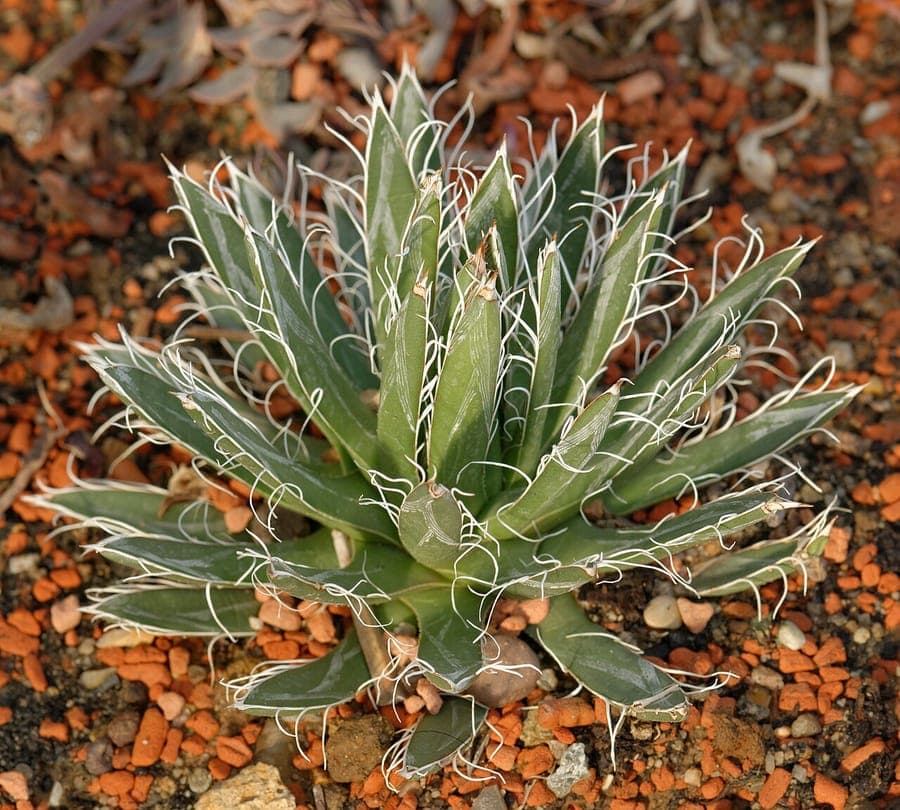
Marie-Lan Nguyen / CC BY 2.5, via Wikimedia Commons
Agave toumeyana: complete guide
Agave toumeyana
Want to see Agave toumeyana: complete guide in your garden?
1 minute, no credit card
Overview
Agave toumeyana, commonly known as Toumey's century plant or Toumey agave, is an impressive succulent naturally occurring in the desert regions of central Arizona. This plant belongs to the Asparagaceae family and is a valuable specimen for gardeners seeking extreme drought and heat-tolerant plants. With its characteristic rosette-forming growth pattern and spectacular flowering spike, it is a showstopper in any sun-facing garden.
The name "century plant" refers to the long period it takes for this plant to first bloom. Although it doesn't actually take a century, Agave toumeyana can take 15 to 30 years to produce its impressive flower spike. This makes it a fascinating choice for enthusiasts of slow growth and patient gardening.
Appearance and bloom
Agave toumeyana forms dense rosette-like clusters of fleshy, grey-green leaves. The leaves are relatively short and broad compared to many other agave varieties, giving the plant a compact and orderly appearance. The leaves have sharp spines at the tips, so be careful when working around the plant.
When the plant finally blooms, which usually happens after 20 to 30 years, an impressive flower spike emerges that can reach up to 4 meters in height. This flowering stem bears numerous yellow flowers that attract bees and hummingbirds. After blooming, the mother plant dies but usually produces pups at the base that can be used for propagation.
Ideal location
Agave toumeyana thrives best in locations with maximum sun exposure. The plant needs at least eight hours of direct sunlight daily and can tolerate much more sun. This is a full-sun plant, unlike many other houseplants that prefer some shade. In Dutch and Belgian climates, this usually means the south-facing part of your garden.
The plant can also be grown in containers on terraces and balconies, as long as they are well-drained. This allows you to cultivate Agave toumeyana even in climates where winters are too harsh for outdoor cultivation. Ensure containers drain well to prevent water accumulation and stagnation.
Soil
Agave toumeyana requires well-draining soil, which is absolutely crucial for the success of this plant. Heavy clay soils are fatal to this species; a combination of cactus or succulent soil with extra sand or gravel is ideal. You can use a mixture of one part garden soil, one part sand, and one part gravel.
The plant tolerates acidic, neutral, or even slightly alkaline soils. It is not fussy about pH as long as drainage is good. For container cultivation, the use of special cactus or succulent potting mix is highly recommended. This ensures the roots don't sit in water and rot.
Free design
Want to see Agave toumeyana: complete guide in your garden? Make a free design now.
Watering
Agave toumeyana is very drought-tolerant and requires much less water than many other houseplants. During the growing season, water can be given, but less frequently than normal. It is better to underwater than to overwater. Watering once every two weeks in summer is usually sufficient.
In winter, when the plant enters dormancy, water can be almost entirely stopped. Water only when the soil is completely dry. This is particularly important in container cultivation in cooler homes. An overly wet plant will certainly rot, which is almost always fatal to Agave toumeyana.
Pruning
Agave toumeyana requires practically no pruning in the conventional sense. The plant grows slowly and forms a natural, compact rosette. Therefore, you don't need to prune to maintain its shape. What you can do is gently remove dead or damaged leaves when they no longer look good.
Avoid reducing the plant by cutting back foliage unless absolutely necessary. Cutting leaves exposes the plant to infections. Always use disinfected tools when you need to remove leaves.
Maintenance calendar
March-May: Water regularly when growing season begins June-August: Height of growth; water every two weeks September-October: Gradually reduce watering November-February: Almost no watering; plant rests
Winter hardiness
Agave toumeyana is not suitable for outdoor wintering in cold climates. In Arizona where it naturally grows, it can overwinter frost-free, but in the Netherlands, Belgium, and France, the plant must be protected from frost. The plant can tolerate temperatures down to about -5 degrees Celsius, but only under very dry conditions.
Better to keep Agave toumeyana in containers and move it to a cool greenhouse, cellar, or heated room in autumn where it is protected from frost. The temperature can drop to about 5 degrees Celsius but not lower. The plant can rest for long periods without light at cool temperatures.
Companion plants
Agave toumeyana combines beautifully with other succulents and desert plants in a xeriscaping garden. Think of other agaves, echeveria, sedums, and other succulents requiring the same growing conditions. You can also combine other Arizona-native plants like palo verde, creosote bush, and various cactus varieties.
In containers, combine well with other Mediterranean or desert plant material. Never combine with regular flowering or foliage plants in the same pot, as these require much more water.
Closing
Agave toumeyana is a beautiful and low-maintenance succulent perfect for gardeners wanting something different. With minimal water requirements and spectacular long-term growth, it offers many benefits. This plant requires patience and tolerance, but rewards you with years of strong, healthy growth. For information and plant material, visit specialized nurseries and garden centers. Start cultivating Agave toumeyana today and discover the beauty of this special plant on gardenworld.app.
Want to see Agave toumeyana: complete guide in your garden? Make a free design now.
Upload a photo, pick a style, and get a photorealistic design with plant list in under a minute.
No credit card required


Similar plants
Narrow-leaved dracaena: complete guide
Dracaena angustifolia
Everything about Dracaena angustifolia - the narrow-leaved dracaena: location, care, overwintering and use as a houseplant or patio plant.
Chaparral yucca: complete guide to Hesperoyucca whipplei
Hesperoyucca whipplei
Hesperoyucca whipplei (Our Lord's candle) is a dramatic rosette-forming plant from California that produces a towering flower spike, ideal for dry and gravel gardens.
False lily-of-the-valley: complete guide
Maianthemum dilatatum
Everything about Maianthemum dilatatum, the false lily-of-the-valley. Care, shade location, propagation and garden combinations for this popular shade ground cover.