
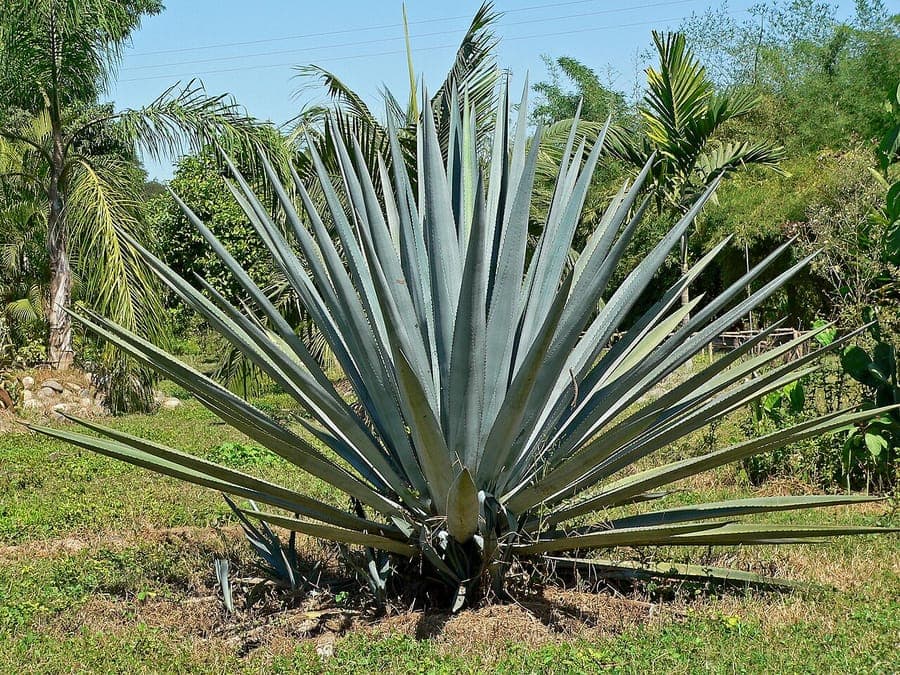
Stan Shebs / CC BY-SA 3.0, via Wikimedia Commons
Tequila agave: complete guide
Agave tequilana
Want to see Tequila agave: complete guide in your garden?
1 minute, no credit card
Overview
Agave tequilana, commonly known as the Tequila agave, blue agave, or maguey azul, is a large, striking succulent native to Mexico, particularly the states of Jalisco, Nayarit, and Tamaulipas. This plant is famous as the primary ingredient in tequila production. Reaching 1.5 to 2.5 meters in height and more than 2 meters across, it creates a truly dominant presence. The foliage is blue-grey to slate-blue, rigid and pointed, forming a broad, massive rosette. This agave grows rapidly and can flower within 5-15 years of maturity.
Appearance and bloom
The Tequila agave features large, broad, thick leaves that are blue-grey to slate-blue in color, with very sharp terminal spines. Leaves reach 1 to 1.8 meters long and 12 to 20 cm wide. Leaf margins are sometimes finely toothed. The plant forms a broad, symmetrical rosette that becomes progressively more massive with age. At maturity (7-15 years old), a very tall flower stalk emerges that can exceed 7-10 meters in height, bearing hundreds of yellow flowers in dense clusters. After flowering, the mother plant dies but not before producing numerous offsets.
Ideal location
This large plant requires full sun and ample space. Plant it where it receives at least 6-8 hours of direct sunlight daily. Provide plenty of room; mature specimens expand significantly in width. Avoid positions near water lines, pipes, or house foundations, as the broad leaves require substantial space. A location with good air circulation is essential to prevent fungal issues. Protect from extreme wind, though it tolerates normal wind exposure reasonably well.
Soil
Agave tequilana requires very well-draining soil. In gardens, a mixture of 50% garden or sandy soil with 50% coarse sand or perlite works well. The plant also thrives in relatively poor soil. Soil pH between 6.0 and 8.0 is acceptable. In containers, use specialized cactus/succulent potting mix. Heavy clay soil without amendment will cause problems. Adequate drainage is crucial.
Watering
Agave tequilana is extremely drought-tolerant and requires minimal watering. Water only during the growing season (May to September), and then only when soil is completely dry. In extreme drought, the plant can survive months without water. In winter, provide almost no water. Give the plant slightly more water in its first two years to promote establishment, but avoid moisture excess. Excessive moisture is the leading cause of plant death.
Free design
Want to see Tequila agave: complete guide in your garden? Make a free design now.
Pruning
The Tequila agave requires no pruning. Remove only dead leaves or damaged leaf tips. Be cautious of sharp leaf edges and spines. Dead leaves can be gently pulled or cut with a sharp knife. Take care to avoid plant sap contacting eyes, as it can cause irritation.
Maintenance calendar
March-April: Inspect for winter damage. Remove dead leaves. May-June: Begin regular watering as season starts. Monitor for pest insects. July-August: Water regularly, enjoy growth and architectural form. September-October: Reduce watering as temperatures cool. November-February: Provide almost no water during dormancy. Protect from freezing rain in cold climates.
Winter hardiness
Agave tequilana is hardy only in USDA zones 9-11, tolerating temperatures no lower than approximately -5 degrees Celsius. In areas with severe winters, grow it in containers and overwinter indoors in a cool greenhouse or space (7-12 degrees Celsius). In milder climates (southern Europe), it can remain outdoors with protection against snow and ice. In northern Europe, always grow in containers and overwinter indoors.
Companion plants
This imposing agave works well with other large succulents and architectural plants. Combine with other Agave species, Aloes, and Yuccas. Add grey, fine-leaved plants such as Santolina, Teucrium, and artemisia for contrast. Position in dry borders with sea pink (Limonium), lavender, and round-leaved rosemary. For group plantings, space multiple plants at distance for dramatic effect. This composition creates a strong, dry, Mediterranean atmosphere.
Closing thoughts
Agave tequilana offers an unforgettable sculptural presence in large gardens or parklands. This is not a plant for small spaces. With minimal maintenance requirements and full sun, this agave will impress for years. Its historical and cultural significance also makes it a conversation starter. This plant is occasionally available at specialized nurseries. For large projects and landscape advice on exotic Agaves, visit GardenWorld for custom garden design.
Want to see Tequila agave: complete guide in your garden? Make a free design now.
Upload a photo, pick a style, and get a photorealistic design with plant list in under a minute.
10,000+ gardens designed already
No credit card required


Similar plants
Narrow-leaved dracaena: complete guide
Dracaena angustifolia
Everything about Dracaena angustifolia - the narrow-leaved dracaena: location, care, overwintering and use as a houseplant or patio plant.
Chaparral yucca: complete guide to Hesperoyucca whipplei
Hesperoyucca whipplei
Hesperoyucca whipplei (Our Lord's candle) is a dramatic rosette-forming plant from California that produces a towering flower spike, ideal for dry and gravel gardens.
False lily-of-the-valley: complete guide
Maianthemum dilatatum
Everything about Maianthemum dilatatum, the false lily-of-the-valley. Care, shade location, propagation and garden combinations for this popular shade ground cover.