
Tangopaso / Public domain, via Wikimedia Commons
Hedgehog agave: complete guide
Agave stricta
Want to see Hedgehog agave: complete guide in your garden?
1 minute, no credit card
Overview
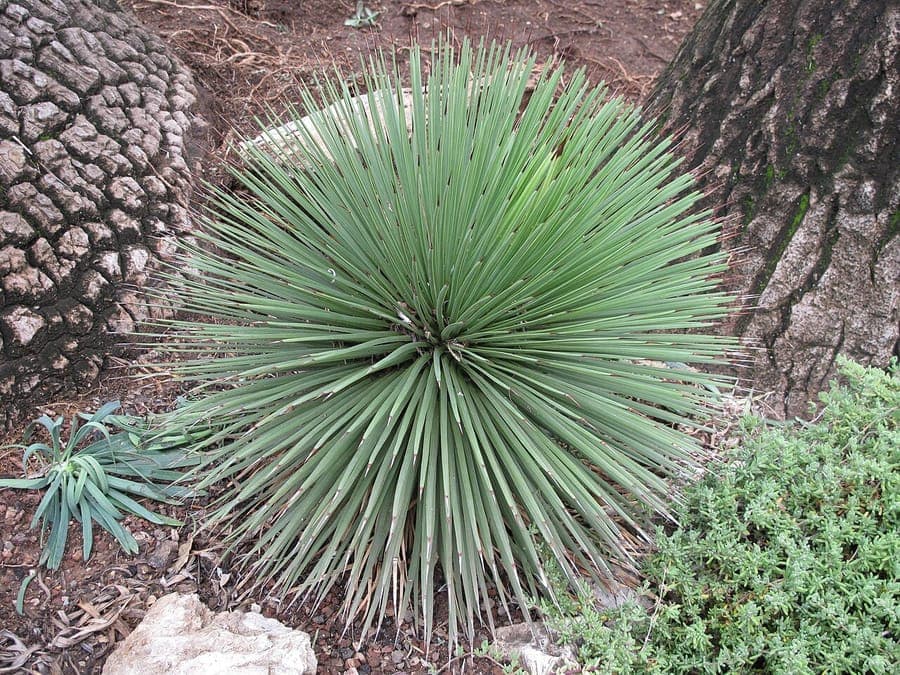
Agave stricta, commonly called the Hedgehog agave or Bottle plant, is a small to medium succulent native to northeastern Mexico, particularly the Oaxaca and Puebla regions. This plant stands out for its dense rosette of stiff, linear leaves that point upward in a characteristic spiky form. Reaching about 40-60 cm in height and similar in width, it creates a striking decorative element. The plant is extremely drought-tolerant and ideal for full-sun gardens with minimal maintenance requirements. Its compact size makes it perfect for container gardening and dry borders.
Appearance and bloom
The Hedgehog agave features very narrow, rigid leaves that stand upright, forming a dense, star-shaped rosette. Foliage is greenish-grey to blue-green, with sharp points at the leaf tips and sometimes fine margins. The plant reaches 40 to 60 centimeters in height with equal spread. Unlike many agaves, this species flowers at maturity with yellow flowers on a long, upright inflorescence. After blooming, the plant produces small offset plantlets around the mother plant, promoting cluster formation. The entire plant has strong architectural character suitable for contemporary gardens.
Ideal location
This plant requires full sun to thrive. Ensure it receives at least six to eight hours of direct sunlight daily. In areas with extreme summer heat, light afternoon shade may be beneficial. The plant grows well in containers on patios, balconies, or in south-facing borders. Avoid locations with high humidity and poor air circulation, as this promotes rot and fungal diseases. Wind exposure is actually beneficial, as it keeps foliage dry.
Soil
Agave stricta requires extremely well-draining soil. Use specialized cactus and succulent potting mix, or create your own blend by mixing 60% coconut coir or peat substrate with 40% coarse sand, perlite, or horticultural grit. Soil pH should range between 6.0 and 7.5. Heavy clay or standard potting soil leads directly to root rot. Ensure drainage with gravel or terracotta shards at pot bottoms. Never add organic matter, as this retains too much moisture.
Watering
Water extremely sparingly and only during the growing season (May to September). In winter, provide almost no water. This is one of the most drought-tolerant plants and abhors moisture excess. Water only when soil is completely dry. In severe drought, the plant can survive months without water. Even during the growth period, 3-4 weeks between waterings is normal. Never wet the rosette; this causes rot. Water only at the base.
Free design
Want to see Hedgehog agave: complete guide in your garden? Make a free design now.
Pruning
Agave stricta requires no pruning. Remove only dead or damaged leaves. Be cautious of the sharp leaf points. After flowering, the spent flower stalk dies back and can be removed. The plant produces offsets that can be left to form clusters or optionally separated and propagated individually.
Maintenance calendar
March-April: Inspect for winter damage, remove dead leaves. Begin feeding only as growth resumes. May-June: Start regular watering during growth period. Monitor for pests. July-August: Enjoy full sun exposure and growth. September-October: Reduce watering as temperatures decline. November-February: Provide almost no water. Protect from frost in cold climates with cloches or fleece.
Winter hardiness
Agave stricta is hardy only in USDA zones 9-11, tolerating brief periods of light frost around -5 degrees Celsius. In areas with winter temperatures below this, bring indoors to a cool greenhouse or conservatory. In milder climates (southern Europe), it can remain outdoors with protection. In northern regions, grow as a pot plant, overwintering indoors in cool conditions (5-10 degrees Celsius). Protect from ice and snow accumulation.
Companion plants
This agave works well in groupings with other succulents and cacti. Combine with Aloe vera, Echeveria, Sempervivum, and other Agave species. Add grass-like plants such as Stipa and Festuca for textural contrast. Position in stone or Mediterranean borders with lavender, santolina, and red-leaf sedum. For container displays, add silvery tone-on-tone companions like Dusty Miller (Senecio cineraria). These compositions create a dry, Mediterranean feel perfect for contemporary gardens.
Closing thoughts
Agave stricta offers a compact, architecturally interesting plant for dry, sunny garden corners. Its minimal water requirements and low maintenance make it ideal for beginning succulent collectors. With well-draining soil and full sun, this agave will retain its spiky beauty for years. It is available as a potted plant at major garden centres. For more inspiration on dry garden design, visit GardenWorld where you can create a complete succulent landscape plan tailored to your space.
Want to see Hedgehog agave: complete guide in your garden? Make a free design now.
Upload a photo, pick a style, and get a photorealistic design with plant list in under a minute.
No credit card required


Similar plants
Narrow-leaved dracaena: complete guide
Dracaena angustifolia
Everything about Dracaena angustifolia - the narrow-leaved dracaena: location, care, overwintering and use as a houseplant or patio plant.
Chaparral yucca: complete guide to Hesperoyucca whipplei
Hesperoyucca whipplei
Hesperoyucca whipplei (Our Lord's candle) is a dramatic rosette-forming plant from California that produces a towering flower spike, ideal for dry and gravel gardens.
False lily-of-the-valley: complete guide
Maianthemum dilatatum
Everything about Maianthemum dilatatum, the false lily-of-the-valley. Care, shade location, propagation and garden combinations for this popular shade ground cover.