
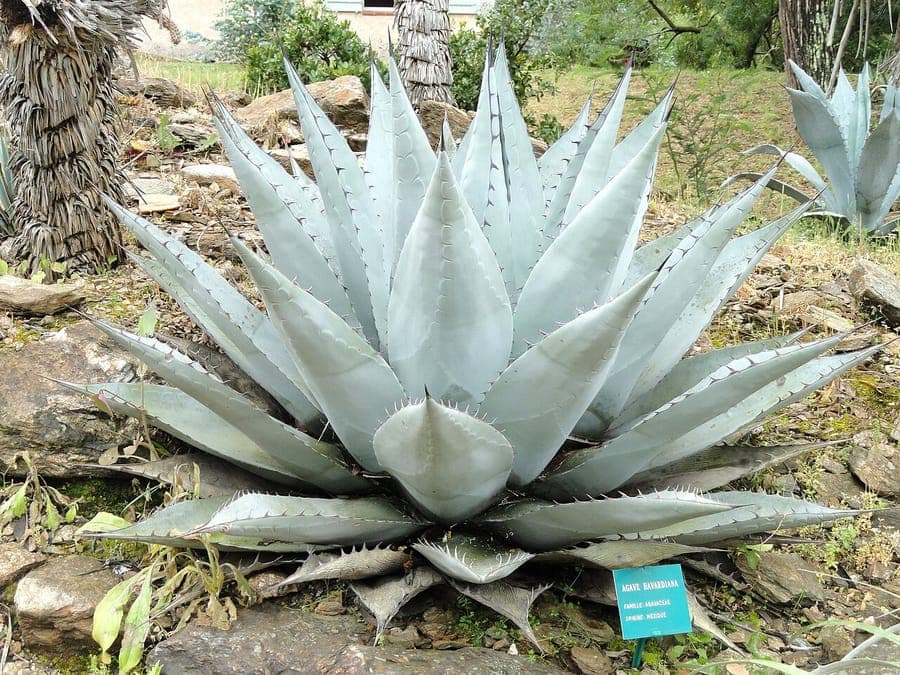
Daderot / Public domain, via Wikimedia Commons
Havard Agave: complete guide
Agave havardiana
Want to see Havard Agave: complete guide in your garden?
1 minute, no credit card
Overview\n\nAgave havardiana, also called Havard's Century Plant or Havard Agave, is a compact succulent from southeastern Texas and northeastern Mexico. One of the most frost-hardy agaves, tolerating -20°C, making it ideal for European gardens with harsh winters.\n\nGrowing 60-75 cm tall, it forms a dense rosette of blue to blue-gray leaves. This unique color adds ornamental value. Requires minimal water and maintenance. Excellent for xeriscape gardens. Very robust and sterile.\n\n## Appearance and Bloom\n\nAgave havardiana grows as a compact rosette 60-75 cm diameter. Leaves reach 20-25 cm, are linear, and distinctly blue-gray. This blue tint is characteristic. Leaf margins have wide, brown edges.\n\nAfter 10-20 years, the plant may produce a tall flower spike, 2-3 meters. Flowers are yellow. A spectacular event following long growth. After bloom, the mother plant dies, but many offset plantlets emerge from the base.\n\n## Ideal Location\n\nThis agave requires full sun. Plant in very sunny, warm locations. In European gardens, south-facing exposure works best. Tolerates full wind and extreme frost well.\n\nIn shade, the plant loses its characteristic blue tint. Ensure good drainage around the plant to prevent winter moisture. Avoid low-lying, wet spots.\n\n## Soil\n\nUse very well-draining potting mix. Add sharp sand, gravel, and broken brick (1:1:1 to 1:2:1 ratio). Heavy clay must be significantly improved before planting. The plant prefers poor soil.\n\nIn containers use drainage holes and mineral potting mix. Avoid humus - causes rot. Acidic pH is better than alkaline.\n\n## Watering\n\nWater very sparingly. During growing season, water once monthly. In winter, practically no water. Drought is better than moisture excess. The key is good drainage.\n\nIn containers, water less than in ground. In European gardens, rain is usually sufficient. Ensure excellent winter drainage. Plant on raised areas when possible.\n\n## Pruning\n\nRemove only dead, damaged leaves. Healthy leaves remain intact. Remove broken leaves. This low-maintenance plant needs no regular pruning.\n\nAfter bloom, remove dead flower spikes. Young plantlets (pups) can carefully be separated and grown separately. Use sharp, clean knife.\n\n## Maintenance Calendar\n\nSpring (March-May): New growth emerges. Very little water. Apply strong sun.\n\nSummer (June-August): Minimal water. Full sun. Plant dormancy.\n\nAutumn (September-October): No feeding. Reduce water. Winter preparation.\n\nWinter (November-February): No water. Plant rest. Frost tolerance useful.\n\n## Winter Hardiness\n\nAgave havardiana is exceptionally frost-hardy. It tolerates -10 to -20°C depending on frost duration. This makes it unique for European gardens. Protect against prolonged ice and snow causing leaf break.\n\nThe key is good winter drainage. Frost heave in ground can cause rot. In wet climates, protect against winter rain.\n\n## Companion Plants\n\nCombine with other drought-tolerant, hardy plants. Sedum, small Yuccas, alpine grasses. Stone and gravel add texture. Create a xeriscape or alpine garden.\n\n## Closing\n\nAgave havardiana is the ideal agave for European gardens with harsh winters. The blue color is ornamental and frost hardiness is unique. Seek this plant at quality nurseries. Via gardenworld.app discover robust garden concepts. At gardenworld.app learn to plan frost-hardy, drought-tolerant gardens.
Want to see Havard Agave: complete guide in your garden? Make a free design now.
Upload a photo, pick a style, and get a photorealistic design with plant list in under a minute.
No credit card required


Similar plants
Narrow-leaved dracaena: complete guide
Dracaena angustifolia
Everything about Dracaena angustifolia - the narrow-leaved dracaena: location, care, overwintering and use as a houseplant or patio plant.
Chaparral yucca: complete guide to Hesperoyucca whipplei
Hesperoyucca whipplei
Hesperoyucca whipplei (Our Lord's candle) is a dramatic rosette-forming plant from California that produces a towering flower spike, ideal for dry and gravel gardens.
False lily-of-the-valley: complete guide
Maianthemum dilatatum
Everything about Maianthemum dilatatum, the false lily-of-the-valley. Care, shade location, propagation and garden combinations for this popular shade ground cover.