
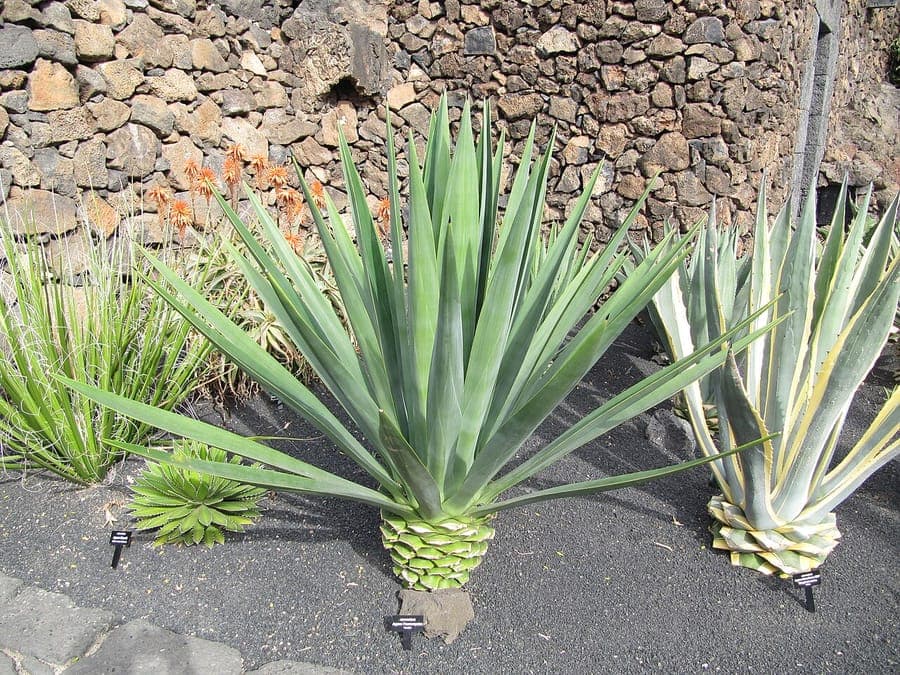
Michiel1972 / CC BY-SA 3.0, via Wikimedia Commons
Yucatan sisal: complete guide
Agave fourcroydes
Want to see Yucatan sisal: complete guide in your garden?
1 minute, no credit card
Overview
Agave fourcroydes, commonly known as Yucatan sisal, is a striking succulent native to southern Mexico and Guatemala. This plant is historically famous for its tough fibres used in rope and textiles - often called 'henequen' in its region of origin. But beyond its industrial past, it's a powerful garden performer. With its bold, blue-green rosette and architectural form, it brings drama and structure to dry, sunny landscapes. For UK and European gardeners looking for bold, low-effort plants, this agave is a standout.
On gardenworld.app, you can design a drought-tolerant garden layout that highlights Agave fourcroydes as a focal point, especially in gravel beds or raised xeriscaped areas where water is scarce.
Appearance & bloom cycle
Mature Yucatan sisal forms a tight rosette up to 150 cm wide, with sword-shaped leaves reaching 100–130 cm in length. The leaves are rigid, fleshy, and display a distinctive blue-green hue with a waxy sheen. Each leaf ends in a sharp, dark brown spine, and the margins are lined with small, hooked teeth. The overall form is symmetrical and imposing.
This agave is monocarpic - it flowers once after 8 to 15 years of growth, then dies. The flower spike can tower up to 5 meters, bearing clusters of yellow-green blossoms. In temperate climates like the UK, flowering is rare due to cooler summers and shorter growing seasons. Most gardeners enjoy the foliage for decades without ever seeing a bloom.
Ideal location
Full sun is essential. Yucatan sisal needs at least 6 hours of direct sunlight daily. In shade, it becomes leggy, loses colour intensity, and risks rot. Choose a south-facing spot, ideally against a stone wall or on a sunny patio where radiant heat helps during cold nights.
Avoid planting near footpaths or play areas - the spiky leaf tips are hazardous. Instead, use it as a sculptural centrepiece in a gravel garden or as a bold accent in a succulent border. For design inspiration, visit gardenworld.app to visualise how this agave fits into modern, water-wise garden schemes.
Soil requirements
The soil must be sharply drained. Use a mix of sandy loam, grit, and a small amount of clay. Avoid heavy, water-retentive soils. Ideal pH ranges from 6.0 to 7.5. In containers, blend cactus potting mix with 30% coarse sand or perlite. Raised beds or alpine mounds work well in gardens with winter wet.
In areas with high rainfall, elevate the planting site or grow in large pots to prevent root saturation.
Free design
Want to see Yucatan sisal: complete guide in your garden? Make a free design now.
Watering
This agave is extremely drought-tolerant. Water only when the top 5 cm of soil is dry. During the growing season (April to September), that's roughly once every 10–14 days. In winter, stop watering entirely. Overwatering is the biggest threat - root rot spreads fast in cool, damp soil.
Use rainwater when possible, especially in hard water areas, to avoid lime deposits on leaves.
Pruning
Pruning is rarely needed. Remove only dead or damaged leaves with clean, sharp shears. Wear thick gloves and eye protection - the spines can cause painful injuries. Never cut into the central growing point; this kills the plant.
Pups ( offsets) often form around the base. Wait until they're 15 cm tall, then gently detach and pot them up in gritty compost. They root easily and make excellent gifts.
Maintenance calendar
- Jan: Keep dry. Check for rot or pest signs.
- Feb: Protect from frost with breathable fleece if needed.
- Mar: No watering. Remove any dead foliage.
- Apr: Resume light watering if temperatures stay above 10°C.
- May: Water every 10–14 days. Monitor for agave weevil.
- Jun: Peak growth. Ensure full sun exposure.
- Jul: Watch for pests and sun scorch in heatwaves.
- Aug: Continue regular care. Avoid wetting foliage.
- Sep: Gradually reduce watering.
- Oct: Stop watering as nights cool.
- Nov: Keep bone dry. Shield from rain.
- Dec: No action needed. Protect from frost.
Winter hardiness
Agave fourcroydes is hardy to USDA zone 9 (-7°C). In the UK (zones 8b–9a), it survives mild winters with protection. Use cloches, cold frames, or move potted plants to a cool, bright greenhouse. Keep roots dry. In colder regions, grow in containers and overwinter indoors at 5–10°C.
Companion plants
Pair with other drought-tolerant species: Aloe arborescens, Echeveria, Sedum spectabile, and Yucca filamentosa. Low-growing groundcovers like Delosperma cooperi or Phlomis add texture. Avoid moisture-loving plants like ferns or hostas.
Contrast the agave's bold form with silvery foliage plants like Artemisia ludoviciana or Stachys byzantina for visual balance.
Closing
Agave fourcroydes isn't for every garden, but for those who appreciate architectural drama and minimal upkeep, it's a gem. Its sculptural form and resilience make it ideal for modern, sustainable landscapes. Buy healthy specimens from reputable garden centres - look for firm, blue-green rosettes with no soft spots or browning.
For planting ideas, explore gardenworld.app's design tools to see how Yucatan sisal can anchor a bold, water-smart garden.
Want to see Yucatan sisal: complete guide in your garden? Make a free design now.
Upload a photo, pick a style, and get a photorealistic design with plant list in under a minute.
No credit card required


Similar plants
Narrow-leaved dracaena: complete guide
Dracaena angustifolia
Everything about Dracaena angustifolia - the narrow-leaved dracaena: location, care, overwintering and use as a houseplant or patio plant.
Chaparral yucca: complete guide to Hesperoyucca whipplei
Hesperoyucca whipplei
Hesperoyucca whipplei (Our Lord's candle) is a dramatic rosette-forming plant from California that produces a towering flower spike, ideal for dry and gravel gardens.
False lily-of-the-valley: complete guide
Maianthemum dilatatum
Everything about Maianthemum dilatatum, the false lily-of-the-valley. Care, shade location, propagation and garden combinations for this popular shade ground cover.