
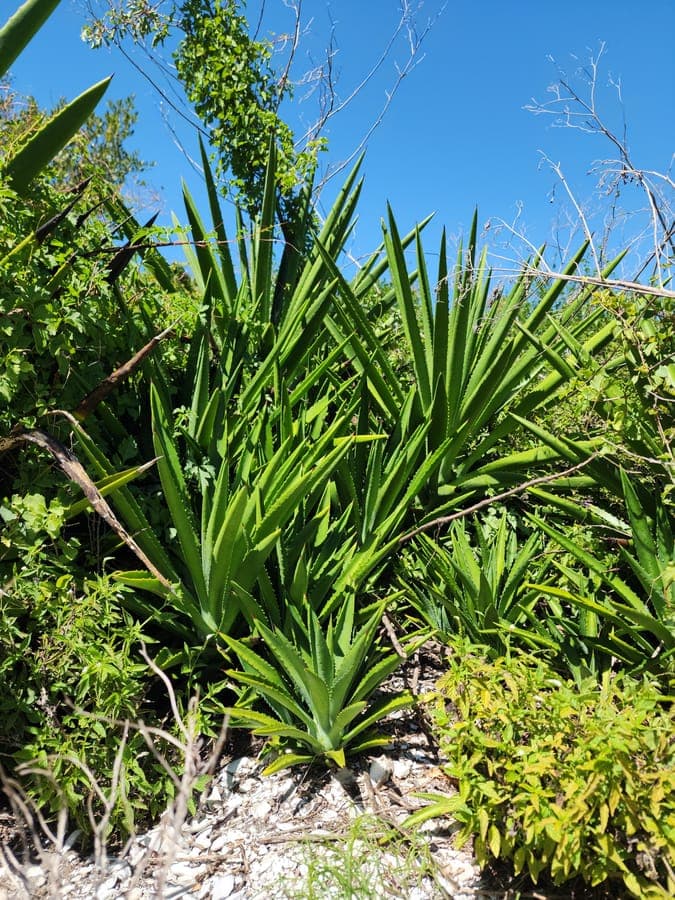
Dsandii / CC BY-SA 4.0, via Wikimedia Commons
False sisal: complete guide
Agave decipiens
Want to see False sisal: complete guide in your garden?
1 minute, no credit card
False sisal, scientifically known as Agave decipiens, is a striking succulent from southern Florida. This attractive plant is a member of the Asparagaceae family and is known for its thick, blue-green leaves that group in a beautiful symmetrical rosette. In its natural habitat, this agave grows in dry, sandy soils and is very drought-tolerant. In temperate climates, however, the plant can also remain outdoors, as long as you protect it from extreme cold.
Agave decipiens grows as a compact rosette with leaves that can reach approximately 30 to 60 centimeters in length. The leaves are greenish to blue-green, linear in shape and sometimes have small thorns along the edges and points at the tips. The plant grows slowly and can remain in the same form for many years without major changes in size. This makes it an ideal plant for pots and containers in dry, sunny locations.
When growing Agave decipiens, it is crucial to provide the right growing conditions. The plant loves full sun and grows best in locations with at least 6 hours of direct sunlight per day. In shade, the plant grows slowly and can take on elongated forms.
Soil is important for success. Agave decipiens thrives best in very well-draining soil with excellent drainage. Use cactus or succulent soil, or make your own mix of regular garden soil with extra sand and perlite. The pH can be between 6.0 and 7.5. Ensure good drainage by adding fine-grain sand to potting soil.
Watering must be done carefully. This is a very drought-intolerant plant, so over-watering is the greatest threat. During the growing season (spring and summer), water sparingly, only when the soil feels completely dry. In autumn and winter, watering is practically stopped. Let the soil dry out between waterings.
Feeding is not essential, but light fertilization during the growing season can be beneficial. Use a fertilizer specifically designed for cacti and succulents, or a very dilute general plant fertilizer. Give fertilizer only once or twice per growing season.
Temperature is an important aspect. The plant is suitable for warm climates and prefers temperatures between 15 and 30 degrees Celsius. In temperate zones, you must bring the plant indoors before temperatures drop below 0 degrees Celsius. The plant is not hardy in temperate climates.
Maintenance is very minimal. Remove dead leaves as you notice them. Do not cut healthy leaves. Ensure that the pot is well-drained and that water does not accumulate around the rosette.
Diseases and pests are very rare. In very wet conditions, fungi can occur, but this is unusual if you water correctly. Mealybugs can sometimes occur, but are easy to treat with neem oil or insecticide.
Propagation can be done via seed or via leaf cuttings. Leaf cuttings are simplest: select healthy leaves, let them dry for a few days, plant them in well-draining soil, and water minimally. After a few weeks, small plants will develop.
Agave decipiens is an ideal plant for gardeners looking for a low-maintenance, drought-tolerant succulent. In warm regions it can stay outdoors, but in temperate climates container culture is best. The plant is remarkably frost-tolerant than many other agaves, so with protection it can sometimes overwinter outdoors in areas where temperatures do not drop much below 5 degrees Celsius.
Use this plant in modern garden designs, Mediterranean gardens, dry gardens or as a decorative potted plant on patios. The symmetrical form and interesting blue-green color make it a visually attractive plant. Combine it with other drought-tolerant plants and succulents for a beautiful dry garden plan.
For gardeners in southern regions and Mediterranean climates, Agave decipiens is a perfect choice. With its moisture tolerance, low maintenance requirements and interesting form, it offers years of decorative value. Plant it in full sun, in well-draining soil, and expect minimal maintenance. This is a plant that truly loves neglect.
Want to see False sisal: complete guide in your garden? Make a free design now.
Upload a photo, pick a style, and get a photorealistic design with plant list in under a minute.
No credit card required


Similar plants
Narrow-leaved dracaena: complete guide
Dracaena angustifolia
Everything about Dracaena angustifolia - the narrow-leaved dracaena: location, care, overwintering and use as a houseplant or patio plant.
Chaparral yucca: complete guide to Hesperoyucca whipplei
Hesperoyucca whipplei
Hesperoyucca whipplei (Our Lord's candle) is a dramatic rosette-forming plant from California that produces a towering flower spike, ideal for dry and gravel gardens.
False lily-of-the-valley: complete guide
Maianthemum dilatatum
Everything about Maianthemum dilatatum, the false lily-of-the-valley. Care, shade location, propagation and garden combinations for this popular shade ground cover.