
Alvesgaspar / CC BY-SA 3.0, via Wikimedia Commons
American agave: complete guide
Agave americana
Want to see American agave: complete guide in your garden?
1 minute, no credit card
Overview
Agave americana, commonly known as American agave, is a bold, architectural succulent that brings drama and structure to any garden. Despite the myth of its century-long life, it typically flowers between 10 and 30 years, then dies - a natural process known as monocarpy. Native to arid regions of Mexico and Texas, it thrives in hot, dry conditions with excellent drainage. In temperate climates like the UK or northern Europe, it's best grown in containers or in well-drained, sheltered garden spots.
This plant isn't for small borders or high-traffic areas - its sharp leaf tips can cause injury, and mature specimens reach up to 1.5 meters across. On gardenworld.app, you can design a layout that positions Agave americana safely, taking into account footpaths, sunlight, and long-term growth. Its imposing form makes it ideal as a focal point in modern or desert-inspired gardens.
Appearance & bloom cycle
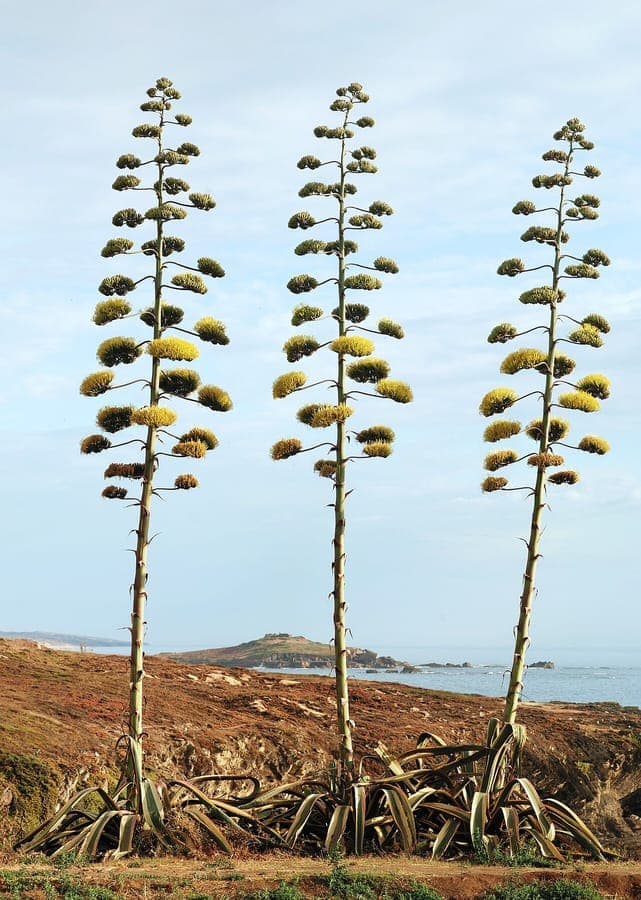
Agave americana forms a large, symmetrical rosette of thick, fleshy leaves that are blue-green to gray-green, often with white serrations along the margins and a dark terminal spine up to 2 cm long. The rosette spreads 1–1.5 m wide and grows about 60–100 cm tall. After years of slow growth, it sends up a towering flower spike reaching 5–8 m in height, bearing yellowish-green flowers in summer. Once flowering finishes, the main plant dies, but it usually produces offsets (pups) around the base before then.
These pups, which form at soil level, can be removed when they're at least 15–20 cm tall and have developed roots. Let them dry for 2–3 days to callus over, then pot in gritty mix. They root easily and grow steadily in warm, sunny conditions. Save these to replace the mother plant or share with fellow gardeners.
Ideal location
Full sun is non-negotiable. Agave americana needs at least 6–8 hours of direct sunlight daily. A south- or southwest-facing spot is ideal. In shaded areas, the plant becomes etiolated - weak, stretched, and pale - and is more prone to rot. In cooler, wetter summers, fungal diseases can take hold, so airflow and sun exposure are critical.
For patios or small gardens, grow it in a container at least 40 cm deep and wide. Use terracotta pots with drainage holes to encourage evaporation. Elevate pots on feet to prevent water pooling. Use gardenworld.app to simulate sun paths across your garden and choose the perfect microclimate for your agave.
Soil requirements
Well-drained soil is essential. The native habitat consists of sandy, gravelly, or rocky substrates with low organic content. In gardens, amend heavy soils with coarse sand, perlite, or crushed grit (30–40% by volume). In pots, use a mix of 50% cactus compost and 50% drainage material like pumice or turface.
The pH should be neutral to slightly alkaline (6–8). Avoid rich composts or manures - they retain moisture and promote root rot. Test soil texture by squeezing a damp handful: if it holds its shape and doesn't crumble, it's too clay-heavy. Improve it before planting.
Free design
Want to see American agave: complete guide in your garden? Make a free design now.
Watering
This agave is drought-tolerant and prone to rot if overwatered. Water deeply but infrequently - once every 10–14 days during active growth (April to September) only when the top 5 cm of soil is dry. In winter, reduce watering to once a month or less, especially if kept outdoors.
Use rainwater if possible, or let tap water sit for 24 hours to off-gas chlorine. Water at the base, avoiding the rosette, to prevent trapped moisture and rot. During prolonged rain, consider temporary cover to protect the crown.
Pruning
Pruning is minimal. Remove only dead, damaged, or diseased leaves with clean, sharp secateurs. Cut close to the base without injuring the stem. Wear gloves and eye protection - the sap can irritate skin and eyes.
After flowering, the main rosette will die. You can leave the flower stalk standing until it dries completely, then remove it. Harvest any pups before removing the parent plant. Don't compost the spent rosette - dispose of it in general waste.
Maintenance calendar
- January: Keep dry. No watering. Check for frost damage.
- February: Continue dry care. Inspect pots for root rot.
- March: Begin monitoring pups. No water unless soil is bone dry.
- April: Plant pups outside after last frost (above 5°C). Start light watering.
- May: Water every 10–14 days in dry spells. Watch for aphids or fungal spots.
- June–August: Peak season. No feeding. Flower spike may appear.
- September: Gradually reduce watering.
- October–December: Stop watering. Protect outdoor pots with fleece or move to a dry, frost-free area.
Winter hardiness
Agave americana is hardy to USDA zones 8b–11 (-9°C to -6°C with dry conditions). In colder zones, it must be container-grown and overwintered indoors or in a greenhouse. Persistent wet cold causes fatal root rot. If planted in the ground, mound gravel around the base and cover with a cloche during frost.
In borderline areas, grow in mobile containers so you can move them before frost sets in. Avoid mulching with organic matter - it holds moisture. Use gravel or crushed stone instead.
Companion plants
Pair with other drought-tolerant plants: Yucca gloriosa, Sedum 'Matrona', Euphorbia myrsinites, and Stipa gigantea. The contrast in form and texture adds depth. Avoid moisture-loving plants like ferns or astilbes.
In gravel gardens, use low-growing thymes or sedums around the base for softening. In containers, combine with Echeveria, Sempervivum, or Dasylirion for a desert look.
Closing
Agave americana is a long-term investment in garden drama. Start with a healthy specimen from local garden centres, and give it space to grow - at least 1.5 m in all directions. Its bold silhouette and rare bloom make it a conversation starter. Use pups to propagate new plants and keep the cycle going.
With proper care, it can thrive for decades, even in cooler climates. Plan your xeriscape design on gardenworld.app, where you can visualise growth patterns and companion plantings for the next 10 years.
Want to see American agave: complete guide in your garden? Make a free design now.
Upload a photo, pick a style, and get a photorealistic design with plant list in under a minute.
No credit card required


Similar plants
Narrow-leaved dracaena: complete guide
Dracaena angustifolia
Everything about Dracaena angustifolia - the narrow-leaved dracaena: location, care, overwintering and use as a houseplant or patio plant.
Chaparral yucca: complete guide to Hesperoyucca whipplei
Hesperoyucca whipplei
Hesperoyucca whipplei (Our Lord's candle) is a dramatic rosette-forming plant from California that produces a towering flower spike, ideal for dry and gravel gardens.
False lily-of-the-valley: complete guide
Maianthemum dilatatum
Everything about Maianthemum dilatatum, the false lily-of-the-valley. Care, shade location, propagation and garden combinations for this popular shade ground cover.