
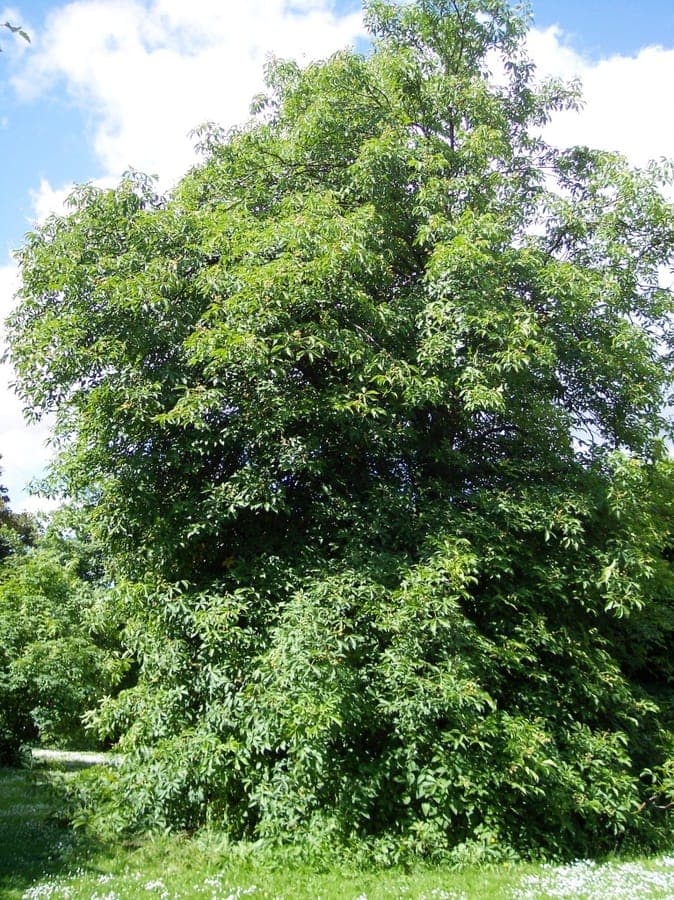
Wikimedia Commons / CC BY-SA 3.0, via Wikimedia Commons
Aesculus glabra: complete guide
Aesculus glabra
Want to see Aesculus glabra: complete guide in your garden?
1 minute, no credit card
Overview
Aesculus glabra, commonly known as Ohio buckeye or smooth horsechestnut, is a majestic North American tree species. This vigorous, fast-growing tree is celebrated for its striking, purplish-red flowers that bloom in large panicles, followed by characteristic spiky seed capsules. It represents an excellent choice for medium to large gardens and can serve as an urban shade tree.
Originally from the Midwest and Eastern North America, ranging from Canada to Texas, this tree performs as a reliable, hardy species. Its adaptation to various soil types makes it a versatile option.
Appearance and Bloom
Aesculus glabra grows to 8 to 20 meters tall and develops a rounded to broad crown. Large, compound leaves composed of five to nine leaflets create a lush, verdant appearance.
Flowering occurs in April through May, producing large, densely packed panicles of greenish-white to yellowish-red flowers. These attract abundant insect visitors. After blooming, characteristic spiky capsules develop, each containing one to two glossy buckeyes.
Ideal Location
Aesculus glabra thrives best in full sun to part shade. At least four hours of direct sun daily promotes compact growth and maximum flowering.
The tree requires ample space for its broad crown. Ensure neighboring trees do not crowd it, allowing good air circulation.
Soil Requirements
Aesculus glabra proves quite flexible regarding soil types. It thrives in standard garden soil, in both acidic and alkaline soils (pH 5.0 to 7.1). Well-draining soil is beneficial, though the tree tolerates less than ideal conditions.
Fertility is not crucial. Normal garden soil, optionally enriched with compost, suffices.
Free design
Want to see Aesculus glabra: complete guide in your garden? Make a free design now.
Watering
Water regularly during the first year until the tree is well-established. Thereafter, rainfall usually suffices.
Even in dry summers, supplemental watering is often unnecessary. The tree develops a deep, extensive root system capable of extracting soil moisture.
Pruning
Aesculus glabra requires minimal pruning. Remove dead branches and occasional awkwardly growing limbs, but allow the tree to retain its natural form.
Prune early in the growing season, before blooming. Avoid heavy pruning, as the tree responds slowly.
Maintenance Calendar
Spring: Inspect for winter damage; perform light pruning before bloom. May-June: Monitor flower and fruit development. Summer: Regular inspection for diseases and pests; water during prolonged drought. Fall-Winter: Clean up fallen leaves; prepare for next season.
Winter Hardiness
Aesculus glabra is highly cold-hardy to approximately -25°C. This means it overwinters without protection in practically all parts of temperate Europe.
The tree poses no special winter requirements. Natural leaf drop in autumn is normal; removal of fallen leaves is unnecessary.
Companion Planting
Aesculus glabra works well as a specimen tree in large gardens. It may also be combined with other fast-growing trees such as maples and birches.
Understory planting proves difficult due to the tree's dense shade. However, shade-tolerant plants such as hostas and ferns can establish beneath it.
Final Thoughts
Aesculus glabra represents a spectacular tree species for gardeners with adequate space. Its flowering truly proves breathtaking, and the tree contributes structure and height to the landscape.
Available from specialized tree nurseries. For more ideas on integrating trees into garden design, visit gardenworld.app. Discover how to add height and dimension to your property.
Want to see Aesculus glabra: complete guide in your garden? Make a free design now.
Upload a photo, pick a style, and get a photorealistic design with plant list in under a minute.
No credit card required


Similar plants
Acer pycnanthum: complete guide
Acer pycnanthum
Acer pycnanthum, the Japanese swamp maple, is a fast-growing tree with early red flowers and brilliant autumn color, ideal for damp garden settings.
Freeman maple: complete guide
Acer × freemanii
Everything about the Freeman maple (Acer x freemanii): a fast-growing shade tree with spectacular autumn colour for large gardens.
Wild ackee: complete guide
Cupania americana
A comprehensive guide to Cupania americana, a tropical tree from the Sapindaceae family with conspicuous white flowers and brown fruits, native to tropical America.