
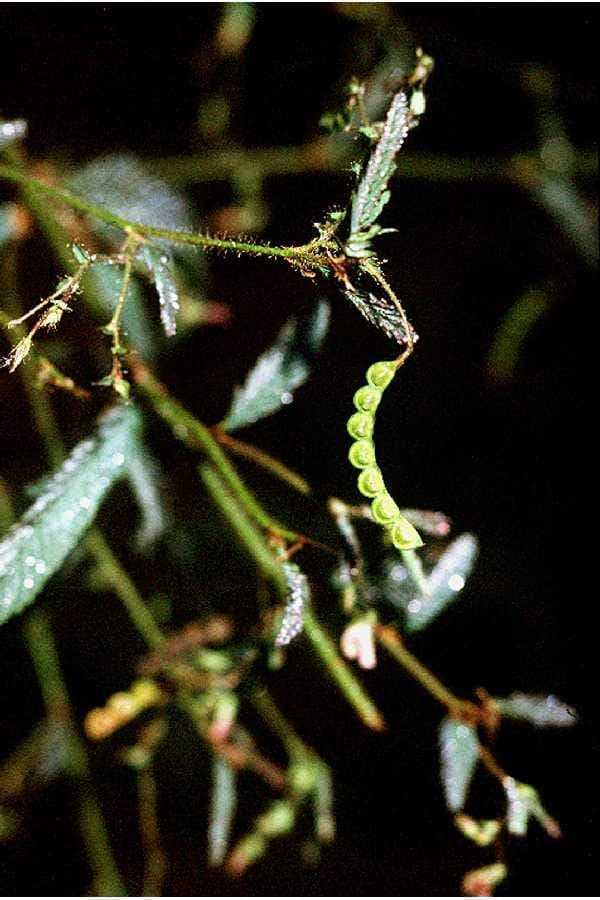
Robert H. Mohlenbrock. USDA SCS. 1991. Southern wetland flora: Field office guide to plant species. South National Technical Center, Fort Worth. Courtesy of USDA NRCS Wetland Science Institute / Public domain, via Wikimedia Commons
Aeschynomene americana: complete guide
Aeschynomene americana
Want to see Aeschynomene americana: complete guide in your garden?
1 minute, no credit card
Overview
Aeschynomene americana, commonly known as Joint-vetch, American Joint-vetch, or Shyleaf, is a fascinating plant in the Fabaceae family (legumes). This species is native to tropical and subtropical Americas, ranging from Florida to Argentina. The plant is renowned for its remarkable seed-dispersal mechanism and nitrogen-fixing capabilities.
Appearance and Bloom
Aeschynomene americana typically grows as an herbaceous plant or small shrub reaching 60-120 centimeters in height, sometimes taller. The leaves are pinnately compound and resemble those of other legumes. The most distinctive feature is the flowers: bright orange to yellow blooms arranged in loose racemes. These flowers appear throughout the warm season and attract numerous pollinators. After flowering, distinctive segmented seed pods develop. These segments are loosely connected and explosively separate when ripe, with each segment containing a single seed that easily adheres to animal fur or clothing.
Ideal Location
Aeschynomene americana thrives in full sun to partial shade. For optimal growth and flowering, at least four to six hours of direct sunlight daily is ideal. The plant tolerates partial shade well, though growth may be less dense. Position in a location protected from strong winds. In extremely hot climates, light afternoon shade is beneficial.
Soil
Aeschynomene americana is not particular about soil types and grows acceptably in lean to moderately fertile soils. Another advantage is that it contains nitrogen-fixing bacteria in its roots, meaning it produces its own fertilizer. This makes it ideal for coastal areas, erosion control projects, and ecological restoration. The plant tolerates heavy clay, sand, and even wet conditions well. A soil pH of 5.5 to 7.5 is acceptable.
Free design
Want to see Aeschynomene americana: complete guide in your garden? Make a free design now.
Watering
Aeschynomene americana is moderately drought-tolerant once established. Young plants require regular watering during their first growing season to establish strong roots. Mature plants can survive on moderate rainfall in most climates, though regular watering promotes better growth. The plant tolerates wet conditions reasonably well, making it suitable for low-lying or waterlogged areas.
Pruning
Aeschynomene americana requires minimal pruning. Remove dead or damaged branches when noticed. To encourage a more compact form, pinch the growing point when young. After flowering, spent flowers need not be removed as these encourage seed production. Allow seeds to ripen and fall for natural reseeding or for wildlife to harvest.
Maintenance Calendar
Spring: Plant seeds or young plants. Summer: Water regularly during dry periods. Fall: Allow seeds to ripen. Winter: No maintenance needed in appropriate zones.
Winter Hardiness
Aeschynomene americana can be frost-sensitive depending on cultivar and winter temperatures. In USDA zones 9-11, it can grow as a perennial. In cooler zones, it typically grows as an annual. In very cold climates, it can be grown indoors in containers and planted outdoors in summer.
Companion Plants
Aeschynomene americana works well in mixed ecosystems and ecological restoration plantings. Plant near other bird-attracting plants. The nitrogen-fixing nature makes it ideal growing near nutrient-hungry plants. Combine with other seed-producing plants for a wildlife garden.
Conclusion
Aeschynomene americana is a truly unique plant combining beauty, ecological value, and practical benefits. Its remarkable seed-flinging mechanism, flower attractiveness, and nitrogen-fixing abilities make it perfect for ecologically-minded gardeners. Whether grown to attract wildlife, control erosion, or simply because it's an interesting seed-flinger, this plant adds something genuinely special to any garden.
Want to see Aeschynomene americana: complete guide in your garden? Make a free design now.
Upload a photo, pick a style, and get a photorealistic design with plant list in under a minute.
No credit card required


Similar plants
Tall Silky Lupine: complete guide
Lupinus elatus
Tall silky lupine is a fast-growing Californian perennial with silvery foliage and blue-purple flower spikes, ideal for a prairie-style garden.
Garfield Lupine: complete guide
Lupinus garfieldensis
The Garfield lupine is a rare, fast-growing American perennial for alkaline, dry grassland gardens, with striking blue flower spikes.
Lupinus elegans: complete guide
Lupinus elegans
Lupinus elegans, the elegant lupine, is a spectacular blooming plant from Mexico with blue flower spikes. Care, cultivation and garden use.