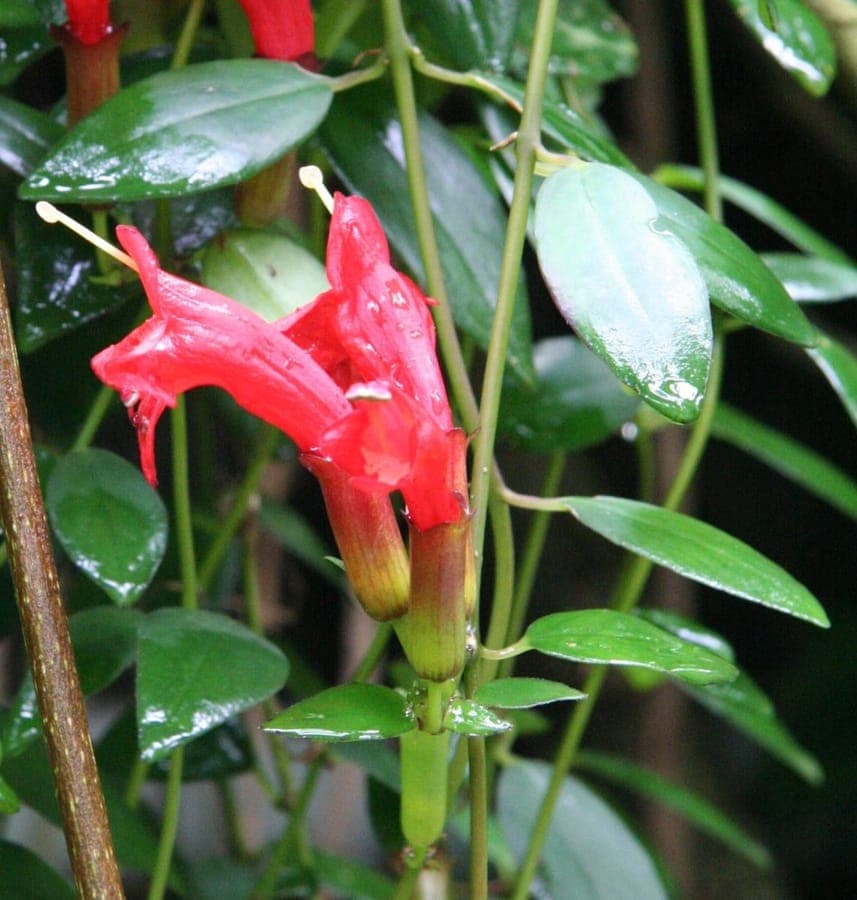
Michael Wolf / CC BY-SA 3.0, via Wikimedia Commons
Lipstick plant (Aeschynanthus radicans): complete guide
Aeschynanthus radicans
Want to see Lipstick plant (Aeschynanthus radicans): complete guide in your garden?
Full design in HD: €7.99
Look after your Lipstick plant with the GardenWorld app
Identify plants with your camera and get a care calendar with reminders for this plant.


Overview
The lipstick plant (Aeschynanthus radicans) owes its name to a striking detail. Its red flowers emerge from a dark, tubular calyx, much like a lipstick rising out of its case. It is a trailing houseplant with long, gracefully arching stems clothed in glossy leaves, and when it is happy it carries clusters of vivid red flowers at the shoot tips from late spring well into autumn.
Aeschynanthus radicans belongs to the Gesneriaceae, the same family as the African violet and gloxinia. It comes from humid tropical forests stretching from the Malay Peninsula to Java. There it grows as an epiphyte, living on branches and trunks, its roots anchored in moss and leaf litter. That explains most of what it needs indoors: an open, airy compost, plenty of indirect light, warmth and higher humidity than the average living room.
You may also find plants sold as Aeschynanthus lobbianus. These are now often treated as a form of Aeschynanthus radicans and need exactly the same care. There are also related species and cultivars with mottled leaves or unusual flowers, and popular selections such as 'Mona Lisa', with deep red blooms.
Appearance and flowering
Indoors the stems reach 60 to 90 cm and spill over the edge of the pot in a loose curtain. The leaves are arranged in opposite pairs, oval to elliptic, 3 to 6 cm long, slightly fleshy and dark green. Young stems and leaves are sometimes lightly hairy.
The flowers appear in small clusters at the ends of the stems. First you see only the dark calyx tube, purplish brown to greenish. From it grows a red flower tube up to 5 to 7 cm long with a gently curved, open mouth and protruding stamens. The photo shows this clearly: two bright red flowers emerging from their brownish green calyces among glossy, rain-dappled leaves. Flowering runs mainly from May to October, peaking in summer.
Position in the home
A lipstick plant looks its best in a hanging basket or on a high shelf where the stems can trail freely. Choose a bright room with an even temperature. A spot a metre or two from an east- or west-facing window often works well. Bathrooms with a window are also suitable because of the extra humidity.
Avoid draughts and sudden temperature changes. A plant hanging next to a busy outside door or directly above a radiator will soon drop leaves or buds.
Light
For a good display the plant needs plenty of bright, indirect light. A little gentle morning or evening sun does no harm, but strong midday sun through glass scorches the leaves. In a dim corner the plant stays green, grows long and bare and refuses to flower, which is the most common complaint. If yours hangs too far from the window, simply move it closer to the light.
Humidity and temperature
During the growing season the lipstick plant enjoys 18 to 26 °C. In winter it can be a little cooler, but not below 15 °C. A short, cooler and drier spell of six to eight weeks at around 15 to 17 °C in winter actually helps it set flower buds. An unheated but frost-free spare room or a cool landing is ideal for this.
Humidity of 50 percent or more keeps the foliage healthy. You can mist the leaves now and then with tepid water, but avoid the flowers. A tray of damp clay pebbles under the pot, or a group of plants together, also helps.
Compost and repotting
As an epiphyte, the lipstick plant wants a light, free-draining compost. Mix peat-free houseplant compost with a third perlite and a little fine orchid bark. The roots can then breathe and water never lingers.
It flowers best when slightly pot-bound. Repot only when the roots genuinely fill the pot, usually every two to three years, in March or April. Choose a pot just a few centimetres larger and make sure it has a good drainage hole.
Free preview
Want to see Lipstick plant (Aeschynanthus radicans): complete guide in your garden? Make a free preview of your design.
Watering and feeding
Let the top 2 to 3 cm of compost dry out before watering again. In summer that usually means once a week, in winter every two to three weeks. Overwatering is far more dangerous than the odd dry spell: soggy compost leads to root rot and limp, browning stems. Use room-temperature water and tip away any excess from the saucer or outer pot after fifteen minutes.
From April to September, feed every three weeks with a liquid houseplant fertiliser at half strength. Do not feed in winter.
Pruning
Pruning keeps the plant bushy and prevents long, bare stems. After flowering, in autumn or very early spring, shorten the longest stems by about a third, just above a pair of leaves. Two new side shoots will grow from that point. Do not prune too late in spring, as the flowers form at the tips of new growth. The trimmings make perfect cuttings.
Propagation
Cuttings root easily almost all year, though spring and summer are quickest. Take tip cuttings 8 to 10 cm long with at least two or three pairs of leaves. Remove the lowest pair and stand the cuttings in a glass of water or insert them straight into moist cutting compost. At around 21 °C under a clear cover, roots appear in three to four weeks. Plant five or six cuttings together in one hanging pot for a fuller plant more quickly.
Toxicity to pets
According to the ASPCA, the American animal welfare organisation whose list of toxic and non-toxic plants is widely consulted, the lipstick plant is non-toxic to dogs, cats and horses. Note that the listing is filed under a close relative, Aeschynanthus humilis. There is no separate entry for Aeschynanthus radicans itself, but no toxic compounds are known either. A cat that chews the dangling stems may still get a mildly upset stomach, so a hanging pot out of jumping range is the safest choice for both cat and plant.
Care calendar
March-April: Repot if needed and resume feeding. Light shaping is still possible.
May-September: Growth and flowering. Water regularly and feed every three weeks. Shield from harsh midday sun.
October-November: After flowering, cut back long stems and use them as cuttings. Reduce watering gradually.
December-February: Cool, drier rest at around 15 to 17 °C with plenty of light. No feeding. This helps flower buds form for the coming season.
Worried you will forget the winter rest or spring repotting? The plant calendar on gardenworld.app shows month by month which jobs are due for your plants.
Companion plants
Trailing plants with similar needs make a lovely green curtain together. Spider plant (Chlorophytum comosum) and inch plant (Tradescantia zebrina) grow happily in the same bright, warm room. A sword fern (Nephrolepis) adds soft, fine foliage beside the glossy lipstick plant. On a shelf below, a flamingo flower (Anthurium scherzerianum) echoes the red blooms with its scarlet spathes.
If you are adding a covered terrace or garden room, you can have a garden design made on gardenworld.app in which that in-between space and the garden beyond are planned together.
Final thoughts
Aeschynanthus radicans is a rewarding trailing plant that looks good all year and surprises you each summer with its lipstick flowers. The recipe is simple: plenty of indirect light, an airy compost that dries a little between waterings, warmth without draughts and a short, cool rest in winter. Trim the stems now and then, pot up the cuttings, and you will have a full, flowering plant for years, one that poses no danger to cats and dogs.
Frequently asked questions about Lipstick plant
When and how do you prune Lipstick plant?
Pruning keeps the plant bushy and prevents long, bare stems. After flowering, in autumn or very early spring, shorten the longest stems by about a third, just above a pair of leaves.
How much water does Lipstick plant need?
Let the top 2 to 3 cm of compost dry out before watering again. In summer that usually means once a week, in winter every two to three weeks.

See it in your garden
See Lipstick plant in your garden
One photo of your garden and a few questions. You see the result in about a minute.
Try it with a photoIdentify this plant in your own garden. Identify a plant
Similar plants
Chlorophytum comosum: complete guide
Chlorophytum comosum
Discover everything about Chlorophytum comosum (spider plant). Learn care requirements, propagation, location and maintenance for thriving indoor plants.
Tradescantia zebrina (Inchplant): complete guide
Tradescantia zebrina
Master Inchplant cultivation: colors, growth habits and stunning displays. Complete care guide for this tropical beauty.
Nephrolepis cordifolia: complete guide
Nephrolepis cordifolia
Discover Nephrolepis cordifolia, an elegant ladder fern with graceful fronds. Read our cultivation guide for moist soil, indirect light, and care tips.
