
Otto Wilhelm Thomé / Public domain, via Wikimedia Commons
Ashweed: complete guide
Aegopodium podagraria
Want to see Ashweed: complete guide in your garden?
1 minute, no credit card
Overview
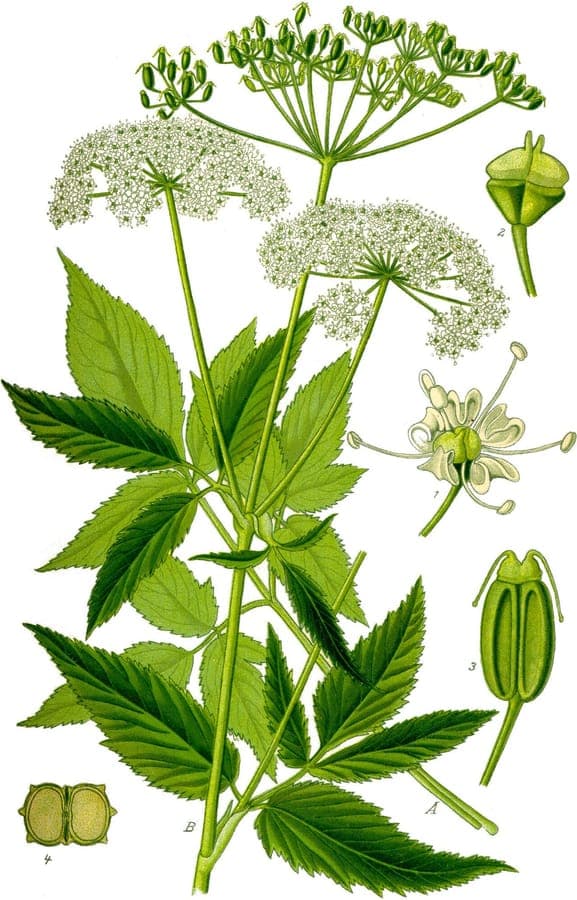
Ashweed, or Aegopodium podagraria, is one of those plants that divides gardeners. Some praise its ability to cover bare soil quickly, while others curse it as a relentless invader. Native to Central and Eastern Europe, it's naturalized across much of the temperate world, including the UK and North America. It's a perennial in the carrot family (Apiaceae), and though it looks delicate with its lacy foliage, it's anything but. Once established, ashweed spreads aggressively through underground rhizomes, colonizing areas within a single growing season. If you're considering planting it, think twice - and plan ahead.
On gardenworld.app, you can design a garden layout that accounts for aggressive spreaders like ashweed by incorporating root barriers and containment zones.
Appearance & bloom cycle
Ashweed features compound leaves divided into three to five leaflets, each with a serrated edge and a bright green color. The variegated cultivar 'Variegatum' has striking creamy-white margins, making it more garden-worthy - though no less invasive. In late spring to early summer (May to June), small white flowers appear in flat umbels typical of the Apiaceae family. These blooms attract hoverflies, bees, and other beneficial insects, adding ecological value. After flowering, seeds form and disperse easily by wind or animal contact.
The plant reaches 30–60 cm in height and spreads horizontally at a rate of up to 1 meter per year. It's the underground network - not the seeds - that makes it so hard to control. Rhizomes can extend deep and send up new shoots meters away from the parent plant.
Ideal location
Ashweed thrives in partial to full shade, making it ideal for difficult areas like under dense tree canopies or along north-facing fences. It tolerates full sun only if soil moisture is consistently maintained. It's often used to stabilize slopes or cover neglected corners where other plants struggle. However, avoid planting it near flower beds or lawns unless you're prepared for constant containment.
Consider using ashweed in wild or naturalistic gardens where its vigor is an asset rather than a liability. Formal gardens usually don't suit it unless you install solid root barriers (40–50 cm deep) around the planting zone. On gardenworld.app, you can simulate these barriers digitally before you plant.
Soil requirements
This plant isn't picky. It grows in clay, loam, or sandy soils, as long as drainage is moderate and moisture is sufficient. It prefers a pH range of 5.5 to 7.5 but adapts to more extreme conditions. Poor, compacted soils don't stop it - in fact, it often outcompetes other plants in such spots. However, in very dry or sandy soils, growth may slow, though survival remains high.
Free design
Want to see Ashweed: complete guide in your garden? Make a free design now.
Watering
During the growing season (April to September), ashweed needs consistent moisture. In dry spells, water deeply once or twice a week, ensuring the water penetrates at least 15 cm into the soil. Avoid frequent shallow watering, which encourages weak root development. In shaded areas, evaporation is slower, so check soil moisture by inserting a finger 5 cm deep. No watering is needed in winter, as the plant goes dormant.
Pruning
Pruning isn't required for health, but it's essential for control. Cut off flower stalks before seeds mature (late June to early July) to prevent seeding. For 'Variegatum', remove any all-green shoots that emerge - these are reversions and will dominate if left unchecked.
Use sharp shears and disinfect them after use to avoid spreading disease. Never compost ashweed material - even small rhizome fragments can regrow. Bag it and dispose of it with household waste.
Maintenance calendar
- January–February: Dormant. No action needed.
- March: Inspect planting boundaries. Mark areas at risk of spread.
- April: Apply a 2 cm layer of compost as mulch. Begin monitoring soil moisture.
- May–June: Flowers appear. Deadhead before seed set.
- July–August: Weekly checks for rhizome spread. Dig out any shoots beyond designated zones.
- September: Reduce watering gradually.
- October–December: Let fallen leaves act as natural mulch. No maintenance required.
Winter hardiness
Ashweed is hardy in USDA zones 4 to 9. It dies back in winter but regrows vigorously in spring. In milder climates (zones 7–9), foliage may remain semi-evergreen. The rhizomes survive freezing temperatures and can resprout even after harsh winters.
Companion plants
Due to its aggressive nature, companion planting is tricky. Only pair it with equally vigorous species that can hold their ground. Good options include Hosta, Ferns (Dryopteris spp.), or Alchemilla mollis. These tolerate similar conditions and aren't easily overwhelmed. Avoid slow growers or rare specimens - they won't stand a chance.
Closing
Ashweed is not a plant to take lightly. It can transform a bare patch into lush greenery in months, but it can also take over your entire garden. If you decide to grow it, commit to strict containment. Use deep edging or grow it in containers. Retailers like garden centres across the UK often stock 'Variegatum' - look for proper labelling to avoid confusion. Once planted, it's nearly impossible to eradicate completely. Think long-term, and plan smart. With tools like gardenworld.app, you can visualize its spread and design a garden that stays manageable.
Want to see Ashweed: complete guide in your garden? Make a free design now.
Upload a photo, pick a style, and get a photorealistic design with plant list in under a minute.
No credit card required


Similar plants
Whorled carrot: complete guide
Daucus involucratus
Daucus involucratus is a Mediterranean umbellifer with white flower heads framed by lacy bracts. Growing this gravel garden gem.
Daucus muricatus: complete guide
Daucus muricatus
Daucus muricatus, the spiny wild carrot, grows wild on Mediterranean coasts. Discover sowing, June-July bloom, and wildflower meadow use.
Daucus pumilus: complete guide
Daucus pumilus
Daucus pumilus is a dwarf wild carrot relative with white lacy umbels, thriving on dunes and coastal rock in poor, fast-draining soil.