
Wikimedia Commons / CC BY-SA 3.0, via Wikimedia Commons
Moschatel: complete guide
Adoxa moschatellina
Want to see Moschatel: complete guide in your garden?
1 minute, no credit card
Overview
Moschatel, or Adoxa moschatellina, is one of those quiet woodland gems that often goes unnoticed - until you know where to look. A low-growing herb reaching just 5 to 10 cm in height, it spreads gently through moist, shady forest floors across Europe and parts of North America. It's a forb, not a grass or shrub, and belongs to the Viburnaceae family, which might surprise some given its size. But despite its unassuming stature, Moschatel has a persistent nature, thriving in conditions where flashier plants struggle. Native from Albania to Alaska, it's adapted to cool, damp climates and thrives in USDA zones 4 through 8.
On gardenworld.app, you can design a shade garden layout that highlights Moschatel's subtle presence among ferns and early spring ephemerals.
Appearance & bloom cycle
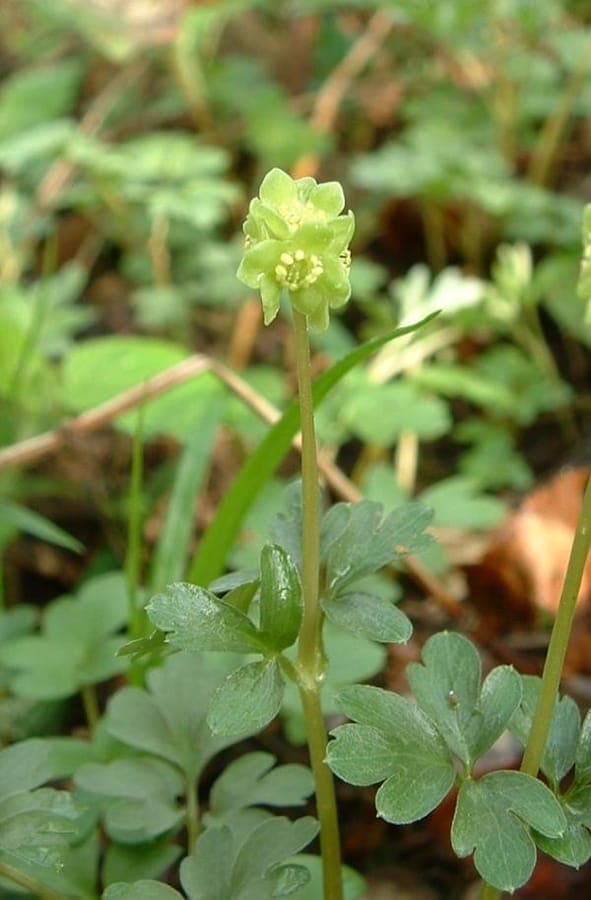
The plant forms a small rosette of divided, triangular leaves on a slender stem. But the real curiosity is the flower: a unique arrangement of five pale green flowers, four arranged in a cross on the sides and one on top, forming what looks like a tiny cube. This rare structure gives it the nickname "town clock plant". The flowers are only 2–3 mm wide, with a faint musky scent - hence the name "moschatellina". Blooming from March to May, depending on local climate and elevation, it's one of the earliest green-flowering plants to appear.
After flowering, Moschatel produces small green berries that turn dark brown or black by mid-summer. These aren't particularly attractive to wildlife, so the plant relies mostly on underground rhizomes to spread slowly over time, forming loose colonies of up to 30 cm across after several years.
Ideal location
Moschatel wants shade - full to partial, with a light rating of 4/10. Think under deciduous trees like beech or maple, where it gets dappled sunlight in early spring before the canopy closes. Avoid hot, south-facing beds or dry, compacted soil. It's perfect for woodland gardens, shaded rockeries, or naturalised areas beneath shrubs. A north- or east-facing border works well, especially where moisture stays consistent. This isn't a plant for containers unless you're very attentive to watering.
Soil requirements
It grows best in humus-rich, moist but well-drained soil. Loam or sandy loam with plenty of leaf mould is ideal. The pH should be neutral to slightly alkaline - 7.0 to 7.5. If your soil is too acidic (below 6.5), work in some ground limestone or wood ash. Avoid heavy clay unless amended with compost. A thick leaf litter layer in autumn helps retain moisture and adds nutrients as it breaks down.
Free design
Want to see Moschatel: complete guide in your garden? Make a free design now.
Watering
Keep the soil consistently moist, especially during dry springs. Aim for about 2 cm of water per week if rain is lacking. Use a watering can with a fine rose to avoid disturbing the delicate stems. Once established, Moschatel is reasonably drought-tolerant for short spells, but prolonged dryness will cause it to die back early. Never let it sit in standing water - it dislikes waterlogged roots.
Pruning
No pruning needed. The plant dies back completely by late summer, retreating into its rhizomes. Leave the stems in place until they're fully withered to allow the plant to reabsorb nutrients. After that, you can gently clear debris or leave it as natural mulch. This is a self-sustaining plant - no shears required.
Maintenance calendar
- January–February: Dormant. Check soil moisture if winter is dry.
- March: New shoots emerge. Top-dress with compost if desired.
- April–May: Bloom period. Keep soil moist.
- June–July: Foliage yellows and dies back.
- August–December: Dormant. Protect with leaf litter.
Winter hardiness
Moschatel is hardy in USDA zones 4–8. It survives temperatures down to -34°C without protection, especially when insulated by a natural layer of fallen leaves. In colder microclimates or exposed sites, a light mulch of leaf mould helps. In containers, move pots to a sheltered, shady spot to prevent freeze-thaw cycles from damaging rhizomes.
Companion plants
Pair Moschatel with other shade-tolerant spring bloomers: Erythronium, Hepatica, Anemone nemorosa, and small ferns like Dryopteris. It also works well with native wild ginger (Asarum) and barrenwort (Epimedium). Avoid aggressive spreaders like mint or English ivy, which can overwhelm it. The goal is a layered, naturalistic planting where Moschatel forms a quiet ground layer.
Closing
Moschatel isn't going to win any flower shows, but it's a quiet achiever in the right setting. For gardeners who value subtlety and ecology, it's a rewarding find. It's rarely stocked in mainstream garden centres, but specialty nurseries and spring plant sales at places like garden centres in the UK or Canada sometimes carry it. You might also find it at local wildflower events. On gardenworld.app, you can simulate a planting scheme that includes Moschatel alongside native companions, helping you visualise how it fits into a low-maintenance, wildlife-friendly garden.
Want to see Moschatel: complete guide in your garden? Make a free design now.
Upload a photo, pick a style, and get a photorealistic design with plant list in under a minute.
No credit card required


Similar plants
Squashberry: complete guide
Viburnum edule
Grow mooseberry (Viburnum edule): ultra-hardy North American shrub with fragrant white flowers and red autumn berries. Perfect for boreal gardens. Zone 3.
Witherod: complete guide to this elegant North American shrub
Viburnum cassinoides
Discover Viburnum cassinoides: an elegant North American shrub with white flowers, yellow fall foliage, and blue berries. Perfect for temperate garden zones.
Buddlejaleaf viburnum: complete guide
Viburnum buddleifolium
Elegant evergreen shrub with delicate foliage and white spring flowers. Perfect for sheltered borders in temperate gardens.