
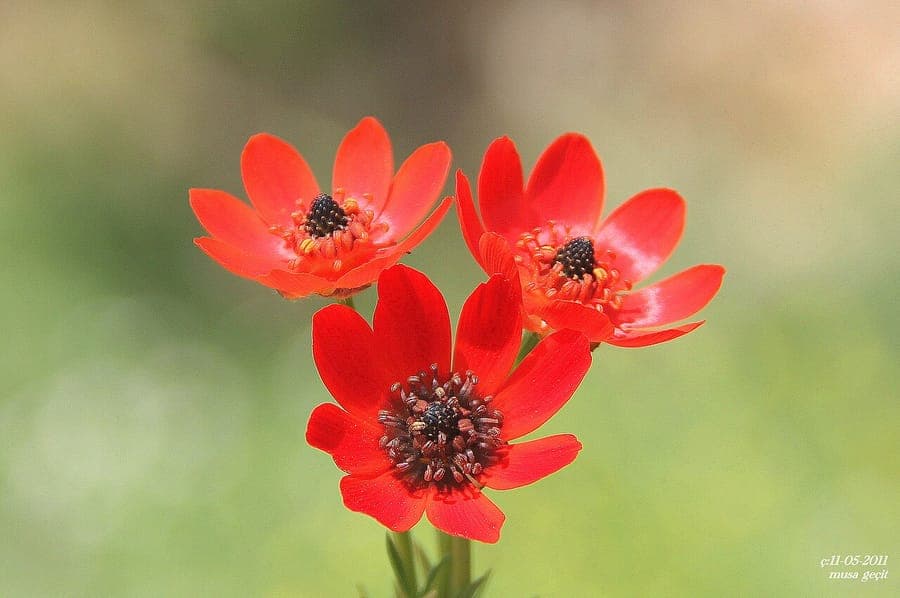
Musa geçit / Public domain, via Wikimedia Commons
Large pheasant's-eye: complete guide
Adonis flammea
Want to see Large pheasant's-eye: complete guide in your garden?
1 minute, no credit card
Overview
Adonis flammea, commonly known as Large pheasant's-eye, is a striking annual that brings a bold splash of colour to gardens from late spring into early summer. Native to parts of southern and central Europe and western Asia, this member of the Ranunculaceae family thrives in sunny, well-drained spots and is perfect for rock gardens, dry slopes, or naturalistic planting schemes. Growing between 15 and 30 cm tall, it's compact and unobtrusive until it bursts into bloom with vivid red to deep crimson flowers that can appear almost purple in certain light.
Though not widely grown in UK or North American gardens, it's a gem for those seeking unusual, low-maintenance plants. The foliage is fine and feathery, resembling that of soft ferns, which makes the fiery blooms stand out even more. If you're designing a drought-tolerant garden, Adonis flammea is a strong candidate. On gardenworld.app, you can visualise how this plant fits into a tailored garden layout that maximises sun and drainage.
Appearance & bloom cycle
The flowers of Large pheasant's-eye are 2–3 cm across, with numerous narrow, glossy petals radiating from a dark yellow centre. The colour is best described as scarlet or blood-red, though some cultivars may appear deeper, almost maroon. The blooming period runs from May through July, peaking in June. Each plant flowers for about 4 to 6 weeks, and the more sun it gets, the longer and more profuse the display.
After flowering, the plant forms a small, rounded seed head that gradually opens to release seeds. If left unchecked, it can self-seed lightly in suitable conditions, returning year after year in the right environment. It's not invasive, but it does appreciate open ground with little competition. Pollinators like hoverflies and small bees are often seen visiting the blooms, adding ecological value.
Ideal location
This plant demands full sun - a solid 8 out of 10 on the light scale. It will flop and fail to bloom in shade. Choose a south- or southwest-facing spot that gets direct sunlight all day. It performs particularly well in rock gardens, dry stone walls, or gravel beds where moisture doesn't linger. Avoid planting it near vigorous perennials that might crowd it out or block its light.
In cooler climates, a sheltered microclimate helps extend the blooming season. USDA hardiness zones 5 to 8 are ideal. If you're unsure whether your garden fits the profile, gardenworld.app offers tools to assess sun exposure and soil type for optimal planting.
Free design
Want to see Large pheasant's-eye: complete guide in your garden? Make a free design now.
Soil requirements
Adonis flammea prefers alkaline soils with a pH between 8 and 9. It hates acidic, heavy clay. The soil must be light, gritty, and free-draining - think limestone rubble, sandy loam, or a mix with added gravel. If your soil is too acidic, amend it with garden lime to raise the pH. Avoid rich compost or manure; too much fertility leads to lush foliage but few flowers.
For container growing, use a mix designed for alpines or succulents, with extra perlite or crushed rock. Always ensure pots have excellent drainage holes.
Watering
Once established, Large pheasant's-eye is drought-tolerant. During germination and early growth (March to April), keep the soil lightly moist. But after that, water only during prolonged dry spells in late spring. Overwatering, especially in cool, wet conditions, invites root rot. Water at the base to avoid wetting the foliage, which can encourage fungal issues.
Pruning
No pruning is required. As an annual, the plant completes its lifecycle in one season. You can deadhead if you prefer a tidier look, but leaving spent flowers encourages light self-seeding. In late summer, cut back or pull out dead stems, or let them decompose naturally if you want seeds to drop.
Maintenance calendar
- January: No action
- February: Start seeds indoors or in a cold frame
- March: Sow directly outdoors when soil is workable
- April: Thin seedlings, keep soil weed-free, light watering if dry
- May: Blooms begin, watch for slugs
- June: Peak flowering, enjoy pollinator visits
- July: Flowers fade, seeds develop
- August: Clear dead plants or leave for natural reseeding
- September–December: Dormant period; seeds overwinter in soil
Winter hardiness
As an annual, the plant itself doesn't survive winter. However, its seeds are cold-hardy and can overwinter in the ground, germinating the following spring. In areas with harsh winters (below -15°C), self-seeding may be spotty. Collect and sow seeds in autumn or store them for spring sowing. Suitable for USDA zones 5–8.
Companion plants
Pair with other sun-loving, drought-tolerant species: Thymus vulgaris, Sedum spectabile, Eryngium planum, or Papaver somniferum. Avoid moisture-loving or heavy-feeding plants like hostas or delphiniums. In a gravel garden, it combines beautifully with silver-foliaged artemisias or low-growing alliums.
Closing
Large pheasant's-eye is a bold, underused annual that delivers high impact with minimal effort. It's ideal for gardeners who want colour without fuss, especially in dry, sunny spots. You can find seeds or young plants at garden centres in spring, particularly at independent or specialty retailers. The plant is toxic if ingested, so keep it away from pets and small children. For gardeners seeking a wild, natural look with a pop of fire, Adonis flammea is a standout. Use gardenworld.app to plan where it'll shine brightest in your outdoor space.
Want to see Large pheasant's-eye: complete guide in your garden? Make a free design now.
Upload a photo, pick a style, and get a photorealistic design with plant list in under a minute.
No credit card required


Similar plants
Drummond's anemone: complete guide
Anemone drummondii
Discover Drummond's anemone (Anemone drummondii): a silvery-grey mountain plant for cool rock gardens and alpine troughs.
Korean clematis: complete guide
Clematis serratifolia
Clematis serratifolia is a hardy climber with fragrant yellow bell flowers in August-September. Pruning group 3, location and care tips.
Aquilegia brevistyla: complete guide
Aquilegia brevistyla
Discover Aquilegia brevistyla, the elegant North American columbine. Growing tips, shade tolerance, and design ideas for woodland and shadowed gardens.