
Wikimedia Commons / CC BY-SA 3.0, via Wikimedia Commons
Pheasant's-eye: complete guide
Adonis annua
Want to see Pheasant's-eye: complete guide in your garden?
1 minute, no credit card
Overview
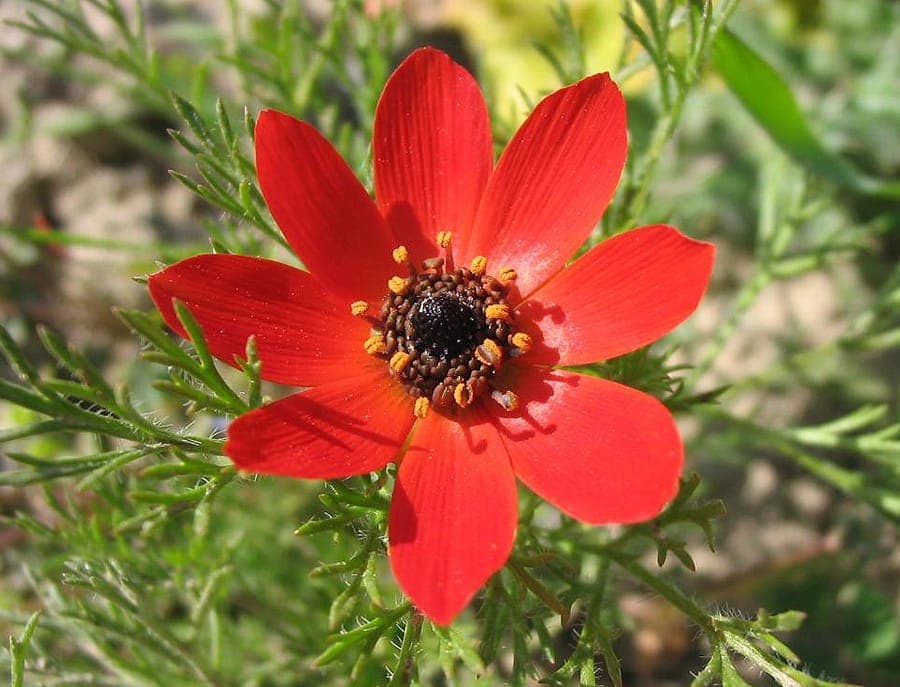
Pheasant's-eye (Adonis annua) is a striking annual from the buttercup family, native to Mediterranean regions and naturalized in parts of southern Europe. It grows to a height of 20–40 cm and features finely divided, fern-like foliage topped with vivid red flowers that bloom from late spring to midsummer. The blooms, around 3–5 cm in diameter, have a dark central eye that gives them their common name. While beautiful, this plant is toxic to humans and pets-keep it out of reach of children and grazing animals.
Because it's an annual, Pheasant's-eye relies on self-seeding to return each year. If conditions are right, you'll see new seedlings emerging naturally in spring. It thrives in poor, dry soils and sunny locations, making it ideal for gravel gardens, rockeries, or wildflower meadows. You can plan its placement smartly using gardenworld.app to design a layout that matches its height and color impact.
Appearance & bloom cycle
The foliage is delicate and bluish-green, forming airy clumps that contrast beautifully with the bold red flowers. Each plant produces multiple blooms over a 4–6 week period, typically from June to July. Individual flowers last only a few days, but new ones open continuously. After blooming, seed heads form and dry out by late summer, releasing seeds that may germinate the following spring.
This plant grows quickly from seed, taking about 10–12 weeks from sowing to first bloom. Direct sowing is best-start in early spring when soil temperatures rise above 10°C. If starting indoors, transplant carefully as the taproot is sensitive to disturbance.
Ideal location
Full sun is essential-aim for at least 6 to 8 hours of direct sunlight daily. Partial shade leads to leggy growth and fewer flowers. Choose south- or west-facing beds, gravel borders, or dry slopes where the plant won't compete with moisture-loving species.
Pheasant's-eye does poorly in humid, shaded areas. In cooler climates (USDA zones 7–9), it performs best in sheltered spots that warm up quickly in spring. Avoid low-lying, damp areas where cold air settles. Check sun exposure patterns in your garden with gardenworld.app to find the ideal spot for maximum bloom.
Soil requirements
Well-drained, lean soil is key. Heavy clay or water-retentive soils will cause root rot. Amend heavy soils with coarse sand or grit. A neutral to slightly alkaline pH (6.5–7.5) is preferred.
Avoid rich compost or fertilizers-fertile soil encourages leafy growth over flowering. In containers, use a mix of 2 parts potting soil to 1 part perlite or sand. Ensure pots have drainage holes. This plant thrives in poor conditions, mimicking its natural habitat on roadside banks and fallow fields.
Free design
Want to see Pheasant's-eye: complete guide in your garden? Make a free design now.
Watering
Once established, Pheasant's-eye is drought-tolerant. Water young seedlings regularly until they're 10 cm tall. After that, water only during prolonged dry spells. Overwatering is a greater risk than underwatering.
When watering, do so in the early morning to reduce evaporation and fungal issues. Use rainwater if possible-this plant dislikes high calcium levels in tap water. Let the top 2–3 cm of soil dry out between waterings.
Pruning
No pruning is needed for health or flowering. You may deadhead spent blooms to encourage seed production or to prevent self-seeding, depending on your garden goals. If you want controlled spread, collect seed heads before they split open.
In late autumn, cut back dead stems to ground level. This keeps the garden tidy and reduces overwintering pests. Leave some seed heads if you want natural reseeding in drifts.
Maintenance calendar
- March–April: Sow seeds directly in the garden or in pots. Prepare soil by removing weeds and adding grit if needed.
- May: Thin seedlings to 15 cm apart. Watch for slugs on young plants.
- June–July: Peak bloom. Monitor for aphids or mildew, though these are rare.
- August–September: Allow seeds to mature. Collect or let them scatter.
- October–November: Cut back foliage. Mark areas where you want reseeding.
Winter hardiness
As an annual, Pheasant's-eye doesn't survive winter. However, seeds can overwinter in the soil and germinate when temperatures rise above 10°C in spring. In milder climates (zone 8–9), some autumn sowing may result in early spring seedlings.
In wet, cold winters, seeds may rot. If reseeding is unreliable, save a small batch of seeds in a paper envelope, stored in a cool, dry place until spring.
Companion plants
Pair with other drought-tolerant perennials and annuals: Gaura lindheimeri, Eryngium, Linum, and Sedum. The red flowers contrast well with blue or purple blooms like Salvia nemorosa or Verbena bonariensis.
Avoid moisture-loving plants such as Astilbe, Hosta, or ferns. These require a different watering regime and can create damp microclimates that harm Pheasant's-eye.
Closing
Pheasant's-eye brings bold color and fine texture to dry, sunny gardens with minimal effort. It's perfect for cottage-style borders, xeriscaping, or adding a pop of red to gravel paths. Seeds are often available in spring at garden centres across the UK and US. With the help of gardenworld.app, you can visualize how this plant fits into your seasonal color scheme and spacing plan, ensuring a balanced, vibrant garden design.
Want to see Pheasant's-eye: complete guide in your garden? Make a free design now.
Upload a photo, pick a style, and get a photorealistic design with plant list in under a minute.
No credit card required


Similar plants
Drummond's anemone: complete guide
Anemone drummondii
Discover Drummond's anemone (Anemone drummondii): a silvery-grey mountain plant for cool rock gardens and alpine troughs.
Korean clematis: complete guide
Clematis serratifolia
Clematis serratifolia is a hardy climber with fragrant yellow bell flowers in August-September. Pruning group 3, location and care tips.
Aquilegia brevistyla: complete guide
Aquilegia brevistyla
Discover Aquilegia brevistyla, the elegant North American columbine. Growing tips, shade tolerance, and design ideas for woodland and shadowed gardens.